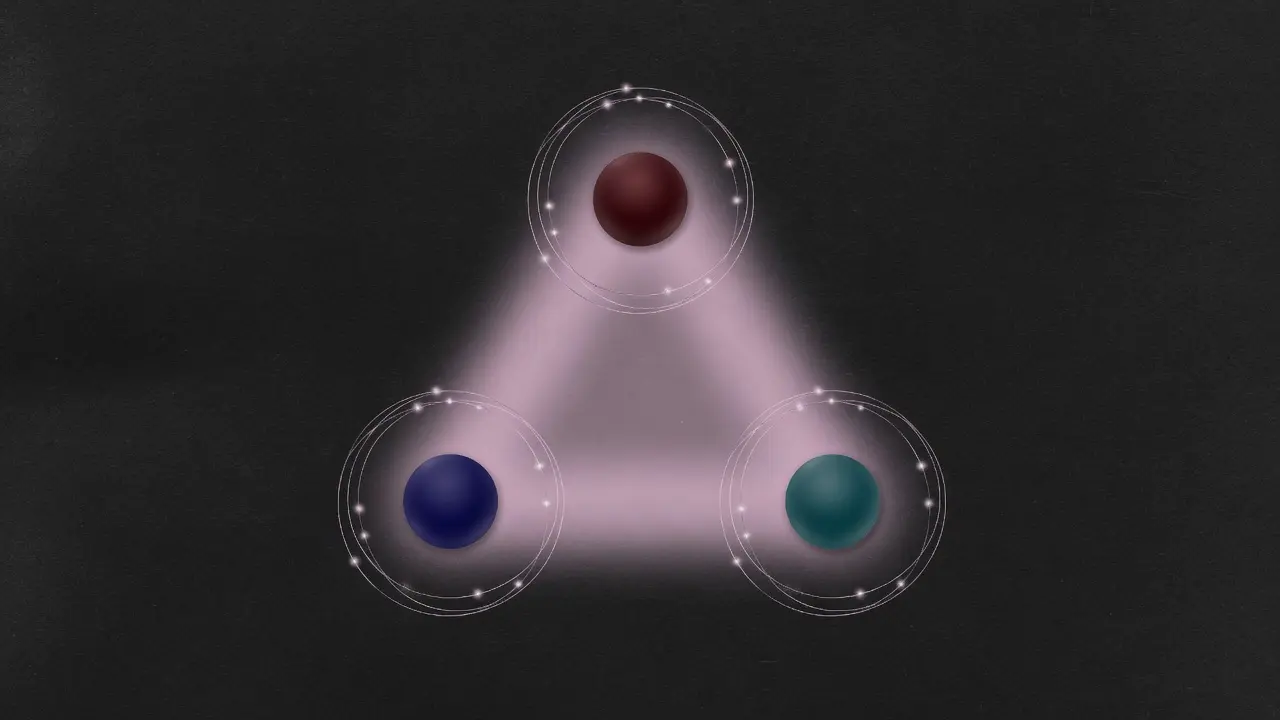
Sylvain Carrozza, Johann Chevrier, and Luca Lionni have developed a new method to detect genuine multipartite entanglement, focusing on three-qubit systems. The researchers demonstrate their entanglement monotones can identify any form of genuine tripartite entanglement within these systems. Their work defines where a state cannot be decomposed into products of states entangled across fewer parties. The team also established a “no-go result” proving that no reasonable genuine multipartite entanglement entropy can simultaneously obey both LOCC-monotonicity and subadditivity.
Irreducible Entanglement as a Stronger Criterion
The ability to definitively identify a specific form of quantum entanglement, irreducible entanglement, has been enhanced by newly developed mathematical tools for analyzing multipartite systems. The work establishes a fundamental limit on how effectively existing measures of entanglement can be used to certify this stronger form of connection. LOCC-monotonicity requires that entanglement, as measured by the entropy, cannot increase under permitted operations, while subadditivity is a mathematical property ensuring the measure behaves predictably with combined systems.
This theoretical constraint highlights the difficulty in creating a single measure that comprehensively captures all aspects of multipartite entanglement. Despite this limitation, the team successfully relaxed the LOCC-monotonicity requirement to LO-monotonicity, allowing them to generate genuine multipartite entanglement monotones possessing the desired properties for detecting irreducible entanglement. These monotones, a type of mathematical function, provide a quantifiable measure of entanglement that decreases as entanglement diminishes under specific operations.
The researchers are interested in devising simple tests certifying that a state admits genuine multipartite entanglement. This quantity, they show, is LO-monotone and effectively distinguishes irreducibly entangled states from those with weaker connections. The study predicts that, for any arbitrarily small positive value, the probability of detecting irreducible entanglement using these measures approaches zero as the local dimension tends towards infinity. This suggests that while effective for lower-dimensional systems, the monotones may become less reliable for characterizing entanglement in more complex, high-dimensional quantum states.
The researchers acknowledge this limitation, noting that the random variable “concentrates around its average in the N → + ∞ limit.” The work builds on the concept of spectral functions, which describe the distribution of entanglement across different partitions of a multipartite system. By analyzing these spectral functions, the researchers can determine whether a state is genuinely entangled or merely a product of weakly entangled subsystems.
The researchers also point out that is “proper, since = ln 2 > 4 ln 3-2 ln 7 = This comparison highlights the ability of the monotone to differentiate between different types of entangled states, such as the GHZ and W states. The development of these new monotones and the associated theoretical constraints contribute to a more nuanced understanding of multipartite entanglement. While the “no-go result” highlights the challenges in creating a universally applicable entanglement measure, the subsequent development of LO-monotone quantities provides a practical tool for certifying irreducible entanglement in specific systems.
Genuine Multipartite Entanglement & Biseparability
This refined understanding moves beyond simply identifying entanglement to characterizing its fundamental structure, demanding a more precise measurement approach. The work addresses a long-standing challenge in quantum information theory: devising reliable metrics to confirm genuine multipartite entanglement, particularly in scenarios where traditional measures fall short. This “no-go result” highlights a fundamental limitation in creating a universally applicable measure that adheres to both principles, forcing a re-evaluation of existing approaches.
By relaxing the LOCC-monotonicity condition to LO-monotonicity, Sylvain Carrozza, Johann Chevrier, and Luca Lionni generated a new class of entanglement monotones with the desired properties. This is a significant advancement, as it provides a concrete tool for verifying entanglement in a commonly studied system size. Characterizing the entanglement structure of a multipartite quantum pure state is a difficult problem, but Sylvain Carrozza, Johann Chevrier, and Luca Lionni have provided a method to address it.
Their analysis showed that certain entanglement measures vanish on all HT states, while others do not, offering a detailed understanding of how different measures respond to varying entanglement configurations. Further analysis revealed that the behavior of these monotones is influenced by the number of parties involved. The researchers found that for any N, a specific function applied to a state vanishes as N approaches infinity, suggesting that these monotones may become less reliable for higher-dimensional systems.
The researchers also explored the implications of their findings for specific states, such as the GHZ state, a quintessential example of genuine multipartite entanglement. Since it vanishes on any biseparable state, a genuine multipartite entanglement monotone can be used to certify genuine D-partite entanglement, the researchers write, emphasizing the practical utility of their work. This certification is a critical step toward realizing the full potential of quantum technologies.
Entanglement Monotones for D-Partite Pure States
The work focuses on defining entanglement monotones, functions that decrease with any entanglement-reducing operation, to identify this irreducible entanglement. The team’s approach introduces a strengthened criterion for genuine multipartite entanglement, moving beyond simply establishing that a state is not biseparable, meaning it cannot be separated into independent parts through a single division of its subsystems. Instead, they define irreducibility as the inability to decompose a state into products of states entangled across at most (D-1) parties, a more stringent requirement that demands a higher degree of interconnectedness.
This definition allows for the creation of functions that can certify the presence of this stronger form of entanglement, serving as an indicator of a system’s quantum correlations. Any such LO-monotone, if it yields a positive value, confirms that the state is irreducibly D-partite entangled.
The team’s functions are designed to be non-increasing under local operations, subadditive and vanish on biseparable states, fulfilling the desired properties for a reliable entanglement witness. This means the monotones decrease as entanglement is reduced by local manipulations, combine predictably when applied to multiple systems, and return a zero value for states lacking genuine multipartite entanglement. The study also acknowledges inherent limitations in applying these monotones to increasingly complex systems.
Analysis of Haar-random states, uniformly distributed pure states, reveals that while these states are often irreducibly D-partite entangled, the value of the monotones can become vanishingly small as the local dimension of the system grows. This limitation does not invalidate the method, but highlights the need for further refinement to maintain sensitivity at higher dimensions.
They found that their functions can detect genuine D-partite entanglement in complete GHZ states, confirming their ability to identify highly entangled configurations. The team also examined other types of states, such as HT states, which are special cases of SHT states with a flat entanglement spectrum on every block.
The team’s work builds on existing concepts of multipartite entanglement spreads, functions that are additive, non-increasing under local operations and vanish on HT states, but may not fully capture the subtleties of SHT states. Their approach aims to address these limitations by providing a more comprehensive framework for detecting and characterizing genuine entanglement.
Three-Qubit Systems: Detecting Irreducible Entanglement
Researchers established a definitive limit on the simultaneous properties of genuine multipartite entanglement entropies, proving that no reasonable measure can be both LOCC-monotonic and subadditive. This “no-go result” constrains the design of functions used to quantify entanglement, specifically those intended to certify a particularly strong form of entanglement termed “irreducible entanglement”. The researchers demonstrated this capability by focusing on a specific subfamily of these monotones, confirming their ability to pinpoint entanglement structures within the limited scope of three qubits.
They introduced explicit examples of functions, denoted as S, satisfying specific conditions, namely, vanishing on Bell states while obeying LO-monotonicity and subadditivity, that are non-vanishing on any irreducibly D-partite entangled SHT state. Any such LO-monotone is a witness of genuine D-partite entanglement beyond SHT states. The team’s work provides a solid foundation for future research aimed at developing even more robust and accurate measures of irreducible entanglement.
👉 More information
🗞 Detection of genuine multipartite entanglement by means of entanglement monotones
✍️ Sylvain Carrozza and Johann Chevrier (Université Bourgogne Europe, CNRS, IMB, UMR, Dijon, France); Luca Lionni (CNRS, ENS de Lyon, LPENSL, UMR, Lyon cedex 07, France)
🧠 ArXiv: http://arxiv.org/abs/2611.27660v1

See today’s quantum computing news on Quantum Zeitgeist for the latest breakthroughs in qubits, hardware, algorithms, and industry deals.