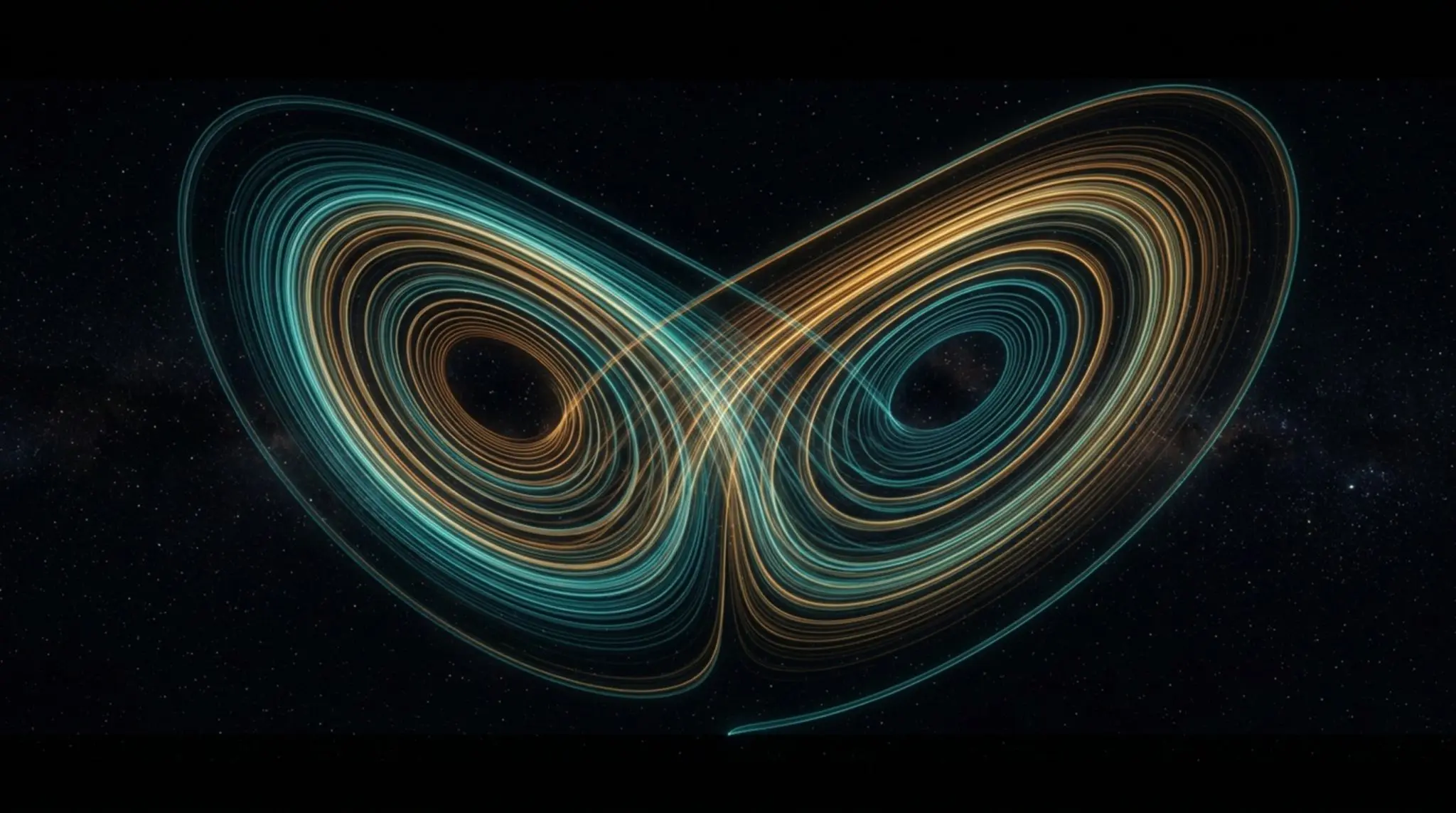
A new method embeds nonlinear dynamics into quantum circuits without requiring extra qubits or complex tensor operations. The framework utilises state-dependent double-bracket flows and recursive unitary implementations to simulate these systems coherently; it relates computational cost directly to how sensitive those dynamic systems are to initial conditions. This technique models complex systems on quantum computers without needing additional qubits or complicated calculations.
The method links a system’s sensitivity to its starting point, a property known as stability, to the amount of computing power required for accurate simulations. By simplifying this connection, previously inaccessible scenarios limited by current hardware capabilities can now be investigated. Researchers from The University of Osaka has developed a method for simulating complex systems on quantum computers without increasing qubit requirements or computational difficulty.
This framework embeds nonlinear dynamics, behaviours where effects aren’t proportional to their causes, into existing quantum circuits using state-dependent Hamiltonian operators; these are sets of rules governing how a system changes that adapt based on its current condition, much like adjusting cooking times depending on whether ingredients are fresh or frozen. Linking the complexity of dynamic systems directly to needed computing power enables researchers to explore scenarios previously beyond reach due to hardware limitations.
The team determined query upper bounds relating to how often information about the simulated system must be accessed, analogous to zooming in on an increasingly detailed map for greater precision. These vary sharply with stability properties.
Reduced computational cost via adaptive Hamiltonians enhances complex system modelling
Previously, achieving this level of complexity required either additional qubits or computationally expensive tensor operations that limited practical application. Applying this specifically to the discrete Gross, Pitaevskii equation, a mathematical model used in physics, yielded optimal query complexity of Θ(egT/2), given certain initial conditions and nonlinearity strength denoted by ‘g’.
State-Dependent Hamiltonians Enable Scalable Nonlinear Quantum Circuitry
A set of rules governing how a quantum system changes forms the basis of state-dependent Hamiltonian operators developed by the team; these adapt based on current condition. This allowed them to embed nonlinear behaviours into existing quantum circuits without needing extra qubits or complex calculations. The recursive unitary implementations they constructed repeatedly call initial preparation routines and their inverses as subroutines, building increasingly accurate solutions step by step.
This focuses instead on how simulation time affects computational demands. Consequently, this method allows for creating circuits capable of embedding nonlinearity into standard quantum operations, specifically unitary transformations preserving quantum coherence, without requiring helper qubits typically used within calculations.
Quantum simulation accuracy correlates directly with dynamical systems’ expansion rates
Researchers are refining techniques for tackling challenges posed by the linear nature of qubits versus real-world nonlinear systems in quantum simulations. Establishing how accurately these simulations reflect dynamic complexity, particularly sensitivity to initial conditions, remains an open question; however, their work reveals that query complexities vary sharply depending on whether solutions contract, remain stable or expand exponentially during simulated time. Even with uncertainties around precisely capturing extremely sensitive behaviours where tiny initial changes create vastly different outcomes, this research offers valuable progress towards more accurate modelling.
Clear links between a system’s inherent behaviour and computational effort needed for accurate simulation on quantum hardware have been established through their findings, understanding this relationship is vital for designing efficient algorithms. Their work establishes a key connection between complex nonlinear system behaviour and the resources required for simulation on quantum computers. Previous approaches often struggled efficiently modelling these dynamics without substantial increases in qubit numbers. Generalising an existing algorithm enabled them to create circuits capable of embedding nonlinearity into standard operations without needing extra qubits typically used as helpers within calculations.
The researchers demonstrated that simulating nonlinear systems with quantum computers requires varying levels of computation depending on how quickly solutions diverge from initial conditions. This matters because it clarifies the link between the inherent complexity of a dynamic system and the computational cost of accurately representing it on quantum hardware. Specifically, they found query complexities ranged from exponential to double-exponential based on whether simulated solutions contracted, remained stable or expanded over time T. Their generalised ancilla-free circuit offers a way to embed nonlinearity using existing quantum operations, avoiding the need for additional qubits.
👉 More information
🗞 Quantum Complexity of Ancilla-Free Unitary Embeddings for Nonlinear Dynamics via Generalized State-Dependent Double-Bracket Flows
✍️ Yuki Ito, Hideaki Hakoshima and Keisuke Fujii (The University of Osaka)
🧠 ArXiv: https://arxiv.org/abs/2609.37802




See today’s quantum computing news on Quantum Zeitgeist for the latest breakthroughs in qubits, hardware, algorithms, and industry deals.