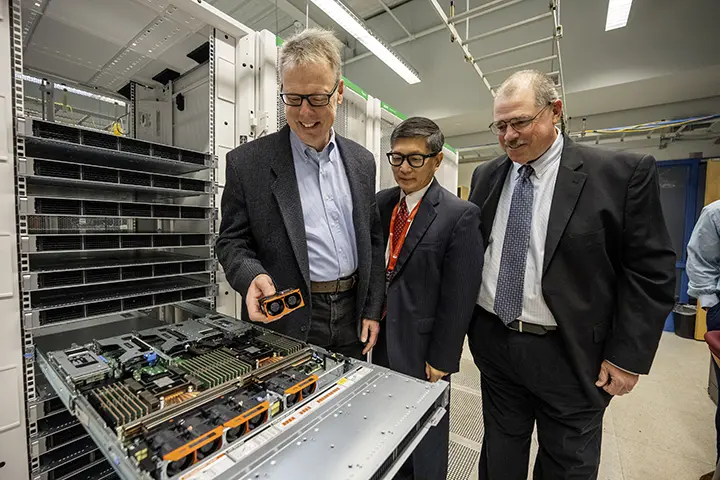
A $22.95 million National Science Foundation grant has delivered the hardware for Kitsune, a new supercomputer at Stony Brook University designed to expand access to artificial intelligence and research computing. Named for a legendary Japanese fox spirit, and a nod to the university’s Seawolf mascot, Kitsune will operate for at least five years, serving as a long-term resource for scientists nationwide through the NSF ACCESS program.
“Stony Brook’s growing supercomputing capabilities give researchers the tools to tackle questions that were previously beyond reach,” said Carl W. Lejuez, executive vice president and provost, anticipating the system will help deepen understanding of the world.
Kitsune Supercomputer: NSF Funding and Democratized AI Access
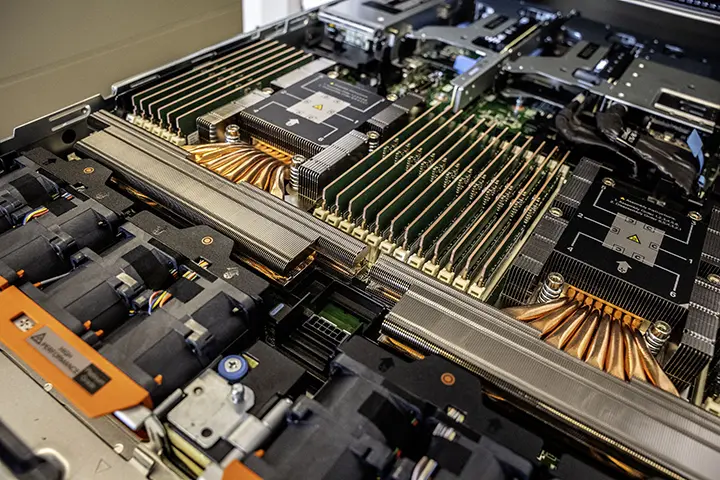
Kitsune’s 61,000 compute cores, powered by AMD EPYC 9965 192-core processors, represent a substantial increase in computational power available through the NSF ACCESS program, directly addressing the growing demand for high-performance computing resources in artificial intelligence research. The system’s 125 terabytes of memory further enhances its capacity to handle complex simulations and large datasets used in modern AI workflows. This hardware configuration positions Kitsune as a key asset for researchers tackling computationally intensive problems across diverse scientific disciplines.
The supercomputer’s integration into the ACCESS program will extend its reach beyond Stony Brook University, providing nationwide access to a resource designed to accelerate scientific discovery. A representative said, “As artificial intelligence opens new paths to discovery, Kitsune will help researchers analyze complex data, test new ideas, and deepen our understanding of the world.” Through NSF’s ACCESS program, they look forward to making this powerful resource available to researchers across the country.
Kitsune supercomputer aims to democratise access to AI computing
By pairing these extensive core counts with the interdisciplinary reach of the Institute for Advanced Computational Science, Kitsune aims to empower researchers to run production-scale simulations and autonomous AI workflows. Robert Harrison, Director of the IACS and Professor of Applied Mathematics & Statistics, described Kitsune as building on the foundation of Ookami, propelling Stony Brook into the era of Agentic AI and high-throughput scientific discovery.
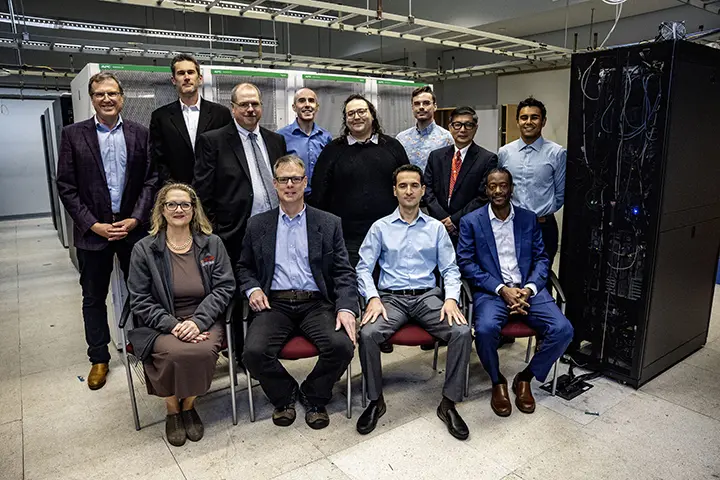
The Kitsune project is a great opportunity, and with the support of Stony Brook University, a wonderful team has been assembled. A team member noted they are delighted to be a part of it.
Building on the pioneering foundation of Ookami, our new NSF-sponsored Tier 1 supercomputing center-anchored by the 6.7 Pflop (64-bit) Kitsune cluster with 125 Tbyte memory-propels Stony Brook into the era of Agentic AI and high-throughput scientific discovery.
Kitsune supercomputer aims to democratise access to AI computing
Robert Harrison, Director of the IACS and Professor of Applied Mathematics & Statistics
Kitsune’s computational power stems from the deployment of AMD EPYC 9965 192-core processors, totaling 61,000 compute cores across 158 dual-processor compute nodes and two additional large-memory nodes. This configuration delivers a peak performance of 6.7 Pflop, representing a substantial increase in processing density compared to previously used server processors at Stony Brook University. The enhanced core density directly addresses the growing demand for tackling larger, more complex simulations and increasingly data-intensive workloads within scientific research.
The selection of 5th Generation AMD EPYC CPUs was strategic, providing a significant leap in computational throughput. This allows researchers to move beyond limitations imposed by older hardware, enabling the execution of autonomous AI workflows at a true production scale. The system’s architecture is designed to support not only traditional high-performance computing but also the emerging demands of Agentic AI, a field focused on creating autonomous, intelligent systems. Beyond raw processing power, the Kitsune cluster’s design prioritizes long-term accessibility and impact.
The Kitsune project is a great opportunity and with the support of Stony Brook University we have assembled a wonderful team I am absolutely delighted to be a part of.
Alan Calder, College of Arts and Sciences Department of Physics and Astronomy Professor and Director of SBSC
To provide the best experiences, we and our partners use technologies like cookies to store and/or access device information. Consenting to these technologies will allow us and our partners to process personal data such as browsing behavior or unique IDs on this site and show (non-) personalized ads. Not consenting or withdrawing consent, may adversely affect certain features and functions.
Click below to consent to the above or make granular choices. Your choices will be applied to this site only. You can change your settings at any time, including withdrawing your consent, by using the toggles on the Cookie Policy, or by clicking on the manage consent button at the bottom of the screen.
Functional
Always active
The technical storage or access is strictly necessary for the legitimate purpose of enabling the use of a specific service explicitly requested by the subscriber or user, or for the sole purpose of carrying out the transmission of a communication over an electronic communications network.
Preferences
The technical storage or access is necessary for the legitimate purpose of storing preferences that are not requested by the subscriber or user.
Statistics
The technical storage or access that is used exclusively for statistical purposes.The technical storage or access that is used exclusively for anonymous statistical purposes. Without a subpoena, voluntary compliance on the part of your Internet Service Provider, or additional records from a third party, information stored or retrieved for this purpose alone cannot usually be used to identify you.
Marketing
The technical storage or access is required to create user profiles to send advertising, or to track the user on a website or across several websites for similar marketing purposes.