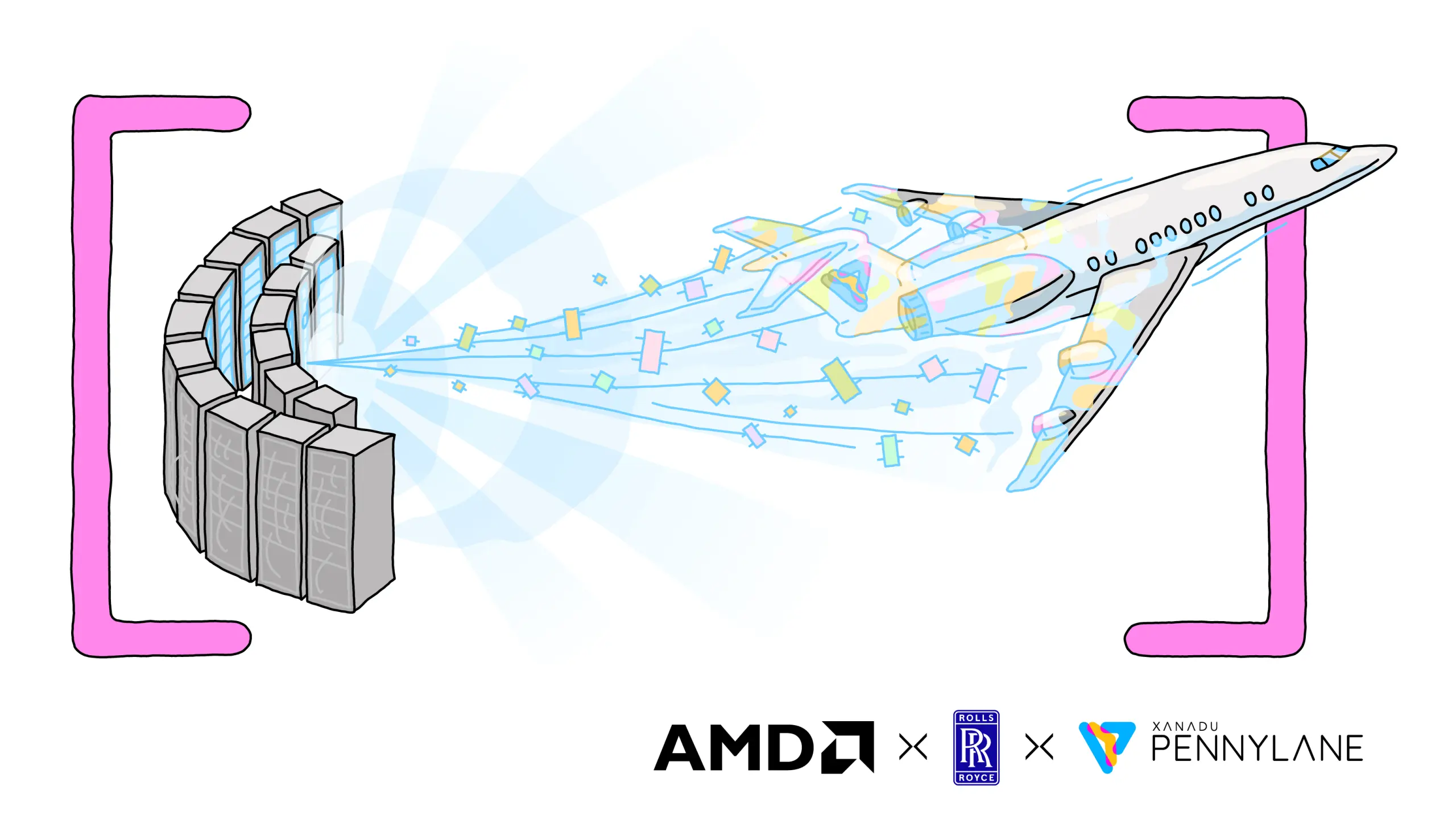
Rolls-Royce, Xanadu, and AMD have run the largest quantum workflow related to aerospace engineering design to date on the Lux supercomputer at Oak Ridge National Laboratory. This demonstration, a key driver of the Quantum Genesis initiative, builds on years of collaborative research establishing a robust classical and quantum foundation for aerospace engineers.
The team used Xanadu’s PennyLane software to tackle computationally intensive computational fluid dynamics, a process that challenges even the most powerful supercomputers, by simulating a 2048 x 2048 mesh with 40 qubits. These advancements signal progress by identifying bottlenecks before the arrival of utility-scale quantum computing.
PennyLane and Lux Supercomputer Enable Aerospace Workflow Scaling
This simulation, achieved through collaboration between Xanadu, Rolls-Royce and AMD, demonstrates a significant step toward applying quantum computing to real-world engineering challenges before fully fault-tolerant quantum computers are available. The work is part of the Quantum Genesis initiative and highlights the importance of preparing workflows for future quantum utility. A key focus of the project was reducing the computational burden of these complex simulations, and the team achieved a greater than 200-fold decrease in the number of non-Clifford gates required for the block encoding process, Xanadu says.
These gates, notoriously resource-intensive for quantum computers, were reduced to just 13% of the process, a substantial improvement from over 99% in prior work. This optimization not only lowers the demands on quantum hardware but also resulted in a 90% reduction in cross-node data communication volume, improving the efficiency of the classical compute resources used in conjunction with the quantum processing.
The successful execution of the workflow relied on PennyLane, Xanadu’s open-source software platform and the AMD Instinct MI355X GPUs within the Lux supercomputer. Compilation of the PennyLane program took less than one minute, enabling a full simulation to complete in under 18 hours across eight nodes and 64 GPUs.
This rapid compilation and execution time emphasises the potential for scaling quantum workflows using current high-performance computing infrastructure. Scott Tease, Corporate Vice President, HPC and Sovereign AI, AMD, said, “The race to quantum advantage will be shaped by the work customers do before fault-tolerant quantum systems arrive.” He continued, “This collaboration shows how AMD high-performance computing can help organizations scale quantum workflows, reduce future quantum resource requirements and prepare industrial applications today.” Designing low-emission jet engines requires detailed simulations of airflow using CFD, a process that involves solving large sets of linear equations.
These calculations currently push the limits of even the most powerful supercomputers, creating a compelling use case for quantum linear solvers. While quantum computers promise a potential speedup, verifying their applicability at an industrial scale requires both algorithmic optimization and access to powerful classical computing facilities. Rolls-Royce and Xanadu have been collaborating for years to build this foundation, and the current demonstration represents a culmination of that effort, according to the company.
The ability to reduce the computational cost of quantum algorithms is critical for bridging the gap between theoretical potential and practical implementation. The team’s success in minimizing non-Clifford gates is particularly noteworthy, as these gates are a major bottleneck for current and near-term quantum hardware.
Dr. Leigh Lapworth, Fellow in Computational Science at Rolls-Royce, emphasized the impact of this work, stating, “These are hugely impressive and important results for anyone interested in using quantum linear equation solvers on fault-tolerant quantum computers.” He added, “Rolls-Royce and Xanadu have an unwavering commitment to fault-tolerant quantum computers and with AMD’s HPC expertise we are seeing many of the barriers to adoption being reduced or eliminated. The date by which fault-tolerant quantum computers will impact businesses might just have come forward by a couple of years.” This demonstration also highlights the importance of a collaborative approach to quantum computing.
By combining Rolls-Royce’s aerospace engineering expertise, Xanadu’s quantum software and AMD’s high-performance computing hardware, the team was able to achieve results that would have been difficult or impossible to obtain with any single technology or expertise.
The collective effort has not only advanced the state of the art in quantum computing but also provided a practical model for how industry leaders can work together to accelerate the development and deployment of quantum applications, demonstrating how application scientists can proactively identify and address bottlenecks in quantum workflows.