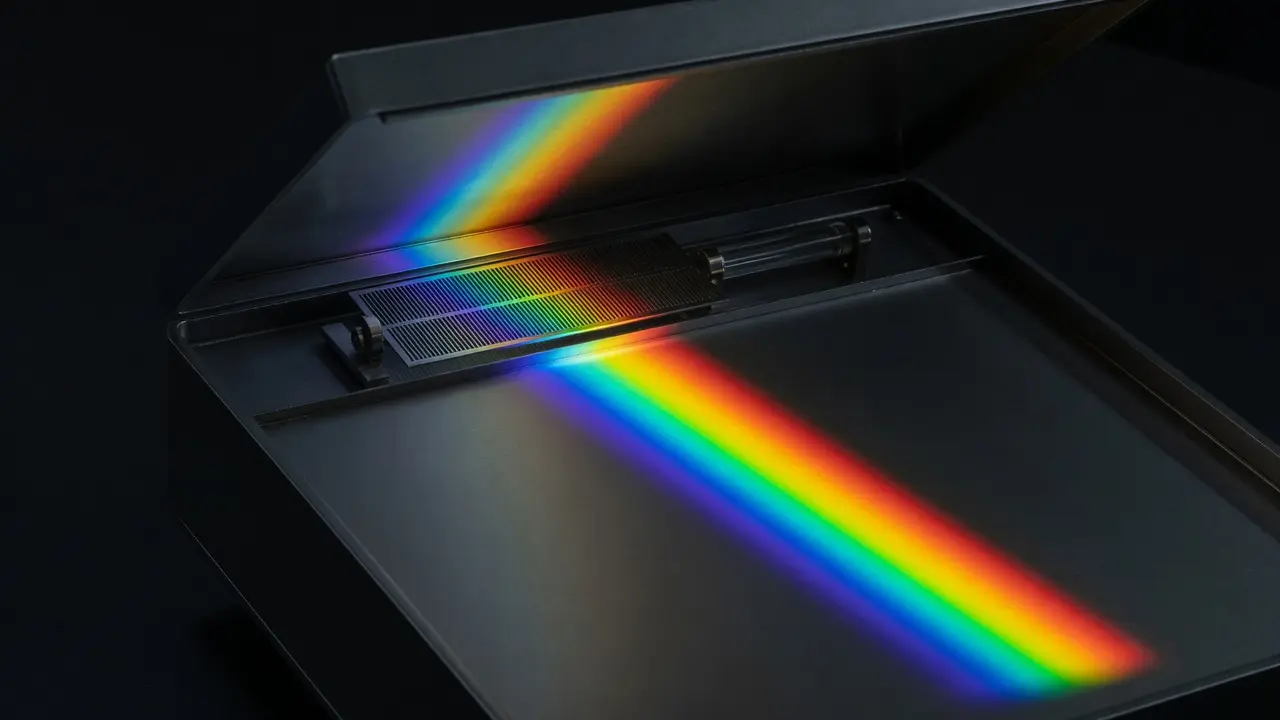
Researchers from the University of Adelaide, Australia and the University of St Andrews, Scotland have achieved an 80-fold increase in resolution for atomic analysis with a new quantum speckle spectrometer. The device overcomes limitations of existing speckle-based spectrometers by using an integrating sphere to enhance spectral sensitivity, reaching a resolution of 6 femtometres at 780 nanometres. This advancement enables the first direct speckle-based measurement of hyperfine structure in rubidium 85, with transmission spectra differing by no more than 3.6% from established wavemeter measurements, establishing speckle as a platform for ultra-high precision spectroscopy.
Integrating Sphere Enhances Speckle Spectrometer Sensitivity
An integrating sphere enabled a speckle spectrometer to achieve six femtometre wavelength resolution at 780 nanometres, representing an approximate 80-fold improvement over previous speckle-based measurements in terms of resolving power. This advance stems from the sphere’s ability to create multiple scattering events, generating a wide range of optical path lengths that interfere at the device’s output, a key element when measuring parameters dependent on accrued phase.
The spectrometer’s design uses a hollow spherical cavity with a highly reflective matte surface, incorporating two apertures for light coupling and output. The imaging system captured speckle grains approximately two pixels wide, ensuring adequate spatial sampling and preventing under-sampling of the interference pattern. A CMOS camera with a 1600×1100 pixel resolution recorded these patterns, facilitating high-precision analysis of the scattered light.
Analysis of the resulting spectrogram confirmed the spectrometer’s ability to discern the expected behaviour of the first-order sideband, demonstrating its capacity for high-frequency measurements. The spectrometer’s capabilities extend to atomic spectroscopy, as demonstrated by measurements of rubidium-85 hyperfine absorption features. The device was configured for saturated absorption spectroscopy, allowing for comparison with a traditional setup employing a photodiode and wavemeter. This comparison highlights the potential for speckle-based spectrometers to rival established techniques in atomic analysis.
The resolving power, defined as the operating wavelength divided by the spectral resolution, provides a useful metric for quantifying spectrometer performance. The integrating sphere design yields a resolution of less than 3 MHz at 780 nm, a substantial leap forward in precision.
While this sensitivity is advantageous, it also introduces challenges related to drift caused by temperature changes, mechanical deformation, or refractive index variations. The calibration of the spectrometer is therefore valid only for a limited duration, necessitating careful control of environmental factors. Despite this constraint, the demonstrated performance opens doors to applications in radio frequency spectrometry and atomic spectroscopy.
The spectrometer’s ability to accurately reconstruct the power of laser sidebands to within 1% of expectation, while simultaneously measuring eleven laser modes, emphasises its potential for complex spectral analysis. “Employing an integrating sphere as the basis for a speckle spectrometer has yielded spectral resolution,” the researchers state in their published work.
The sensitivity of the speckle generated within the integrating sphere arises from its dependence on path-dependent perturbations, meaning that even small changes in the optical path length can significantly affect the observed speckle pattern. This characteristic, while demanding precise calibration, is the key to achieving the high resolution. These results establish speckle as a viable platform for ultra-high precision spectroscopy, radio-frequency spectrometry and microwave photonics.
Speckle Patterns Encode High-Dimensional Spectral Information
This achievement represents an approximately 80-fold improvement over previously implemented speckle-based spectrometers, extending the reach of this technology into the radio-frequency domain and opening new avenues for atomic analysis. The core of this advancement lies in transforming traditionally unwanted speckle patterns, random interference patterns formed when light scatters off a rough surface, into a source of high-dimensional spectral information. The experimental setup deliberately uses the multiple scattering events within the integrating sphere to enhance spectral sensitivity, a characteristic dependent on path-length variations of light within the cavity.
This design allowed for the accurate reconstruction of laser sideband powers to within 1% of expected values, a critical validation of the technique’s reliability. This level of precision is important for applications requiring precise frequency measurements, such as radio-frequency spectrometry and microwave photonics.
The spectrometer’s functionality relies on constructing a matrix, designated ‘T’, whose columns represent the output speckle patterns at different wavelengths of interest. This matrix was determined by recording speckle patterns as the wavelength of an Er:fibre laser was swept across a defined region, achieved by tuning the laser’s cavity length using a built-in piezo-electric transducer. The resulting data enabled the creation of spectrograms, visual representations of the spectral content over time, and facilitated the direct measurement of hyperfine structure in rubidium-85.
The team’s approach diverges from conventional spectrometers by encoding spectral information within the complex interplay of light within the integrating sphere, rather than relying on dispersive elements like prisms or gratings. This encoding allows for a compact and mechanically robust instrument, less susceptible to alignment errors that plague traditional optical setups.
The use of an integrating sphere, a hollow sphere coated with a highly reflective material, ensures numerous internal scattering events, effectively increasing the interaction length of light and amplifying subtle spectral variations. The researchers demonstrated the spectrometer’s capacity to resolve eleven distinct laser modes, highlighting its ability to dissect complex spectral signatures. This capability is particularly valuable in applications requiring the analysis of multi-mode lasers or the identification of subtle spectral features obscured by broader emission lines.
The ability to accurately measure the power of these laser sidebands, alongside the hyperfine structure of rubidium-85, highlights the versatility and potential of this new speckle-based approach. The work demonstrates that the seemingly random nature of speckle is, in fact, deterministic and rich in information about the laser, the scattering medium and the environment.
The implications of this advancement extend beyond fundamental spectroscopy, offering a pathway towards miniaturized and robust spectroscopic instruments for diverse applications. The inherent robustness of speckle-based systems, coupled with their compact footprint, makes them well-suited for deployment in challenging environments where traditional spectrometers may be impractical. The team’s work opens the door to a new generation of spectroscopic tools capable of pushing the boundaries of precision measurement. The development of this technology represents a step towards realizing the full potential of speckle as a powerful tool for precision metrology and beyond.
Fold Resolution Improvement Achieves 6 fm Wavelength Measurement
The device’s capability extends beyond simply identifying wavelengths. It allows for the discrimination of closely spaced spectral features, a challenge for traditional interferometers that struggle with multi-line laser outputs. Traditional wavelength measurement tools face limitations when analyzing multiple laser lines due to their periodic output, but the multi-dimensional nature of speckle patterns allows this spectrometer to resolve the contribution from each spectral component. The instrument’s resolving power, calculated as 1.3 x , demonstrates a significant advancement in the field of precision metrology, enabling measurements at a scale previously unattainable with speckle-based systems.
This enhanced resolution was demonstrated through the analysis of an electro-optic modulator, confirming the spectrometer’s ability to resolve laser sidebands with extracted power values agreeing with expected values to within 1%. The spectrometer’s performance was further validated by its application to the study of rubidium-85, specifically the D2 transition.
Spectrometer Resolves Rubidium Hyperfine Structure
The spectrometer discerned individual hyperfine structure lines within the rubidium-85 D2 transition, differing from wavemeter-referenced measurements by no more than 3.6 percent. The device simultaneously measured up to eleven optical modes, establishing a power accuracy of 0.2 percent relative to total optical power. The researchers employed a fibre-coupled electro-optic modulator driven by an arbitrary waveform generator as a first test of the system’s resolution, before switching to the rubidium saturated absorption spectroscopy setup.
This leap in resolution is directly attributable to the integrating sphere, functioning as a multiply scattering cavity that accesses a high range of optical path lengths to enhance spectral sensitivity. The team presented both averaged spectrograms, obtained after twenty modulation periods and single-period spectrograms to illustrate the stability of the measurement. The calibration process involved sweeping the laser frequency and carefully analyzing the resulting speckle patterns, assuming a unique pattern corresponds to each single-wavelength input.
👉 More information
🗞 Ultra-high precision speckle spectrometer enabling radio-frequency scale resolution of atomic spectra
✍️ Gabriel Britto Monteiro, Christopher Perrella, Sarah K. Scholten, Morgan Facchin, Andre N. Luiten, Graham D. Bruce and Kishan Dholakia
🧠 DOI: https://doi.org/10.1038/s41467-026-78325-y




See today’s quantum computing news on Quantum Zeitgeist for the latest breakthroughs in qubits, hardware, algorithms, and industry deals.