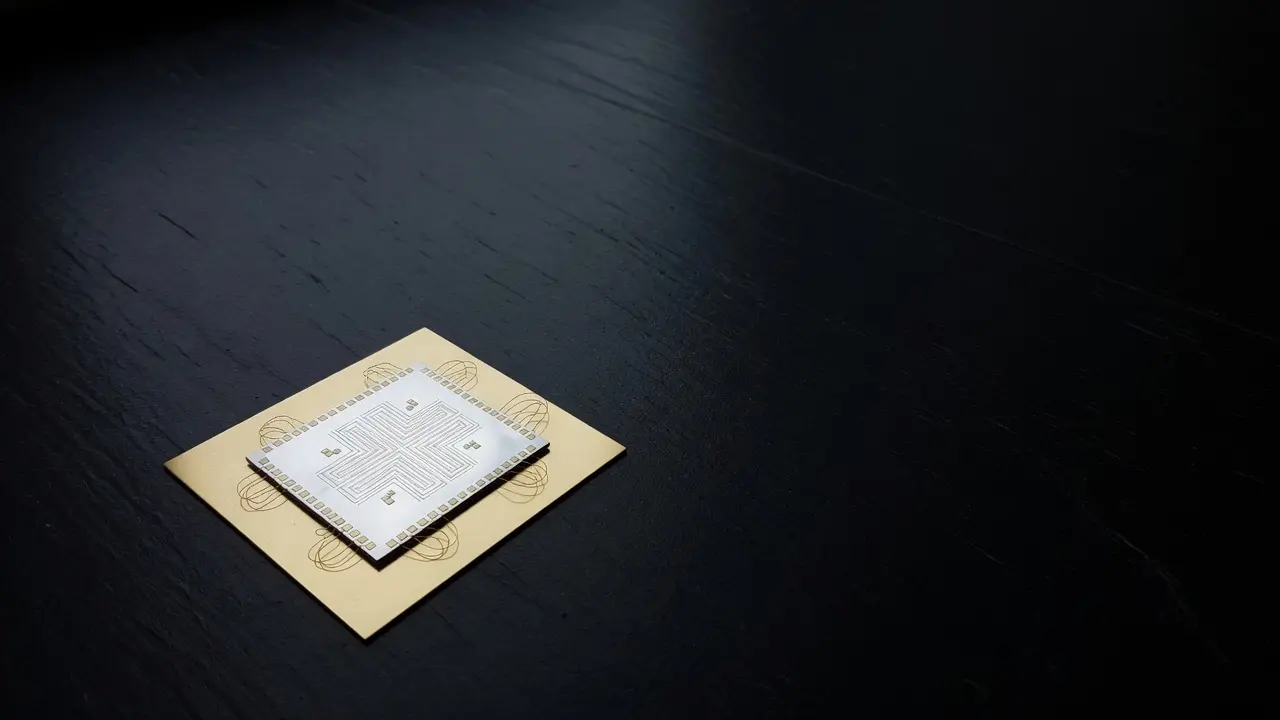
Jeroen Grimbergen and colleagues at QuTech, TU Delft, demonstrate a new dynamic multiplexing policy for quantum repeaters that improves the fidelity of entanglement distribution. Their work focuses on systems where, on average, less than one entangled link is successfully generated per communication cycle, a realistic constraint for building near-term quantum networks.
The team proposes a reconfigurable router that dynamically assigns quantum chips to either end node in every cycle, and shows this approach significantly improves entanglement quality over fixed assignment policies while only marginally impacting the rate of entanglement generation. This makes dynamic multiplexing particularly relevant for developing practical quantum communication systems.
Quantum Repeater Multiplexing with Integrated Quantum Chips
Each quantum chip within the multiplexed repeater incorporates both a communication qubit and a distinct memory qubit, enabling both entanglement generation and storage. The communication qubit functions as the interface for establishing entanglement between chips, while the memory qubit preserves this entanglement for later use. A reconfigurable router interconnects these chips, dynamically assigning each to either of the two end nodes in every communication cycle, a key feature of the system’s architecture.
This dynamic assignment isn’t a one-time setup. The router actively adapts resource allocation based on the success of entanglement attempts. The team compared this dynamic assignment policy, termed “DynMux,” to a “FxdMux” policy where chip assignments remain fixed throughout the process. Even though the dynamic multiplexing policy requires a deeper, and hence, more lossy, router than the fixed policy, it can still achieve higher secret key rates in the parameter regime studied. This enhancement is particularly pronounced when memory coherence times are limited, suggesting that dynamic multiplexing can mitigate the effects of decoherence.
A reconfigurable router offers a means to improve entanglement fidelity by dynamically allocating quantum chips, a strategy previously unexplored in many multiplexing schemes. Unlike conventional approaches that fix the assignment of quantum modes to nodes, this system allows for real-time adjustments to which chips attempt entanglement generation with either end node.
Parallel work has demonstrated that dynamic multiplexing can enhance the quality of end-to-end entanglement, though previous analyses focused on scenarios with strict asymmetry between end nodes and did not account for imperfections within the repeater node itself. This work demonstrates a fidelity improvement even when the repeater node is symmetrically placed between end nodes, a configuration relevant to near-term quantum networks.
Dynamic Chip Assignment for Enhanced Entanglement Fidelity
The dynamic assignment policy detailed here marginally improves the rate of entanglement generation while providing a significant boost to fidelity, a trade-off that prioritizes quality over speed in this specific setup. “In the limit of many quantum chips, a dynamic multiplexing policy yields similar rates of end-to-end entanglement generation to a fixed policy,” according to the researchers.
Reconfigurable Router Enables Dynamic Multiplexing Policies
A reconfigurable router offers a new approach to quantum repeater design, allowing for dynamic assignment of quantum chips to optimize entanglement distribution. Unlike previous systems that fixed the connection between quantum modes and end nodes, this architecture actively shifts resources during each end-to-end communication cycle, a strategy that improves fidelity even as the rate of entanglement generation remains comparable. This dynamic assignment contrasts with fixed policies where each chip maintains a consistent link throughout the process.
The ability to dynamically allocate resources becomes particularly advantageous in scenarios where establishing an entangled link succeeds, on average, less than once per communication cycle. Analyses of this parameter regime, relevant to near-term quantum networks, reveal that a dynamic multiplexing policy can significantly enhance fidelity compared to a fixed approach.
While fixed multiplexing can use a shallower router, dynamic multiplexing requires a router with a depth of 2 log2(m) + 1, where ‘m’ represents the number of quantum chips, leading to a faster decrease in entanglement generation probabilities. Despite this, the fidelity gains outweigh the marginal reduction in rate. Detailed Markov chain analysis, not previously undertaken in the literature, has been used to examine both the rate and fidelity of this multiplexed quantum repeater.
This analysis builds on prior work that demonstrated similar entanglement generation rates between dynamic and fixed policies when a large number of quantum chips are available, and parallel studies showing dynamic multiplexing’s potential to improve end-to-end entanglement quality. The team’s work details the assumptions and definitions of both the dynamic and fixed multiplexing policies.
Near-Term Quantum Network Parameter Regime Analysis
A dynamic multiplexing policy demonstrably improves fidelity in quantum repeaters when establishing fewer than one entangled link per communication cycle, a parameter regime reflective of current quantum network capabilities. Analyses reveal this dynamic allocation yields a noticeable improvement in entanglement quality, even with a marginal increase in the rate of entanglement generation.
The team’s work details how this dynamic policy, while requiring a more complex router architecture, can still achieve higher secret key rates than fixed policies under these conditions. Direct optimization of this trade-off is computationally intensive, but the team’s analysis provides a foundation for future refinement.
Entanglement Generation Rate vs. Memory Decoherence
The ability to maintain entanglement, a cornerstone of quantum communication, is fundamentally limited by the coherence time of quantum memories within repeater nodes. Analyses reveal that a dynamic multiplexing policy reduces decoherence stemming from links awaiting matching, pushing the Werner parameter above the threshold required for quantum key distribution (QKD). The study also considered the effects of non-ideal local entanglement generation, represented by a local entanglement probability less than 1 and finite active coherence time.
These imperfections primarily rescale the entanglement generation rate and the Werner parameter, but the relative advantage of the dynamic policy remains. For a 100-kilometer end-to-end distance, a remote entanglement generation probability of 10 to the power of negative five, and a memory coherence time of 100 seconds, the dynamic policy demonstrably improves performance.
Optical Integration of Communication and Memory Qubits
Quantum repeater designs increasingly rely on optical integration to manage numerous quantum chips, each housing both a communication qubit for entanglement generation and a separate memory qubit for storage. The router’s ability to reconfigure in this manner is central to a new multiplexing policy designed to improve performance. This rapid succession of attempts is facilitated by the reconfigurable router, which routes outgoing photons to the appropriate heralding station.
The design allows for a sequential excitation of communication qubits, optimizing the use of resources within the repeater node. This dynamic assignment of quantum chips differs from static approaches, and is particularly beneficial when the average rate of successful entangled link generation is less than one per communication cycle, a realistic scenario for current quantum network capabilities.
The researchers found that this dynamic policy demonstrably improves the fidelity of entanglement, even if the rate of entanglement generation sees only marginal improvement. This suggests a deliberate prioritization of quality over speed in this specific configuration, a potentially unexpected outcome. The reconfigurable router, therefore, isn’t simply a component, but an active element in optimizing entanglement distribution.
Dynamic Policy Minimizes Link Storage Time
Minimizing the time a quantum link must be stored before use is central to improving the performance of near-term quantum repeaters, a challenge addressed by dynamically allocating resources based on successful entanglement generation. This strategy avoids the buildup of queued links waiting for a connection to the other end, a common bottleneck in fixed assignment schemes.
“The dynamic policy obtains its advantage over the fixed policy not only because it can match links faster, but also because it avoids links to the same end node to be queued up while waiting for links with the other end node to be generated,” the researchers write, detailing the core benefit of their approach.
The system’s design ensures that at most one link is in queue at any given time, a consequence of rapidly shifting resources after each successful entanglement. After establishing a link with one end node, all subsequent entanglement attempts target the other, streamlining the process. This prioritization of minimizing storage time, rather than simply maximizing the rate of entanglement generation, demonstrates a deliberate optimization strategy for practical quantum networks.
Markov Chain Analysis of Rate and Fidelity
A Markov chain analysis provides exactly computable expressions for the steady-state rate and fidelity of a multiplexed quantum repeater, offering a new level of precision in evaluating dynamic and fixed entanglement generation policies. This analytical approach, building on the Ergodic Theorem for Markov-modulated Processes, moves beyond previous approximations that limited the assessment to rate alone, now incorporating entanglement quality into the model.
The team’s work distinguishes itself from earlier studies by providing an exact Markov chain analysis, a method not previously applied to assess both rate and fidelity in multiplexed quantum repeaters. Previous analytical tools, including elementary probability theory and Fourier transforms, have been used to model repeater performance, but often lacked the ability to quantify fidelity alongside rate.
The current analysis builds on an approximate Markov chain used to study rate in fixed multiplexing policies, expanding the scope to include a dynamic policy where chip assignment shifts with each end-to-end communication cycle. This dynamic approach allows for a detailed comparison of how resource allocation impacts both the speed and quality of entanglement generation, an important step toward practical quantum networks. The researchers define the state of the repeater as the number of unmatched links, demonstrating its evolution as a Markov chain, and enabling the computation of the steady-state rate and Werner parameter.
This parameter, a measure of entanglement quality, is central to assessing the effectiveness of the dynamic multiplexing policy, which is optimized to balance rate and fidelity, with a particular focus on maximizing the secret key rate. “The optimization of this tradeoff with respect to the secret key rate is considered,” the paper states, highlighting the practical implications of their analytical framework for secure quantum communication.
Secret Key Rate Optimization with Approximate Models
Analyses using these expressions align closely with results from discrete-event simulations conducted in NetSquid, validating the approach for parameters relevant to near-term quantum networks. This means the method accurately models systems where entanglement generation probability is low and memory coherence times are limited, conditions currently defining the capabilities of existing hardware. The team’s work focuses on optimizing the balance between these two factors to maximize the achievable secret key rate, a metric quantifying the secure information transfer possible over the quantum channel.
Approximations to the maximum achievable secret key rate are determined by optimizing a cutoff value controlling the number of local entanglement generation attempts during an entanglement swap. The resulting heuristic estimate provides a practical means of predicting the maximum achievable secret key rate given the steady-state rate and Werner parameter for a given cutoff value.
👉 More information
🗞 A Dynamic Multiplexing Policy for a Quantum Router
✍️ Jeroen Grimbergen, Sounak Kar, Michal van Hooft, Conor Bradley and Stephanie Wehner
🧠 DOI: http://link.aps.org/doi/10.1103/1s61-6lf2



See today’s quantum computing news on Quantum Zeitgeist for the latest breakthroughs in qubits, hardware, algorithms, and industry deals.