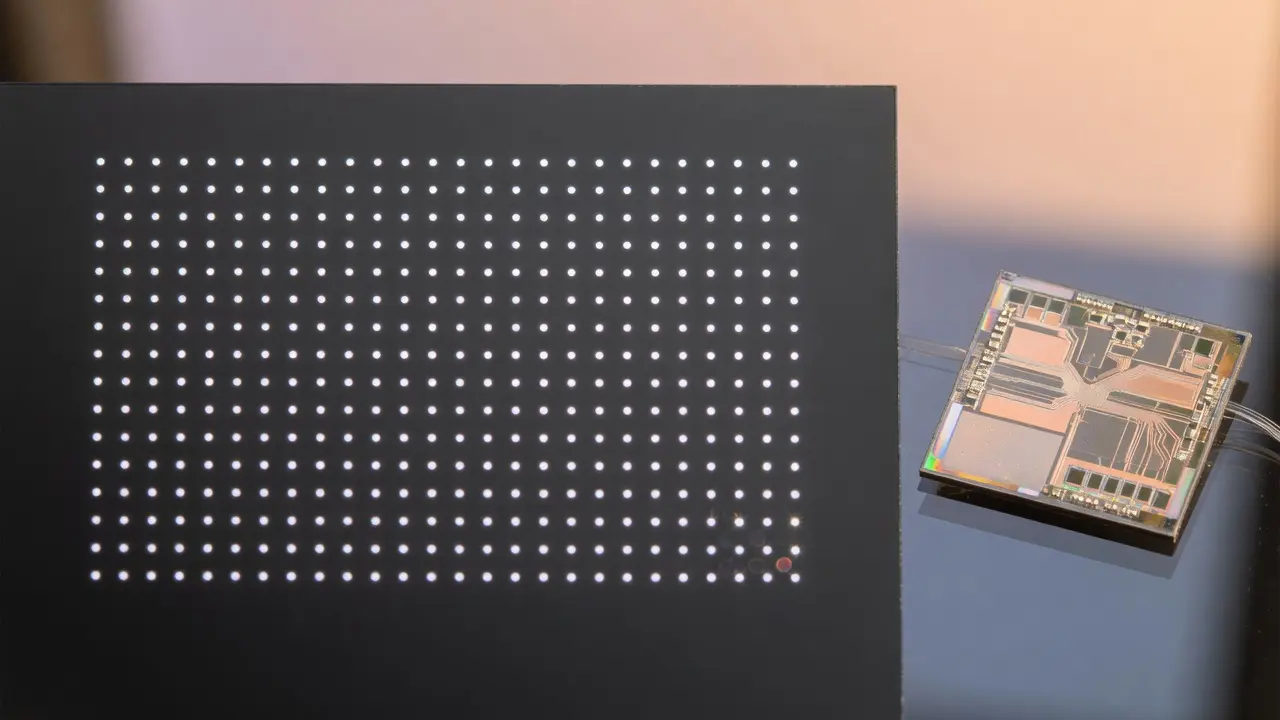
Researchers have developed a method to estimate the fidelity of quantum states using local Pauli measurements with substantially reduced computational demands. Yi Li and colleagues demonstrate their fidelity bounding framework works for hypergraph states with up to 500 qubits, decreasing measurement overhead under depolarizing noise. The scheme selectively measures operators sharing permutational symmetry, reducing the optimization process to a linear program with only O(n) variables, where ‘n’ represents the number of qubits. These results enable scalable characterization of quantum resources for computing and networks.
Pauli Measurements Bound Fidelity for Non-Stabilizer States
Yi Li and colleagues achieved this reduction by selectively measuring operators exhibiting permutational symmetry, a technique that minimizes computational demands without restricting the types of quantum systems it can assess. This approach avoids the need to make assumptions about the underlying physical system, broadening its applicability to diverse quantum computing architectures. The framework developed by Li, Otfried Gühne, and Qiongyi He demonstrates significant reductions in measurement overhead, particularly for hypergraph states, which are known to exhibit extensive nonstabilizerness, a property essential for universal quantum computation.
Their methods were successfully tested on systems with up to 500 qubits, showing substantial improvements under both local and global depolarizing noise conditions. The researchers also extended their methods to estimate nonlinear quantities like purity using convex quadratic programs, offering a more comprehensive characterization of quantum states. Carefully chosen measurements can significantly reduce both the computational and experimental costs associated with verifying the performance of complex quantum systems, suggesting a path toward more efficient quantum verification.
👉 More information
🗞 Bounding Fidelity of Non-Stabilizer States from Local Pauli Measurements
✍️ Yi Li, Otfried Gühne and Qiongyi He
🧠 ArXiv: https://arxiv.org/abs/2610.41808

See today’s quantum computing news on Quantum Zeitgeist for the latest breakthroughs in qubits, hardware, algorithms, and industry deals.