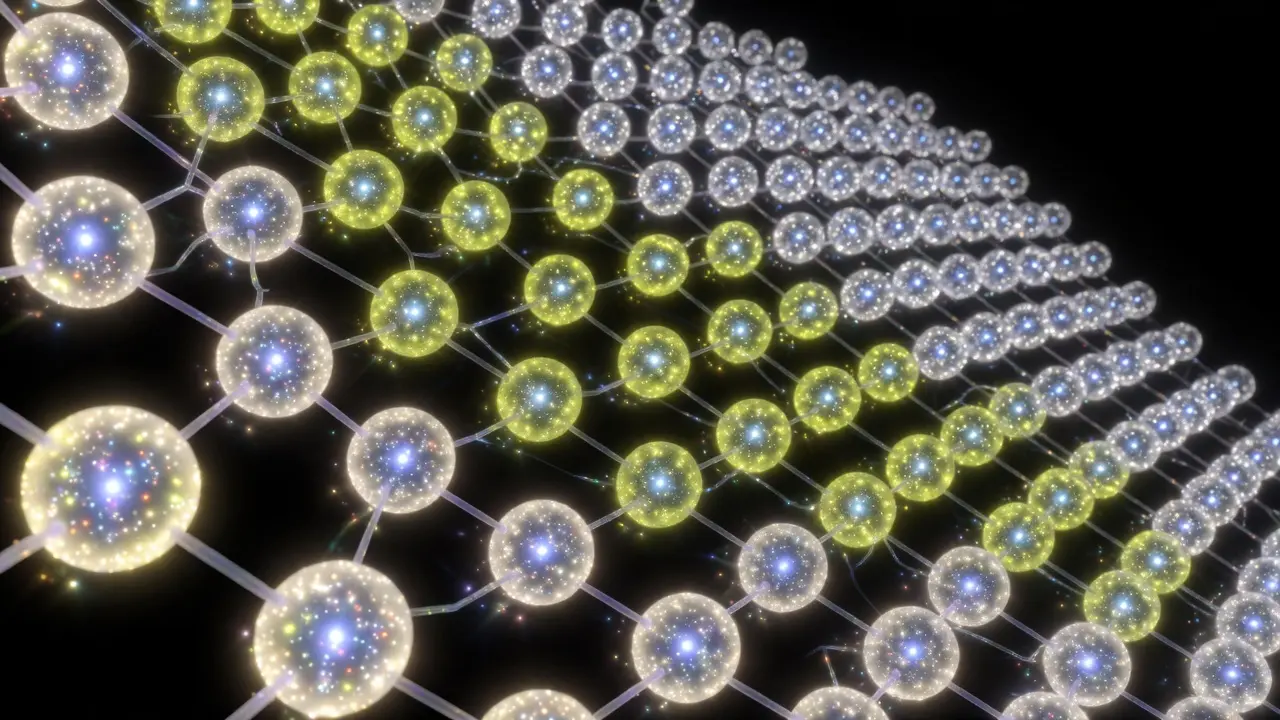
A computational pipeline using graphics processing units compiles braids representing two-qubit gates based on Fibonacci anyons; this sharply reduced unwanted signal leakage to one ten billionth, with error rates also around that level at braid length sixty-nine. The advancement enables more complex quantum operations than previously possible due to improved control over these delicate systems. A new computational method uses graphics processing units to design sequences of operations, called braids, for quantum gates based on exotic particles known as Fibonacci anyons.
The technique sharply reduces unwanted signal loss from qubits; they achieved leakage rates below one ten billionth alongside similarly low error rates for braid lengths up to sixty-nine steps. These theoretical particles could be used as key qubits due to their unique properties; imagine them like tiny knots with inherent stability against disturbances. This is done by efficiently navigating the “braid group”, which describes how these anyons are interwoven together, similar to braiding strands of hair but representing manipulations of qubit states, and finding simplified forms akin to reducing fractions in mathematics.
Fibonacci Anyon Gate Leakage Reduced Ten Thousand-Fold via Golden Ratio Discovery
Leakage from two-qubit Fibonacci anyon gates dropped dramatically to approximately 10^-10, a reduction from earlier results around 10^-3. The team achieved this breakthrough thanks to a new computational pipeline developed by Moscow Institute of Physics and Technology in collaboration with cITMO University. The level of precision now attained crosses a key threshold, as such minimal leakage was previously unattainable, hindering progress towards stable topological quantum computation based on these exotic particles known as anyons.
The team’s systematic approach identified exceptionally accurate braid sequences representing qubit operations while also revealing fundamental mathematical relationships governing signal loss: unwanted leakage values are always whole number multiples of a value related to the golden ratio. Utilizing graphics processing units, Moscow Institute of Physics and Technology developed this pipeline allowing examination of increasingly complex operation sequences up to length 72.
Low leakage confirms potential but highlights scaling challenges in braiding qubits
Achieving leakage below one ten billionth represents a step toward viable topological quantum computation; however, exhaustive searches for braid sequences become computationally prohibitive as complexity increases. Optimizations narrowed the search space enabling them to reach braids with sixty-nine steps, yet revealed inherent tension, consistently achieving these lowest error rates at higher lengths requires further resources or refinement. Still, even with apparent computational limits at greater complexity, this work remains significant because it demonstrates that extremely low error rates are achievable within topological quantum computing systems using specific braid sequences.
Compilation of two-qubit Fibonacci anyon gates faces complications from leakage (ell) originating from a four-dimensional computational sector into a fifth fusion space state. At L=69, they found a braid exhibiting both ellsim10-10 and d[CNOT]sim 10-10.
This research successfully compiled two-qubit Fibonacci anyon gates with very low error rates, leakage as low as approximately one ten billionth (10-10) was achieved using a GPU pipeline to search through complex sequences of braids up to length 72. The study also established mathematical relationships governing leakage in braid sequences, and showed that exhaustive searches can outperform random sampling when seeking optimal configurations; however, it highlights increasing computational demands as complexity grows.
👉 More information
🗞 Meet-in-the-Middle Compilation of the $[\mathrm{CNOT}]$ Class with Fibonacci Anyons
✍️ Matvei Fedin (Moscow Institute of Physics and Technology); Andrey Morozov (Affiliation: Moscow Institute of Physics and Technology)
🧠 ArXiv: https://arxiv.org/abs/2610.37552


See today’s quantum computing news on Quantum Zeitgeist for the latest breakthroughs in qubits, hardware, algorithms, and industry deals.