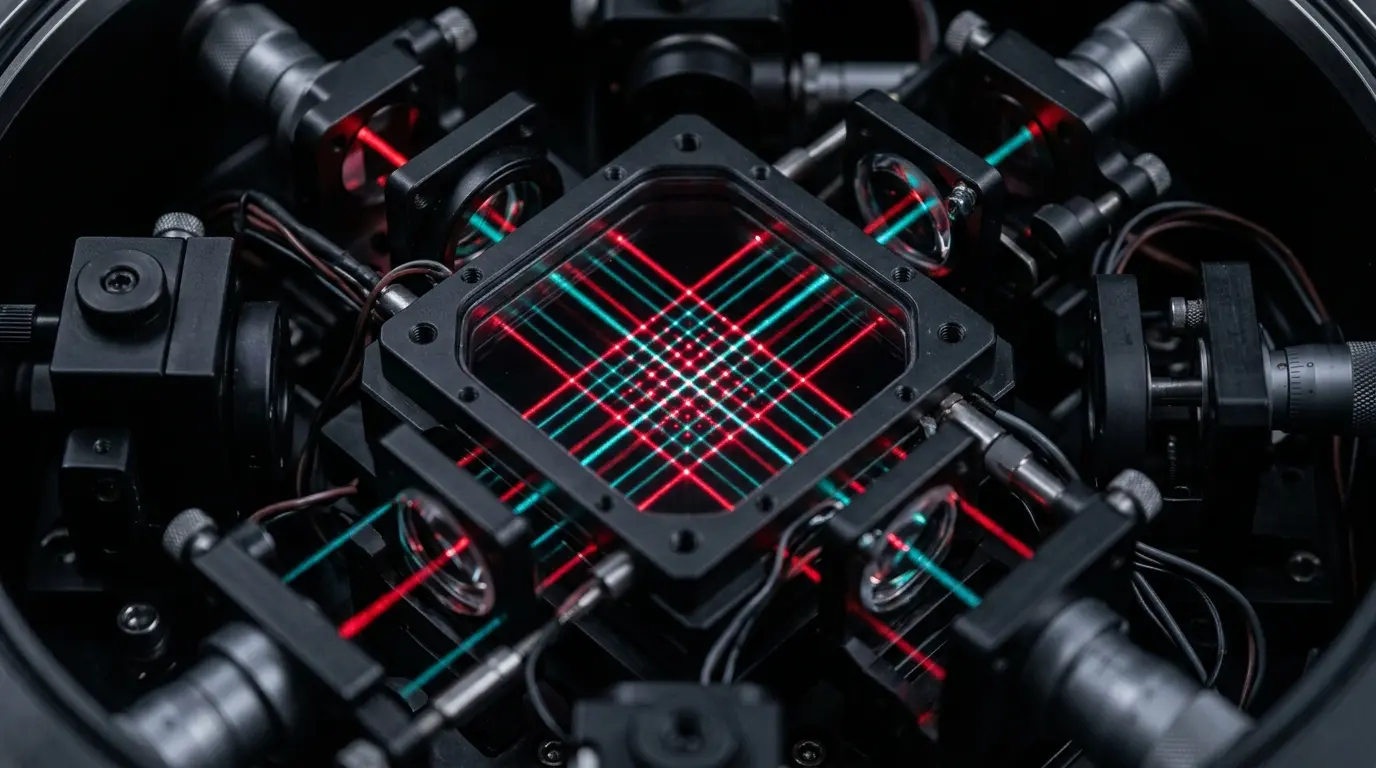
Researchers have, for the first time, created a “multimode quantum description” of parametrically driven cavity solitons in pure-Kerr media, potentially leading to more stable and predictable quantum systems. The work demonstrates up to 20 decibels of quantum noise reduction using these cavity solitons, a level limited only by experimental factors. This achievement provides a pathway to observe strong multimode quantum noise reduction, with implications for advancing the sensitivity of quantum measurements and metrology. The study also uncovered “quantum” dispersive waves above a certain threshold, revealing a quantum analog of soliton Cherenkov radiation.
Pure-Kerr Parametric Driven Cavity Solitons Enable Multimode Squeezing
These waves appear as a direct consequence of the nonlinear dynamics inherent to pure-Kerr media, offering a new avenue for exploring the interplay between solitons and quantum effects. Researchers verified single- and two-mode squeezing in the regime below the soliton threshold, demonstrating the potential for precise control over quantum states of light within the microresonator. This squeezing, a reduction in quantum noise, is fundamental to enhancing the sensitivity of quantum measurements and improving the performance of quantum technologies.
Morphing supermode analysis of the pure-Kerr parametrically driven cavity solitons revealed highly squeezed states, generating up to 20 dB of squeezing, only limited by overcoupling and intrinsic losses within the system. The analysis confirms that the observed squeezing is achievable under experimentally routine parameters. This is particularly significant as it suggests that existing experimental setups can be readily adapted to observe and use these quantum effects without requiring substantial technological advancements.
The observed squeezing is not limited to a single mode of light; the researchers also demonstrated two-mode squeezing, associated with degenerate and non-degenerate optical parametric amplifiers. This multimode squeezing is important for applications requiring entanglement between multiple quantum states, such as quantum communication and quantum computation. The ability to control and manipulate multiple modes simultaneously expands the possibilities for creating complex quantum systems with enhanced capabilities.
The team identified regimes where the dominant squeezed supermode is spectrally localized at the quantum dispersive waves, a phenomenon they term “pseudo” two-mode squeezing, and confirmed this with analysis of the intra-cavity temporal noise profile. The microresonator used in the study, with its intrinsic loss rate denoted as Γi, is coupled to a waveguide with a rate of Γc, and bichromatically pumped with opposite phases at frequencies ω ±.
This configuration induces two coherent soliton pulses in the temporal domain, accompanied by quantum noise temporal envelopes. The researchers’ theoretical framework provides a detailed “multimode quantum description” of these complex interactions, allowing for a precise understanding of the squeezing mechanisms at play. This detailed description is a departure from previous studies, which often relied on simplified models that did not fully capture the multimode nature of the system.
The team’s work extends beyond simply demonstrating squeezing. It also provides insights into the fundamental quantum states of light generated within parametrically driven Kerr solitons. The potential applications of these states are broad, ranging from quantum sensing, where enhanced sensitivity is paramount, to frequency-domain information processing, which relies on the precise manipulation of optical frequencies. The ability to generate and control these quantum states could lead to the development of new technologies with improved performance characteristics.
The study’s analysis of oscillatory solitons, solitons with a periodic temporal profile, revealed that their squeezing spectrum exhibits features similar to those of stable solitons, albeit with more asymmetrical excited supermodes. This observation suggests that the squeezing behavior is robust and not limited to specific soliton types.
By unveiling these unexplored quantum properties of pure-Kerr PDCS, they have opened up new avenues for investigating nonlinear dynamics and developing advanced quantum technologies. The ability to achieve significant quantum noise reduction, coupled with the discovery of novel quantum phenomena, positions pure-Kerr PDCS as a promising platform for realizing practical quantum applications.
Quantum Dispersive Waves Analogous to Soliton Cherenkov Radiation
The emergence of quantum dispersive waves (QDWs) mirrors classical soliton Cherenkov radiation, a phenomenon previously observed in nonlinear optical systems, but now manifested in a quantum regime within pure-Kerr parametrically driven cavity solitons (PDCS). The study identifies these QDWs above a specific threshold, demonstrating their dependence on the interplay between system parameters and the inherent properties of the cavity solitons themselves. Analysis of the PDCS reveals highly squeezed states, reaching levels limited by experimental factors like overcoupling and intrinsic losses, and exceeding 20 decibels of squeezing for routinely achievable parameters.
The morphing supermode analysis of the PDCS confirms these squeezed states across strikingly different regions of the system’s classical phase diagram, suggesting robustness and predictability. Simulations in purely quadratic dispersion, where quartic dispersion is absent, demonstrate the role of zero-dispersion crossings in the emergence of these quantum dispersive waves, highlighting the importance of specific dispersion characteristics for their creation.
The absence of complex interactions and the resulting lack of QDWs in the purely quadratic case further validates the role of quartic dispersion in this phenomenon. Researchers constructed temporal noise envelopes of the comb states to further confirm the presence of QDWs, employing a method detailed in a supplemental reference. This analysis revealed rapid oscillatory waves in the temporal domain, analogous to soliton Cherenkov radiation observed in dissipative Kerr solitons (DKSs).
The interference between the soliton spectrum and sub-comb formation near zero-dispersion crossings generates these oscillations, providing additional evidence for the quantum nature of the observed dispersive waves. “A key feature of dispersive waves in dissipative Kerr solitons (DKSs) is the emission of soliton Cherenkov radiation,” the study notes, drawing a direct parallel between the classical and quantum phenomena.
Analytical Bloch-Messiah Decomposition Reveals Squeezing Levels
Analytical Bloch-Messiah decomposition of parametrically driven cavity solitons (PDCS) reveals the degree to which these localized optical pulses can suppress quantum noise, a metric important for advancing quantum technologies. The analytical technique allows researchers to dissect the cavity interaction Hamiltonian into its constituent parts, ultimately quantifying the squeezing levels and identifying associated supermodes within the system. The process relies on relating input and output quadratures of light using a transfer function matrix, S(ω), which is then diagonalized through the Bloch-Messiah decomposition.
This diagonalization yields a diagonal matrix, D(ω), representing the degree of squeezing and anti-squeezing for each supermode, and the columns of its conjugate, †(ω), define the linear coefficients of frequency mode quadratures participating in the squeezed supermode. The complex nature of U(ω) indicates differences between the left and right sidebands of the squeezed light, a nuance important for precise quantum state control.
This level of squeezing is achieved across a range of parameters, bridging the gap between classical and quantum dynamics of these solitons. The team accounted for intrinsic loss by modeling it as a virtual waveguide, mixing with input quantum modes before decomposition into squeezing values. This allowed them to isolate the true squeezing spectrum, represented by and its corresponding supermodes, †(ω). The researchers note that the supermodes remain unchanged by intrinsic loss, only the squeezing spectrum is altered, a finding verified through simulations where the loss was set to zero.
Analysis of below-threshold states revealed that squeezing levels consistently appear as nearly-overlapping pairs, with avoided-mode crossings at specific analysis frequencies. These frequencies shape the squeezing spectrum and the overall quantum state of the system. Higher-order supermodes, observed in these below-threshold scenarios, consistently show single-mode squeezing, distinct from the paired behavior.
The team devised an analytical expression to maximize squeezing at a particular quantum mode by ensuring perfect phase-matching between the effective dispersion and the intrinsic dispersion profile, demonstrating the highest squeezed supermodes at ω/Γ = 0 for detuning values chosen to enforce this phase matching. Above threshold, the study identified quantum dispersive waves and verified their presence using the temporal noise envelope. “We note that D(ω) in the main paper corresponds to already accounting for intrinsic losses, and we only exchanged their notation,” the researchers state, clarifying the consistency of their calculations.
The analytical Bloch-Messiah decomposition, therefore, provides a powerful tool for characterizing and optimizing quantum states generated by these cavity solitons.
Output ONLY the corrected text:
The ability to map the quantum properties of these solitons across different dynamical regions of the PDNLSE phase diagram represents a step toward harnessing their potential for large-scale quantum correlations. The work not only provides one of the first quantum analyses of these newly-discovered cavity solitons, but also promotes their potential for generating large-scale quantum correlations.
PDCS Noise Reduction Limited by Overcoupling and Loss
This substantial squeezing, verified through a newly developed multimode quantum description, positions PDCS as a promising tool for enhancing the sensitivity of precision measurements and advancing metrological techniques. The analysis reveals that while the potential for noise reduction is significant, it is fundamentally limited by how effectively the cavity is coupled to external systems and the unavoidable losses inherent in the material itself.
The investigation details how the observed squeezing manifests in distinct regimes of operation. Below the threshold for soliton formation, both single and two-mode squeezing were confirmed, mirroring the behavior of optical parametric amplifiers. These squeezed states, characterized by reduced quantum fluctuations in specific modes, are important for improving the signal-to-noise ratio in quantum applications.
The team’s approach involved a morphing supermode analysis, which allowed them to map the behavior of these squeezed states across the classical phase diagram of the system, identifying the conditions that maximize noise reduction. These waves, appearing as a result of interactions between the soliton and the surrounding spectral environment, further complicate the noise profile but also offer potential avenues for manipulating and controlling quantum information.
The team’s simulations, conducted with varying levels of dispersion, highlighted the importance of quartic dispersion in shaping the observed quantum effects. Simulations performed with purely quadratic dispersion, intentionally omitting the effects of quartic dispersion, demonstrated a marked absence of the highly entangled levels observed when quartic dispersion is present. This absence manifested as a disappearance of the quantum dispersive waves at specific parameter values, underlining the critical role of higher-order dispersion in generating the observed quantum phenomena.
The team modeled the impact of intrinsic losses by treating them as a beam-splitter, effectively tracing out the loss channel and quantifying the resulting reduction in squeezing. This approach allows for a more realistic assessment of the achievable noise reduction in experimental settings, where losses are unavoidable.
👉 More information
🗞 Quantum dispersive waves and multimode squeezing in pure-Kerr parametrically driven cavity solitons
✍️ Rafael Romero Mendez, Sashank Kaushik Sridhar, Samyak Gothi, Pradyoth Shandilya, Yichen Shen, Curtis Menyuk and Avik Dutt
🧠 DOI: http://link.aps.org/doi/10.1103/jwmx-j2pg


See today’s quantum computing news on Quantum Zeitgeist for the latest breakthroughs in qubits, hardware, algorithms, and industry deals.