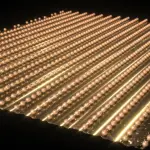
Researchers at the Ningbo Institute of Materials Technology and Engineering (NIMTE) of the Chinese Academy of Sciences (CAS) report achieving 18.8% power conversion efficiency on large-area (15.6 cm²) organic solar modules, a record for active-area performance in this technology. The team stabilized interfaces between electrodes and hole-transport layers using an InCl x interlayer, a key component of their newly developed approach. This approach triggers ligand exchange, forming a multidentate In-O-P coordination network that anchors self-assembled monolayers and prevents degradation under light and heat.
Large-Area Modules Achieve 18.8% Power Conversion Efficiency
This scaling success followed initial results with small-area OSCs, which demonstrated 20.4% power conversion efficiency before expanding to the larger format. This strategy centers on a vacuum-deposited InCl x interlayer that facilitates ligand exchange, creating a multidentate In-O-P coordination network. This network firmly anchors self-assembled monolayers, preventing their desorption under prolonged exposure to light and heat, a common limitation in organic solar cell technology.
According to corresponding author Prof. LIU Quan, “We scaled the technique to large-area modules with an aperture area of 15.6 cm², reaching a record active-area PCE of 18.8%.” The robust interface created by this method is intended to address the longstanding challenge of maintaining both efficiency and stability in large-scale organic solar applications. Operational stability testing revealed the modules retained over 85% of their initial efficiency after 2,000 hours of continuous operation at 25 °C under maximum power point tracking.
This performance suggests the molecular locking strategy offers a pathway toward commercially viable organic solar technology by overcoming the traditional trade-off between efficiency, stability and scalability. The researchers propose this interface platform has broad applicability, potentially enabling efficient and scalable organic photovoltaic modules for widespread use.
We scaled the technique to large-area modules with an aperture area of 15.6 cm 2, reaching a record active-area PCE of 18.8%.
Prof. LIU Quan, corresponding author of the study




See today’s quantum computing news on Quantum Zeitgeist for the latest breakthroughs in qubits, hardware, algorithms, and industry deals.