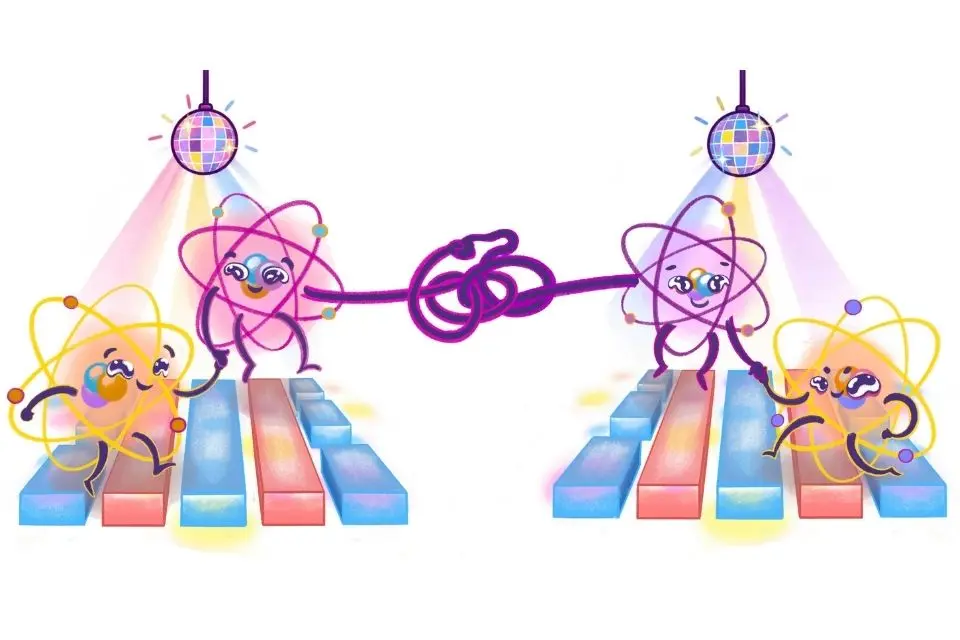
Physicists at the University of Oxford have demonstrated entanglement between strontium and calcium atoms across a quantum network, a step towards linking diverse quantum processors. The team created shared quantum states involving up to four atoms and then extended the entanglement’s lifetime to over 10 seconds using calcium atoms, a duration that could be important for practical applications.
“Different types of atoms offer different advantages and disadvantages for quantum applications,” says lead author Dr Dougal Main. “Having more than one type in your quantum computer lets you take the best from each.” This combination of multi-atom entanglement and extended preservation promises to support future quantum computing, sensing and timekeeping technologies.
Strontium-Calcium Entanglement Demonstrates Inter-Species Quantum Linking
This achievement moves beyond simply creating entanglement; the researchers demonstrated control over entanglement between different atomic species, an important step toward building more versatile quantum technologies. Dr. Calcium’s quantum states exhibit reduced sensitivity to magnetic-field noise compared to strontium, a characteristic that enabled the preservation of entanglement for over 10 seconds. This represents an improvement over the milliseconds typically achieved with strontium alone, and addresses a key challenge in maintaining quantum information long enough for complex operations.
The researchers extended its lifetime from milliseconds to more than 10 seconds. It allows for applications requiring sustained quantum connections between multiple atoms. Co-author Dr. Gabriel Araneda notes that this could support “quantum computing, more sensitive measurements made across remote locations, and comparisons between different types of atomic clocks.” The ability to preserve entanglement for this duration is critical for coordinating operations between separate quantum processors, effectively creating a distributed quantum computer.
The research, published in Physical Review Letters, details how the team combined the ability to entangle multiple atoms of differing elements with the extended preservation timeframe. The successful demonstration of this technique has implications beyond computation, potentially enabling more precise sensing and timekeeping technologies.
By using the unique properties of both strontium and calcium, the researchers have laid the groundwork for future quantum networks capable of connecting diverse processors and supporting a wider range of applications. The team’s work, detailed in Multipartite mixed-species entanglement over a quantum network, marks an advancement in the field of quantum networking and distributed quantum information processing.
Source: https://www.physics.ox.ac.uk/news/quantum-network-entangles-several-atoms-different-elements



See today’s quantum computing news on Quantum Zeitgeist for the latest breakthroughs in qubits, hardware, algorithms, and industry deals.