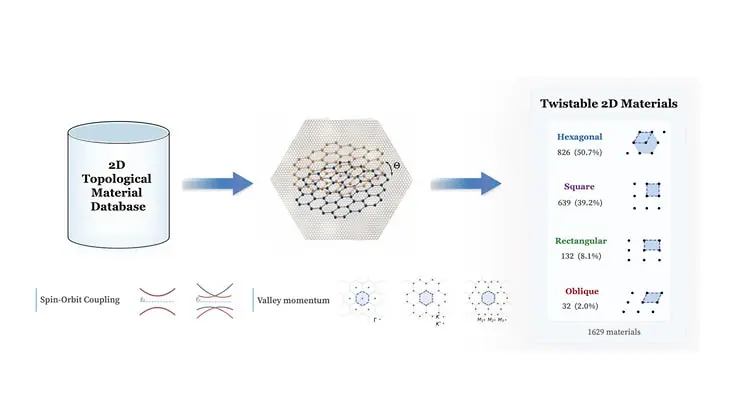
Researchers from Princeton University and the Max Planck Institute for Structure and Dynamics of Matter have compiled a catalog of 8,872 two-dimensional materials, dramatically expanding the search beyond graphene and transition metal dichalcogenides for use in twistronics research. The team’s work, published in two back-to-back papers in Science, also identifies 1,568 insulating and 61 semimetal candidates particularly well-suited for creating new quantum simulators.
“Twistronics has so far been built on a handful of materials that happened to work,” says Angel Rubio, Director of the MPSD Theory Department, “Together, these two efforts give the field a systematic way to identify the next ones.” This curated database offers a materials roadmap for exploring quantum states beyond those achievable with current platforms.
Twistronics Expanded: Mapping 8,872 Two-Dimensional Material Structures
This systematic cataloging of electronic structures and topologies represents a departure from relying on materials that happened to work. The database prioritizes layers with electronic structures simple enough to model the behavior of their twisted forms using continuum models, streamlining the search for viable quantum simulators. A hafnium disulfide homobilayer, created using these materials, is currently undergoing study with scanning tunneling microscopy at millikelvin temperatures, demonstrating the immediate applicability of the database.

The research shifts materials discovery from serendipity to a targeted approach, enabling researchers to design quantum systems with properties not found in individual layers. “When we described moiré heterostructures as quantum simulators, the central idea was that twisting could give us access to many controllable models of interacting electrons, far beyond the few systems known at the time.
This catalog turns that vision into a practical materials roadmap: it tells us where to look next and opens the door to lattices and quantum phases that established moiré platforms may not be able to realize,” explains an author. “The monolayer catalog provides a solid starting point for identifying which layers are worth twisting, and in the computed twisted bilayers, many interesting features such as topological and flat bands are observed,” the team reports.
“What is especially exciting is that this database turns materials discovery into an experimental roadmap. By controlling the choice of material, twist angle and electron density, we can design quantum systems with properties that do not exist in the individual layers.” Exploring these new platforms may reveal correlated and topological states that have so far remained out of reach.
Twistronics has so far been built on a handful of materials that happened to work. Together, these two efforts give the field a systematic way to identify the next ones.
Angel Rubio, Director of the MPSD Theory Department
“Theoretically Twistable” Materials Identified via High-Throughput Algorithm
Identifying 61 semimetal and 1,568 insulating candidates, the team’s algorithm determined these materials possess electronic structures simple enough to model when layered and twisted. This criterion excludes materials with complex band arrangements, streamlining the search for viable moiré structures and moving beyond reliance on serendipitous discovery. The resulting catalog prioritizes layers where the physics of twisted versions can be predicted using simplified continuum models, allowing for the design of predictable quantum systems.
These newly identified materials expand the possibilities for twistronics research, which currently relies on a limited selection of materials. The catalog details the electronic band structures of each layer, both with and without topological characteristics, providing a comprehensive resource for researchers worldwide. This library of building blocks allows scientists to compare structures and select candidates tailored to specific physical phenomena they wish to investigate.
The team’s work, published in Science, makes the electronic structures publicly available, encouraging collaboration and accelerating the pace of discovery, MPSD Theory Department says. The database represents a shift in approach, moving away from trial-and-error toward a targeted, computational strategy. The catalog’s focus on theoretically twistable materials addresses a key limitation in the field, as modeling complex band structures hinders the design of predictable quantum simulators. The team’s high-throughput algorithm efficiently screened nearly 9,000 atomically thin structures, establishing a roadmap for future experimental work and potentially unlocking a new era of quantum device development.
When we described moiré heterostructures as quantum simulators, the central idea was that twisting could give us access to many controllable models of interacting electrons, far beyond the few systems known at the time. This catalog turns that vision into a practical materials roadmap: it tells us where to look next and opens the door to lattices and quantum phases that established moiré platforms may not be able to realize.
Dante M. Kennes (RWTH Aachen University and MPSD)
This catalog prioritizes materials where modeling the effects of twisting is computationally feasible, excluding those with complex band arrangements that would hinder accurate predictions. This process yielded 61 semimetal candidates, representing a substantial increase over the limited number of materials previously explored.
Some of these candidates are already crystals we can grow and peel down to a single layer. That gives experiments a concrete starting point for making new twisted structures and testing the physics predicted for them.
Kin Fai Mak, director at MPSD
Experimental Validation: Crystal Growth & Initial Twisted Bilayer Testing
Initial crystal growth and exfoliation have confirmed the viability of several candidates identified within the 8,872 two-dimensional materials cataloged in the recent work, moving beyond theoretical prediction toward functional devices. Researchers have successfully peeled several of these materials down to single atomic layers, a critical step for fabricating twisted heterostructures and testing predicted quantum behaviors. The team’s focus extends beyond simply creating twisted bilayers; they are actively tuning both the twist angle and electron density within these structures to observe the emergence of collective quantum states.
Ji Shan, MPSD Director, emphasizes that the database transforms materials discovery into a directed experimental roadmap, allowing researchers to design quantum systems with tailored properties. By controlling material selection, twist angle and electron density, the potential exists to create systems exhibiting behaviors not found in the individual, untwisted layers.
The theoretical work underpinning this experimental phase has already yielded a companion database, the Twisted Bilayer Moiré Superlattice Database (TBMSD), containing structures and electronic properties of over 600 computed twisted bilayers. Lede Xian notes that the monolayer catalog is a strong foundation for identifying promising materials for twisting, and that initial computations of these twisted bilayers reveal intriguing features like topological and flat bands.
What is especially exciting is that this database turns materials discovery into an experimental roadmap. By controlling the choice of material, twist angle and electron density, we can design quantum systems with properties that do not exist in the individual layers. Exploring these new platforms may reveal correlated and topological states that have so far remained out of reach.
Ji Shan, Director at MPSD




See today’s quantum computing news on Quantum Zeitgeist for the latest breakthroughs in qubits, hardware, algorithms, and industry deals.