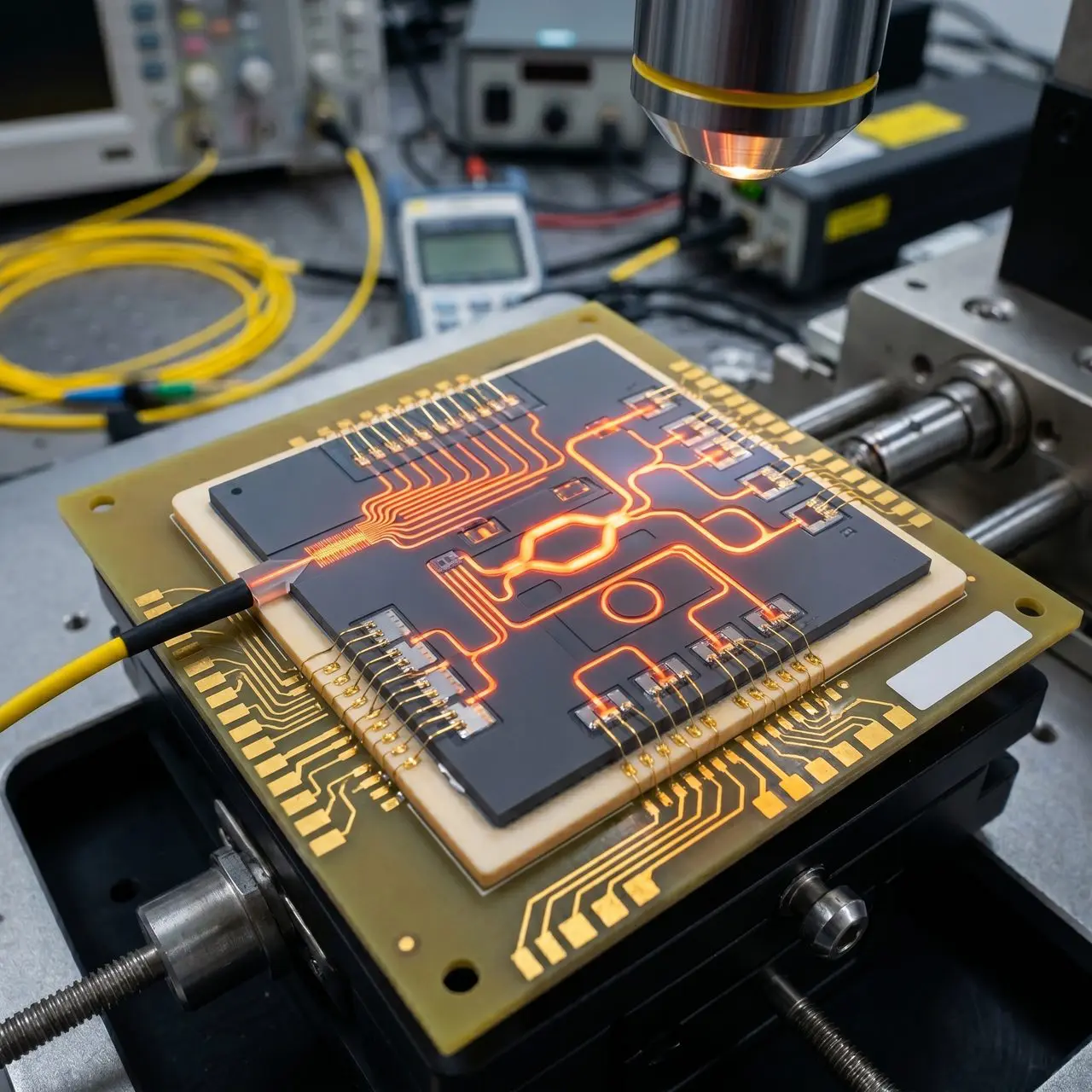
Researchers have experimentally reported 1,300-km transmission using a three-mode fibre, directly optimizing the spatial division multiplexed channel with programmable photonic processors. This approach shifts away from solely relying on digital equalization at the receiver, reducing the computational load needed for long-haul data transmission.
The work demonstrates a telecom-grade programmable photonic unitary processor with high-fidelity operation, achieving R² greater than 96% across the C band, and establishes a scalable framework for integrating photonic computation into optical networks. The results offer a path toward more efficient, high-capacity systems needed to meet the demands of growing global data traffic.
Programmable Photonics Address Data Capacity Limits
Parameterized spatial division multiplexed transmission uses programmable photonic unitary processors installed at nodes along long-haul fibre networks, directly addressing challenges posed by modal dispersion. Researchers detailed the use of silicon-based multiplexers with insertion losses below 1.8 dB for all modes.
The optimized photonic processor substantially reduces modal dispersion and post-processing complexity. “Instead of relying on conventional digital equalization on only the receiver side, our approach enables direct optimization of the SDM transmission channel itself by the programmable unitary processor, which reduces digital post-processing loads,” the researchers explain. This direct optimization is a departure from conventional methods and promises significant gains in energy efficiency for future optical communication systems. The technology also draws on advances in all-optical MIMO demultiplexing using silicon-photonic dual-polarization optical unitary processors.
Spatial Division Multiplexing Overcomes Single-Mode Fibre Constraints
Installing programmable photonic processors at intermediate points along optical fibre networks directly addresses the challenges of long-distance spatial division multiplexing, moving beyond reliance on receiver-side digital signal processing. Fibre attenuation in the implemented fibre remained below 0.228 dB/km for all guided modes, ensuring minimal signal loss during transmission. Silicon-based multiplexers used in the system exhibited insertion losses below 1.8 dB, with mode-to-mode loss differences of up to 0.4 dB, indicating efficient signal coupling and minimal disruption of individual spatial channels.
Modal crosstalk was characterized at better than 18 dB, further minimizing interference between modes and preserving signal integrity. This level of performance is critical for maintaining data integrity over vast distances, ensuring minimal errors and consistent connectivity.
Modal Dispersion Challenges Long-Haul SDM Transmission
Programmable photonic unitary processors installed mid-span directly address modal dispersion, a key obstacle to extending spatial division multiplexing beyond current limitations. Traditional methods of compensating for this distortion scale computationally as O(N²L), where N represents the number of modes and L is the time dispersion window, a complexity that quickly becomes unmanageable for long-haul systems with L reaching hundreds of nanoseconds. The system employs a differentiable transmission model, allowing for gradient-based optimization of the unitary processor parameters to minimize modal dispersion.
Researchers calculate the differential ∂F to refine the photonic unitary processor, then transfer the optimal matrix (U opt, k) to the physical circuit at each transmission span, denoted ‘k’. This iterative optimization process, performed within a digital twin of the system, represents a departure from fixed mode-scrambling or permutation techniques previously explored, offering increased flexibility and adaptability.
This method’s effectiveness stems from its ability to directly manipulate the optical signal, rather than solely attempting to correct for distortions after transmission. The work builds on prior studies in silicon photonics and integrated photonic processors, including advancements in all-optical MIMO demultiplexing and determining optimal communication channels, as detailed in publications from SPIE PC13118 and Nanophotonics in 2025.
Differentiable SDM Model Enables Gradient-Based Optimization
Programmable photonic unitary processors, installed at each spatial division multiplexing transmission node, move beyond simply compensating for modal dispersion at the receiver; instead, they directly configure the optical channel itself to optimize signal delivery. Experimental validation confirms the effectiveness of this optimization framework, with simulated and measured data demonstrating strong agreement. Analysis of the potential landscape for modal dispersion showed distinct optimization trajectories for various initial states, as depicted in the research, and training curves revealed consistent reduction in modal dispersion for both simulations and physical experiments.
This method represents a shift from conventional analogue multiple-input multiple-output (MIMO) techniques limited to transmitter or receiver sides, and it bypasses reliance on extensive digital signal processing. “Unlike conventional optical SDM transmission, where modal dispersion is mitigated solely by digital MIMO processing at the receiver, our approach directly optimizes the optical channel itself by configuring the installed photonic unitary circuit,” the researchers explain, highlighting the core innovation.
The framework’s success hinges on the backpropagation algorithm used to estimate the gradient ∂L / ∂ξ, allowing for precise adjustment of trainable phase parameters within the photonic unitary processors, and paving the way for more efficient long-haul data transmission.
Telecom-Grade Photonic Unitary Processor Implementation
A telecom-grade programmable photonic unitary processor achieved 1,300-kilometer transmission using a three-mode fibre, demonstrating a substantial increase in the reach of spatial division multiplexing technology and overcoming previous limitations imposed by modal dispersion. The system’s high-fidelity operation, characterized by an R² value exceeding 96% across the full C band, indicates a marked improvement in signal quality and reliability for long-haul data transmission, essential for future network capacity.
This performance was attained through a gradient-based optimization algorithm utilizing a differentiable spatial division multiplexing transmission model to determine the optimal unitary transformation for signal processing. Fabrication of the photonic unitary processor yielded a fibre-to-fibre insertion loss of 2.1 dB, with minimal sensitivity to both wavelength and spatial ports, a result detailed in supplementary information. While deterministic calibration initially addressed systematic errors, machine learning-based calibration further refined performance by inferring unknown parameters from datasets generated during random matrix implementation.
Numerical simulations explored extending the approach to scenarios with varying unitary matrices across transmission spans, finding it efficient for practical situations where span lengths or fibre characteristics differ, suggesting adaptability for diverse network configurations. Energy consumption remains a practical consideration for widespread deployment; the current implementation utilizes a Clements mesh requiring N(N-1)/2 Mach-Zehnder interferometers with two tunable parameters each, plus N output phases, resulting in N² independently biased parameters. Each thermo-optic heater phase shifter requires approximately 0.2 watts to induce a π phase shift, denoted as Pπ.
Low-Loss, Wideband Operation Achieved with MZI Processor
A telecom-grade photonic processor fabricated on a silica-based planar lightwave circuit platform achieved 2.1 dB of fibre-to-fibre insertion loss, demonstrating a substantial reduction in signal attenuation for long-distance data transmission. This processor operates across the full C band, supporting wideband communication, and maintains polarization independence, important for reliable signal propagation through optical fibres. High-fidelity operation, exceeding 96% across the C band, further validates the processor’s performance in demanding telecommunications environments.
The optimized photonic processor directly addresses the challenge of modal dispersion, a key limitation in spatial division multiplexing systems, and simultaneously minimizes the computational burden typically required for post-processing. These components work in concert to create a system capable of supporting both wavelength division multiplexing and polarization division multiplexing alongside spatial division multiplexing.
The experimental result of a 1,300-km transmission was achieved using a three-mode fibre. Simulations and experimental data aligned, revealing substantial suppression of intermodal dispersion, from approximately 25 ns to 10 ns, across all wavelengths, confirming the wideband and high-fidelity operation of the fabricated processor, as demonstrated by the optimized transformations.
1,300-km Transmission Demonstrated in Three-Mode Fibre
The experimental setup utilized a multi-mode fibre spanning 51.2 kilometers, supporting transmission across three distinct modes, one fundamental and two degenerate, to investigate transmission characteristics over varying distances achieved through recirculations within the fibre loop. Silica-waveguide-based multiplexers facilitated the fan-in and fan-out of spatial channels, exhibiting insertion losses below 1.8 dB with mode-dependent loss remaining below 0.4 dB, ensuring minimal signal degradation during spatial channel management.
Total insertion loss per span, accounting for multiplexers, the photonic processor, and the fibre itself, reached an estimated 5.7 dB, a figure subsequently compensated for by erbium-doped fibre amplifiers. The system’s ability to manage signal loss across extended distances was further validated by quantitative analysis of total modal dispersion using a required MIMO equalizer window, a detailed explanation of which is available in the associated methods documentation.
Researchers tested span-independent unitary matrices for the three-mode fibre transmission, enabling investigation of performance across different transmission spans and demonstrating the system’s adaptability to varying network configurations. The fibre’s low attenuation, below 0.228 dB/km for all guided modes, contributed to the overall feasibility of long-haul transmission.
The experimental setup enabled a detailed examination of transmission characteristics with varying numbers of recirculations within the multi-mode fibre loop, allowing for precise control and analysis of signal propagation. “Despite the promise of optical-domain MIMO-assisted processing, demonstrations of photonic-assisted MIMO equalization for long-haul fibre transmission are lacking,” the paper notes, highlighting the significance of this demonstration in bridging a critical gap in long-distance data communication technology.
The implemented system leverages a differentiable spatial model to determine optimal unitary transformations, enabling precise control over signal propagation within the three-mode fibre. Unlike fixed mode-scrambling or mode-permutation techniques, the implemented system’s flexibility and adaptability allow for end-to-end optimization of physical transmission characteristics.
Scalable Framework Integrates Photonics into Optical Networks
Programmable photonic processing now extends to long-haul optical networks, with a newly implemented system achieving 1,300-km transmission using a three-mode fibre. The processor’s performance directly optimizes the transmission channel, a departure from systems that rely solely on digital equalization at the receiver. Researchers report the total insertion loss, including input/output buffers and the processor itself, reached 5.7 dB per span, a level readily compensated for by standard optical amplifiers alongside typical fibre transmission loss.
This demonstrates practical viability and validates the effectiveness of the approach in real-world network conditions. Simulation and experimental results align closely, confirming the strategy’s potential for scalable integration of photonic computation into optical layers. This work builds on earlier demonstrations of photonic processing for very-short-reach multimode fibre and free-space optical links, suggesting a broader trend toward optical-domain signal manipulation to lessen computational loads.




See today’s quantum computing news on Quantum Zeitgeist for the latest breakthroughs in qubits, hardware, algorithms, and industry deals.