PHIX Photonics Assembly and SENKO Advanced Components are establishing a standardized, detachable fiber connection for photonic multi-chip modules, a move designed to ease manufacturing challenges and improve long-term serviceability. This collaboration positions PHIX in Enschede, Netherlands, as a European Centre of Excellence for this emerging technology, which supports scaling artificial intelligence infrastructure and high-performance computing.
“The industry needs solutions that connect precision assembly, package-level testing, system integration, and long-term serviceability,” says a Vice President at SENKO. By combining PHIX’s packaging expertise with SENKO’s Micro Prism Array technology and 6DoF alignment processes, the companies aim to create a repeatable optical interface throughout a product’s lifecycle.
SENKO’s Micro Prism Array & SAM-T Enable Repeatable Optical Interfaces
SENKO’s Micro Prism Array technology directly addresses a critical challenge in photonic module manufacturing: maintaining consistent optical performance throughout the product lifecycle. This new architecture utilizes detachable fiber connectivity, a departure from traditional permanently attached interfaces, and allows for repeatable alignment during assembly, package-level validation, and system integration. The system uses SENKO’s SEAT receptacles and SAM-T, or SENKO Alignment Master-Testing, alongside precision 6DoF alignment processes to establish a common optical reference point throughout the supply chain.
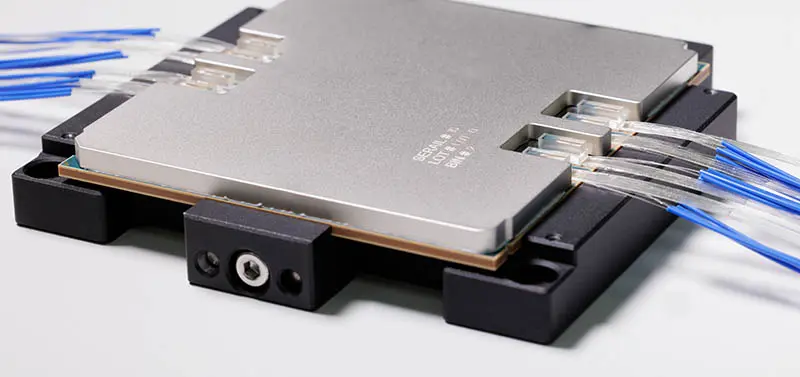
This collaborative effort between SENKO and PHIX Photonics Assembly isn’t simply about improving manufacturing consistency; it’s about enabling future serviceability, the company says. By separating photonic packaging from permanent fiber attachment, the design facilitates inspection, diagnostics, and component replacement without requiring a complete optical assembly redesign.
This approach is particularly relevant as optical engines move closer to application-specific integrated circuits, or ASICs, where maintaining operational flexibility is paramount. “As optical engines move closer to the ASIC, the industry should keep the operational flexibility that made pluggable optical transceivers so successful,” said a company representative.
“By combining advanced photonics packaging with a repeatable, detachable optical interface, this collaboration helps bridge the gap between CPO performance requirements and the practical needs of testing, maintenance, and long-term serviceability.” PHIX, headquartered in Enschede, Netherlands, contributes to realizing this architecture through its expertise in advanced photonics packaging, according to SENKO. PHIX’s Characterization Package is already utilized in a photonic quantum processor, demonstrating the practical application of its packaging capabilities. The company’s involvement in EU projects like LOLIPOP, POLYNICES, PATTERN, and photonixFAB further underscores its commitment to advancing photonic manufacturing technologies and establishing scalable approaches for multi-chip modules.
The industry needs solutions that connect precision assembly, package-level testing, system integration, and long-term serviceability. By working with PHIX, we are helping establish a common optical interface that supports the complete lifecycle of photonic multi-chip modules.
PHIX Establishes European Center for Detachable Fiber Assembly & PIC Packaging
PHIX Photonics Assembly’s newly established role as a European Centre of Excellence focuses on a critical, previously unaddressed aspect of photonic module manufacturing: standardized, detachable fiber connections. This specialization goes beyond simply assembling photonic integrated circuits, concentrating instead on the interface between those circuits and external fiber optics, a distinction vital for scaling production. SENKO Advanced Components’ Micro Prism Array technology forms the core of this connection, enabling precise alignment and repeatable performance throughout a device’s lifespan, the firm reports.
The collaborative framework between SENKO and PHIX delivers a system where optical components undergo alignment during assembly, validation at the package level, and verification during system integration, all using the same detachable interface. This contrasts sharply with traditional methods requiring permanent fiber attachment, which complicates diagnostics and repair. The use of SENKO’s SEAT receptacles and SAM-T further refines this process, providing a standardized method for connecting and testing modules.
Founded in 2018 and headquartered in Enschede, PHIX has rapidly become a key player in advanced photonics packaging, with its Characterization Package already integrated into a photonic quantum processor from QuiX Quantum. Jeroen Duis, PHIX’s Chief Technology Officer, explains that by decoupling packaging from fiber attachment, the architecture allows for inspection, diagnostics, replacement, and maintenance without necessitating a complete redesign. Visitors to ECOC 2026 can explore this technology firsthand at the SENKO (booth #1005) and PHIX (booth #1051) exhibits.
As optical engines move closer to the ASIC, the industry should keep the operational flexibility that made pluggable optical transceivers so successful. By combining advanced photonics packaging with a repeatable, detachable optical interface, this collaboration helps bridge the gap between CPO performance requirements and the practical needs of testing, maintenance, and long-term serviceability.




See today’s quantum computing news on Quantum Zeitgeist for the latest breakthroughs in qubits, hardware, algorithms, and industry deals.