Quantum computer errors can now be flagged by monitoring the behavior of auxiliary qubits, temporary workspace qubits expected to return to a defined state. Researchers tested this method using Classiq’s platform and have demonstrated a method of identifying calculation failures by verifying these qubits reset to |0⟩ after each use, serving as a clear indicator of errors, the company says.
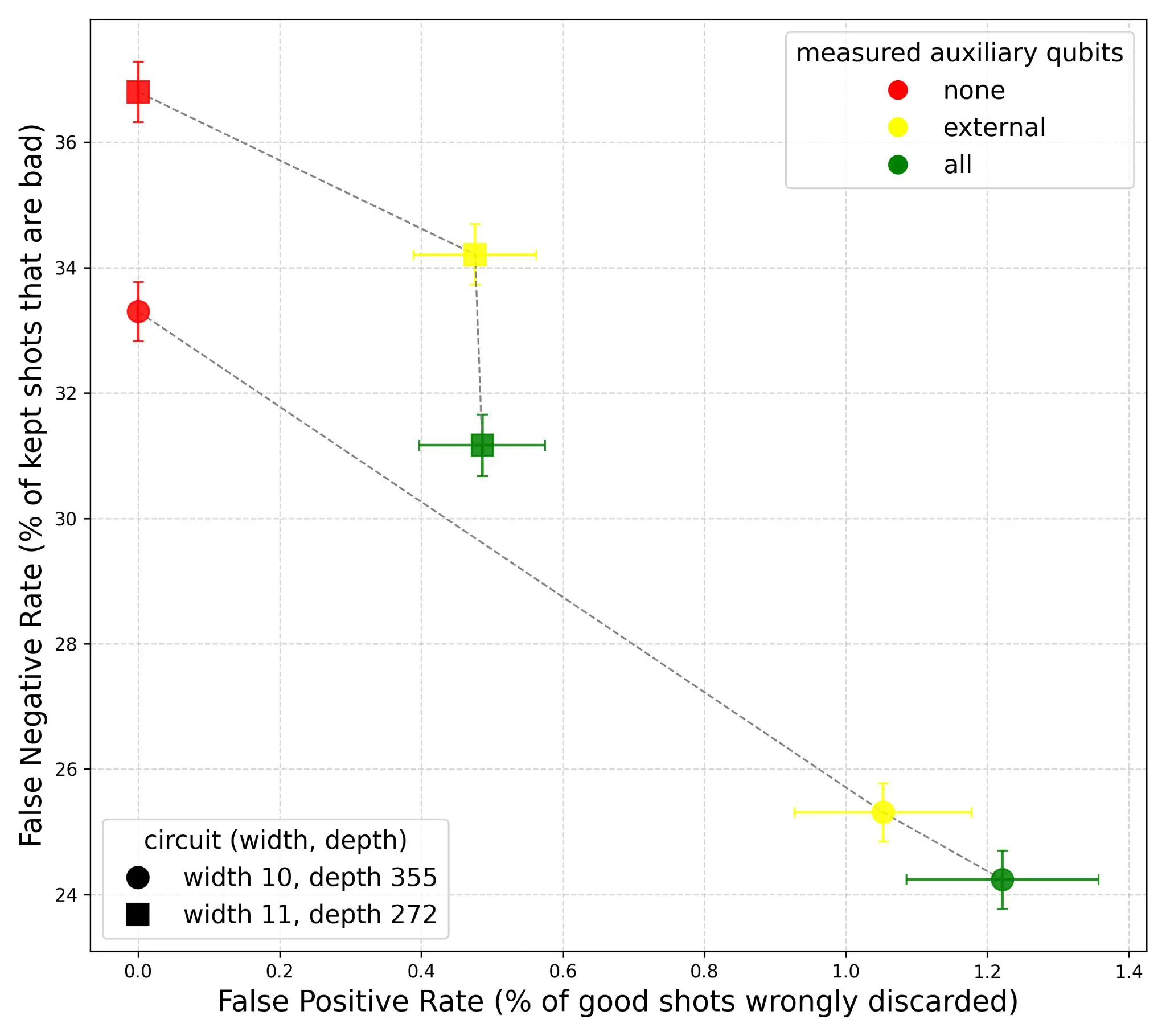
By filtering results based on auxiliary qubit behavior, the team reduced false negatives by approximately 10 percent, improving output fidelity with a minimal increase in false positives. This post-selection strategy offers a practical, low-cost approach to error mitigation for near-term quantum devices.
Auxiliary Qubit Monitoring Identifies Errors in Quantum Circuits
Classiq’s quantum software platform enables the identification of calculation failures by monitoring whether auxiliary qubits return to their initial state, a critical indicator of error within a quantum circuit. The company’s approach focuses on qubits 1 and 2, specifically reused across both the “assign” and its inverse functional blocks within a quantum program. This design choice, while efficient, introduces potential vulnerabilities to noise and decoherence.
This reuse necessitates careful monitoring to ensure the qubits are properly reset before being utilized in subsequent calculations. The system flags errors when these auxiliary qubits do not return to the |0⟩ state, providing a measurable signal beyond general noise descriptions. This concrete indicator allows for the discarding of results from erroneous runs, improving data quality and fidelity.
Classiq’s platform can systematically identify expected reset points, streamlining the identification of these points and simplifying the implementation of these auxiliary checks compared to manual circuit inspection, according to the company. This automated tracking is a key feature, allowing for systematic error detection without extensive manual effort. Classiq tested this methodology by generating two implementations of a simple arithmetic function accessible through its platform. The company’s software automatically creates circuits with varying width and depth, manipulating auxiliary allocation to assess the impact of reuse on error rates.
By pinpointing expected reset points, Classiq’s system facilitates a near-effortless approach to auxiliary qubit monitoring. The resulting circuits demonstrate a reduction of false negatives by approximately 10 percent, while increasing false positives by only about 1 percent. This balance between reducing false negatives and accepting a modest increase in false positives represents a significant optimization for near-term quantum applications.
The ability to immediately reset a calculation upon detecting an auxiliary qubit error, enabled by mid-circuit measurements, further optimizes processing time by preventing the completion of corrupted runs. Classiq’s work builds on a foundation of model-based quantum software, a design philosophy that allows users to define algorithms at a high level before mapping them onto specific quantum hardware, the firm reports. Founded in 2020 and headquartered in Tel Aviv, Israel, the company has raised over $200 million.
Classiq’s collaboration with C12 addresses the need for scalable quantum hardware and software, while a trial with Comcast and AMD completed a trial demonstrating quantum algorithms can enhance network routing resilience. The company’s recent unveiling of a quantum agent capable of translating natural language into executable programs underscores its ambition to democratize access to quantum computing. This practical, low-cost tool for error mitigation offers a valuable addition to the toolkit for near-term quantum computing, providing a means to improve data quality and reduce bias without requiring full-scale fault tolerance.
Classiq Platform Automates Auxiliary Reset Point Tracking
The system’s ability to pinpoint these points surpasses manual circuit inspection, offering a significant advantage for developers. The approach centers on a post-selection strategy, where results are filtered by discarding data from runs where auxiliary qubits deviate from their expected |0⟩ state. This optimization potentially reduces overall processing time by avoiding the completion of corrupted runs, a benefit demonstrated with circuits generated by the platform.
In a recent test, the team observed that qubits one and two within a model served as auxiliaries, being reused across both assignment and inverse functional blocks, highlighting a design choice susceptible to error if not carefully monitored. By varying auxiliary allocation, the platform created circuits with differing widths and depths, allowing for a comprehensive evaluation of the error mitigation technique. False negatives, representing undetected errors that corrupt results, are generally more detrimental to overall fidelity than false positives, which simply discard valid data.
The ability to automatically track qubit reuse and lifetime is a key differentiator. Better data quality (fidelity) and faster runtimes can be achieved through this strategy.
This practical, low-cost error mitigation technique is particularly valuable for near-term quantum computing, where fully fault-tolerant error correction remains a distant goal. While it won’t eliminate all errors or bias, the trade-off of discarding a small number of valid results for cleaner data can significantly improve the reliability of quantum applications. As Gilad Kishony, Avi Elazari, Ron Cohen, and Lior Gazit explain, the system offers flexibility in how aggressively it is applied, allowing developers to tailor the error mitigation strategy to their specific needs and priorities.
Source: https://www.classiq.io/insights/auxiliary-qubit-error-mitigation