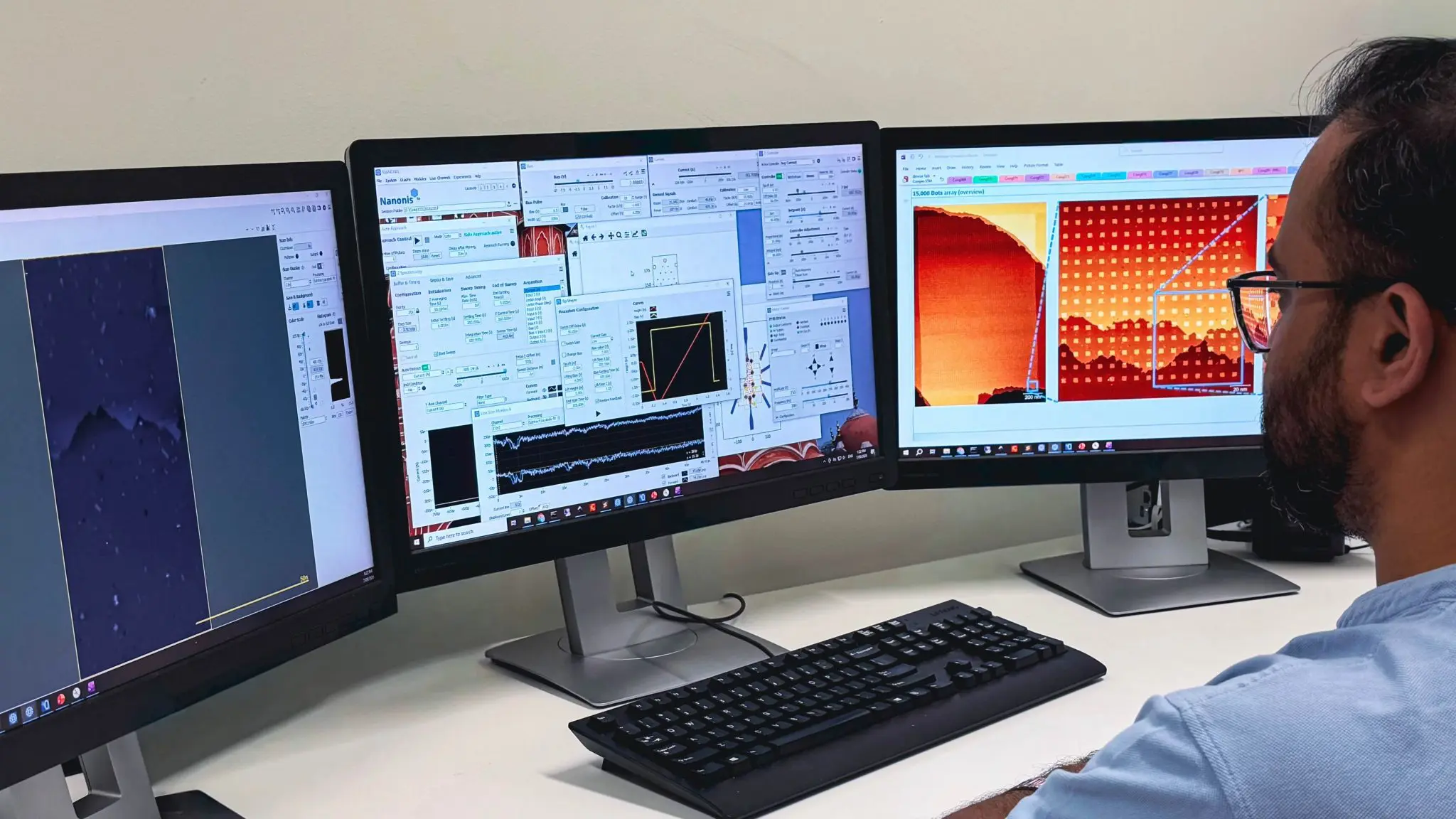
SQC has reduced the time needed to pattern its Watermelon quantum-enhanced AI chips from hours to minutes through the deployment of custom machine learning scripts, the company says. The company’s Precision Atom Qubit Manufacturing process, PAQMan, achieves 0.13 nanometer accuracy when placing phosphorous atoms in silicon, a scale 100 times smaller than the best classical processes.
This automation, built around specially adapted Scanning Tunneling Microscopes, has already delivered success in patterning and enables SQC’s one-week chip iteration cycle. “Atomic precision becoming a routine, automated manufacturing step is what moves quantum computing from exotic to industrial,” says SQC, demonstrating a practical step toward scalable quantum computing.
Machine Learning Scripts Automate Watermelon Chip Patterning
These scripts operate within Quokka, SQC’s proprietary atomic fabrication control software, generating precise command sequences for the company’s Scanning Tunneling Microscopes (STMs). This automation significantly accelerates a process previously reliant on manual intervention by skilled atomic fabrication scientists. The advance builds upon SQC’s 25 years of experience refining its Precision Atom Qubit Manufacturing process, PAQMan, which achieves 0.13 nanometer accuracy when positioning phosphorous atoms within silicon, according to the company.
This level of precision, a hundredfold improvement over the best classical semiconductor manufacturing techniques, is now further enhanced by machine learning’s ability to rapidly translate design changes into physical chip layouts. The company’s one-week chip iteration cycle, already a competitive advantage, is now even more responsive, allowing for faster optimisation of the Watermelon processor for its target markets.
The deployment of these scripts is not simply about speed; it’s about unlocking design possibilities. According to SQC, “When device patterning is fast, repeatable and automated, changes to a device design are no longer limited by time, or what can be achieved by hand.” This capability has already been demonstrated through the successful patterning of hundreds of thousands of quantum dots, freeing the team to explore more complex and ambitious device architectures.
SQC is currently extending this machine learning-enabled patterning to its gate-based quantum processing units, the firm reports. The company envisions a future where atomic precision is not an exceptional achievement, but a routine step in manufacturing, and the success with Watermelon demonstrates this vision in practice, establishing a pathway toward scalable and efficient quantum computer production.




See today’s quantum computing news on Quantum Zeitgeist for the latest breakthroughs in qubits, hardware, algorithms, and industry deals.