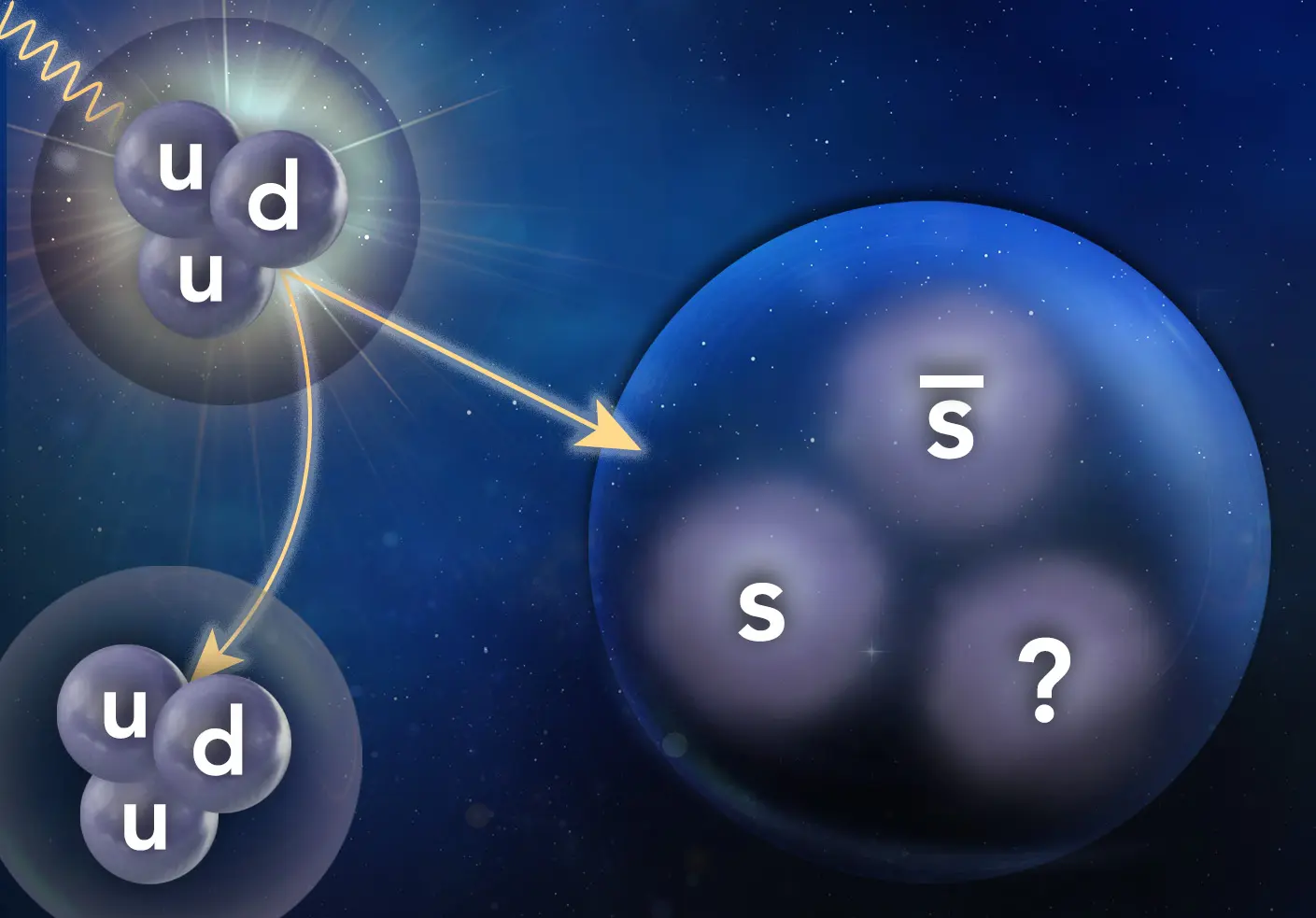
A beam of high-energy photons interacting with a proton target at the U.S. Department of Energy’s Thomas Jefferson National Accelerator Facility has unexpectedly revealed evidence of two new structures, despite researchers initially searching for a confirmed XYZ candidate. The results from the Gluonic Excitations (GlueX) Collaboration, recently published in Physical Review Letters, suggest these structures could help clarify the perplexing family of XYZ states that don’t fit neatly into the established model of particle physics.
“We went searching for a confirmed XYZ candidate with a photon beam but instead found two other structures,” said Malte Albrecht, a staff scientist at Jefferson Lab. These findings may offer insights into the fundamental forces shaping the formation of matter.
Photon Beam Reveals Unexpected Strange Quark Signals
The observation of two previously unseen structures resulting from high-energy photon interactions with protons at Jefferson Lab offers a new avenue for understanding exotic XYZ states, particles containing at least two strange quarks. These signals emerged unexpectedly during an experiment designed to confirm the existence of the Y(2175) particle, a long-sought meson observed in electron-positron collisions but never conclusively produced via photoproduction. The Gluonic Excitations (GlueX) Collaboration’s findings, recently detailed in Physical Review Letters, demonstrate a novel method for probing the composition of these enigmatic particles and challenge existing theoretical models.
Researchers utilized a beam of photons directed at a proton target to induce interactions that could reveal the internal structure of hadrons, composite particles bound by the strong nuclear force. This approach differs from traditional methods relying on colliding beams of particles, offering a complementary perspective on the formation of XYZ states.
The observed structures, characterized by their mass and decay patterns, do not neatly fit within the established quark model, which predicts the properties of hadrons based on their constituent quarks. While up and down quarks are fundamental components of protons and neutrons, the inclusion of heavier strange quarks introduces additional complexities and potential for exotic configurations.
Determining the precise arrangement of these quarks within the observed structures is a key focus of ongoing research. Klaus Goetzen, a physicist at GSI conducting research at Jefferson Lab, noted the difficulty in interpreting the data, stating, “The challenge is that you have many measurements around the world in very different experiments that have to find consensus about what they are seeing.” This underscores the need for collaborative efforts and rigorous analysis to establish the true nature of these new signals.
The Y(2175) particle itself remained elusive in this photoproduction experiment. “One of the interesting things about this result is that we didn’t observe Y(2175) at the place we were searching,” Albrecht added, suggesting that the production mechanisms for this particular state may be more complex than previously assumed. The absence of Y(2175) further emphasizes the significance of the newly discovered structures, which offer a different pathway for exploring the strange quark sector.
The team is now investigating whether gluonic excitations, fluctuations in the strong force field binding quarks together, contribute to the observed structures. “That’s one of the investigations, to try to understand whether there is a gluonic contribution to the structure we see,” Albrecht said. These findings are not merely an addition to the catalog of known particles; they represent a potential shift in understanding the fundamental forces governing matter.
The observed signals suggest that the internal dynamics of XYZ states are more intricate than previously imagined, potentially requiring modifications to the Standard Model of particle physics. Theorists are expected to refine their models to accommodate these new observations and predict further experimental signatures.
Goetzen emphasized the iterative nature of this process, stating, “Theorists may come to further conclusions and identify measurements that could help pin down the real nature of these particular states.” The continued analysis of data from the GlueX experiment, combined with theoretical advancements, promises to shed light on the elusive world of XYZ states and the underlying principles that govern their existence. Albrecht concluded, “But now that these have been observed, that doesn’t mean we’re done.”.
We went searching for a confirmed XYZ candidate with a photon beam but instead found two other structures.
Malte Albrecht, a staff scientist at Jefferson Lab
Quark Model & the Rise of XYZ Exotic States
The GlueX experiment at Jefferson Lab has detected signals suggesting the existence of two previously unknown structures containing strange quarks, despite initially aiming to confirm a different, predicted particle. These observations, detailed in recent publications, expand the growing catalog of XYZ states, enigmatic particles that challenge the established quark model. The original quark model, established in 1964 and expanded with the discovery of heavier quark flavors, successfully categorized most hadrons, particles composed of quarks, but the XYZ states defy easy classification.
Frank Nerling, a Jefferson Lab collaborator from Germany’s GSI Helmholtz Centre for Heavy Ion Research and Goethe University Frankfurt, draws a parallel to an earlier period in particle physics: “First, a zoo of hadrons was discovered. Now, we’re facing a zoo of so-called exotic states.” This proliferation of unexpected particles necessitates a refinement of theoretical frameworks to accommodate their existence and internal dynamics. The search for these exotic states is complicated by their fleeting existence and subtle signals.
“It’s more complicated than it sounds, because there are states that are close by in mass and might or might not be the same thing,” Nerling explained. The GlueX experiment, designed to investigate hybrid mesons, particles where excited gluons contribute to the structure, provides a unique environment for probing these complex interactions.
Quantum chromodynamics, the theory governing the strong force, predicts the possibility of such exotic states, but confirming their existence requires meticulous experimentation and analysis. The absence of the initially sought-after Y(2175) particle in this photoproduction experiment further highlights the significance of these unexpected findings. Researchers are now focused on determining the precise quark configurations responsible for these new structures, with a particular emphasis on understanding the role of excited gluonic fields.
The team is also investigating whether these states represent entirely new forms of matter, or simply unusual combinations of known quarks and gluons. With the results validated at a high level of statistical significance, the focus shifts to theoretical physicists to develop new predictions and guide future experiments. “The next step is to figure out which exotic quark configurations nature might have realized here,” Nerling said.
These theoretical refinements will be important for interpreting the experimental data and predicting the properties of other, yet undiscovered, XYZ states. The GlueX collaboration anticipates that these findings will “really open the door for a whole new set of hadron spectroscopy measurements we can make with GlueX,” paving the way for a more complete understanding of the strong force and the fundamental building blocks of matter. The ongoing investigation promises to reshape our understanding of the subatomic world and potentially reveal new physics beyond the Standard Model.
One of the interesting things about this result is that we that we didn’t observe Y(2175) at the place we were searching.
Malte Albrecht, a staff scientist at Jefferson Lab
GlueX Experiment Searches for Hybrid Mesons at Jefferson Lab
The GlueX experiment at Jefferson Lab generated data at a rate fast enough to fill an average laptop’s hard drive every few minutes, showing the intensity of its high-energy photon beam. This beam, created by converting electrons from the Continuous Electron Beam Accelerator Facility, or CEBAF, impacted a liquid hydrogen target, initiating a cascade of particles analyzed by a large-acceptance spectrometer.
Despite initially targeting a specific particle, Y(2175), the GlueX Collaboration uncovered unexpected signals indicating the presence of two previously unknown structures. This discovery occurred while utilizing photoproduction, a method where photons interact with protons, a technique employed to search for the elusive Y(2175) which remains unseen outside of electron-positron annihilation experiments.
Justin Stevens, a William & Mary physics professor and spokesperson for GlueX, described the potential internal composition of these states, saying, “Excited gluonic fields are what could be in these mesons where you have more than just the quark-antiquark pair.” Determining whether gluons contribute to the structure is a key focus of ongoing analysis. “We’ve got much more data to sort through, so this is just the beginning of the story,” he added, indicating that the current observations represent an initial step in a larger investigation.
The implications of these findings extend beyond simply adding to the catalog of known particles. Stevens commented, drawing a parallel to a period of significant advancement in particle physics. The experiment’s success in generating and analyzing such high-intensity photon beams, combined with the unexpected discovery of these new structures, positions Jefferson Lab as a crucial center for future research into the fundamental building blocks of matter.
We are in a new era here, similar to 70-odd years ago.
Frank Nerling, a Jefferson Lab collaborator from Germany’s GSI Helmholtz Centre for Heavy Ion Research and Goethe University Frankfurt
Source: https://www.jlab.org/news/releases/search-strange-quark-sector-reveals-new-particle-possibilities




See today’s quantum computing news on Quantum Zeitgeist for the latest breakthroughs in qubits, hardware, algorithms, and industry deals.