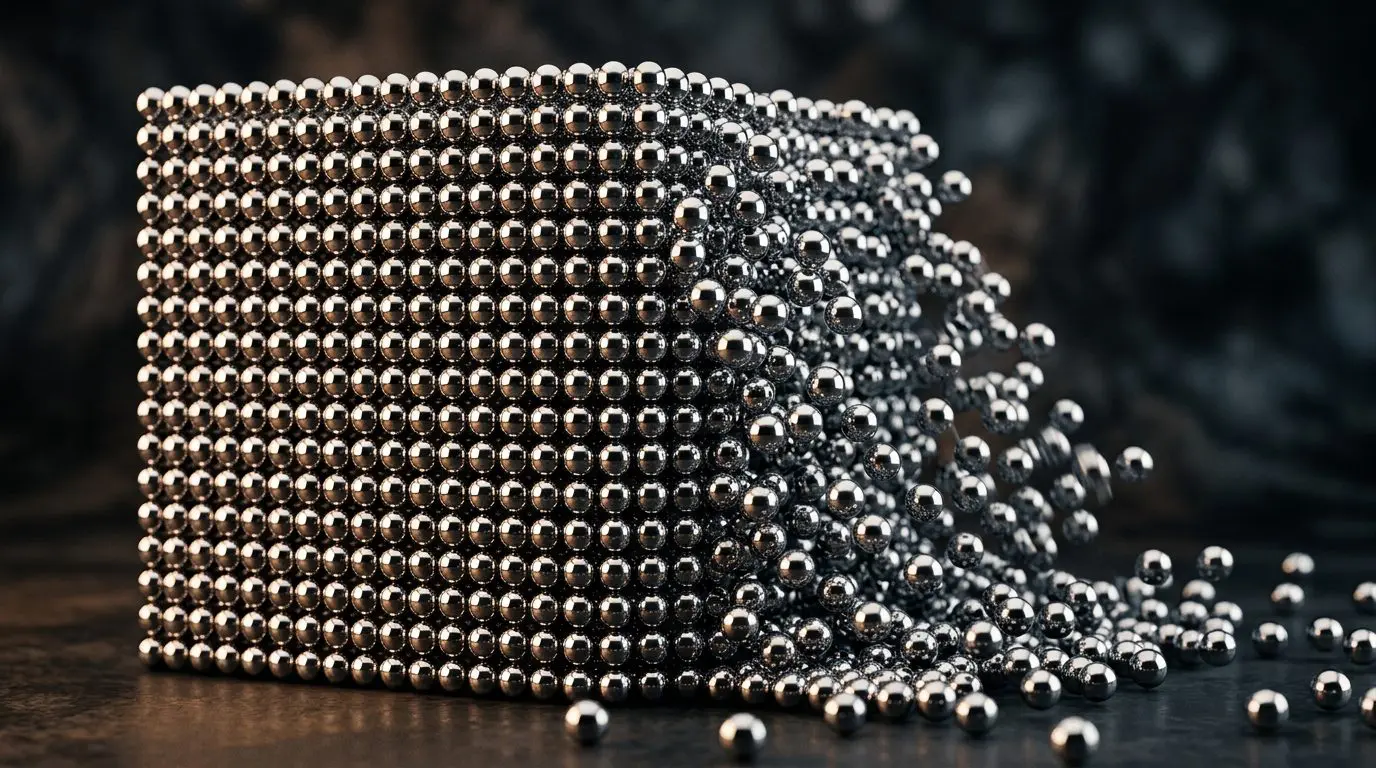
ITMO University researchers have created light-amplifying microresonators using polystyrene spheres just five micrometers in diameter, ten times thinner than a human hair. These devices not only contain and amplify light, but also generate it, increasing intensity by hundreds of times for potential use in sensitive medical diagnostics and anti-fraud measures.
At the core of the technology are nanocrystals composed of silver, indium, and sulphur, alongside carbon dots, layered onto the microspheres. “It’s easy to tell apart the noise signal from the ‘trapped’ light,” explains research engineer Anton Tkach, “the sporadic noise has a broad and blurred spectrum, while the light locked inside the resonator has sharp, narrow peaks at specific wavelengths.”
Polystyrene Microspheres with Luminophores Amplify Light Emission
These minute spheres function as microresonators, dramatically increasing light intensity for potential applications ranging from medical diagnostics to anti-counterfeiting measures. The team’s innovation lies in creating a device that not only confines and amplifies light but actively generates it, achieving amplification levels hundreds of times greater than previous designs. Researchers then layered a polymer and gold nanoparticles onto this base; the polymer acts as an insulator, preventing interference between the gold and the underlying nanocrystals, while the gold functions as an antenna to further amplify emitted light.
This carefully constructed architecture allows the microresonator to trap and intensify light even when stimulated by a relatively weak laser source. A portion of the light enters the polystyrene sphere, where repeated reflections intensify the signal as it interacts with radiation from other nanocrystals. Gold nanoparticles selectively diminish extraneous noise and amplify the light contained within the sphere, resulting in a brighter, clearer signal.
Experimental results have confirmed this suppression of unwanted signals and a significant increase in light brightness within the microsphere cavity. The researchers demonstrated the ability to adjust the emission of the luminophores by altering the layer-deposition architecture, allowing for the creation of microresonators optimized for diverse applications. A key advantage of this technology is the non-toxic nature of all the microsphere components.
This work builds on earlier research by the team, who previously developed a material that improved the sensitivity of Raman spectroscopy by a factor of 10,000, enabling the detection of minimal concentrations of target molecules in complex media like blood and water.
“In the future, we are planning to combine our earlier research and use these results to create a lab-on-a-chip structure capable of simultaneously detecting the analyte in the detector and analytical channels,” says Kirill Bogdanov, head of the Laboratory of Raman Spectroscopy of Semiconductor and Dielectric Nanostructures at ITMO’s International Research and Educational Center for Physics of Nanostructures. Bogdanov’s team will also investigate the resilience of these hybrid structures in liquid environments and assess their performance with complex samples, identifying the limits of detection and selectivity for various microsphere designs.
It’s easy to tell apart the noise signal from the ‘trapped’ light: the sporadic noise has a broad and blurred spectrum, while the light locked inside the resonator has sharp, narrow peaks at specific wavelengths. Gold nanoparticles in our microresonators selectively dim this sporadic noise and amplify the part of the radiation inside the sphere, making it brighter and clearer.
See today’s quantum computing news on Quantum Zeitgeist for the latest breakthroughs in qubits, hardware, algorithms, and industry deals.