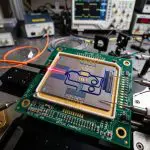
Quemix, working with Sumitomo Rubber Industries, Ltd., has detailed a new method for extracting data from quantum computations that scales logarithmically with problem size. The team reports demonstrating a “Fourier space readout (FSR) method” for efficiently recovering functions encoded in quantum states, a critical step in applying quantum computers to complex engineering challenges. This quantum-classical hybrid approach obtains key data on a quantum computer and reconstructs the full function using classical computation, potentially preserving speedups for computer-aided engineering (CAE) problems. According to the researchers, the quantum computer’s workload increases with the logarithm of grid points, unlike traditional methods where cost rises linearly; this finding appears in the journal Quantum Science and Technology. This suggests a path toward tackling increasingly complex CAE tasks with quantum systems, extending beyond typical pharmaceutical and financial applications.
Theoretical analysis and numerical experiments reveal the quantum computer’s workload increases logarithmically with the number of grid points, a significant advantage over traditional linear scaling. Unlike methods that require processing every grid point, this approach focuses on the most significant data, reducing the quantum computer’s burden. The researchers found the classical computer’s workload scales with the number of points needing reconstruction, not the total grid points, further enhancing efficiency. This preservation of quantum speedups during the readout process is critical for realizing practical quantum advantages in fields like materials science and beyond, offering a potential solution to limitations encountered when applying quantum computers to complex simulations.
The pursuit of practical quantum computing for complex engineering tasks received a boost with this new approach to data extraction from quantum systems, potentially enabling more efficient simulations and analyses.
See today’s quantum computing news on Quantum Zeitgeist for the latest breakthroughs in qubits, hardware, algorithms, and industry deals.