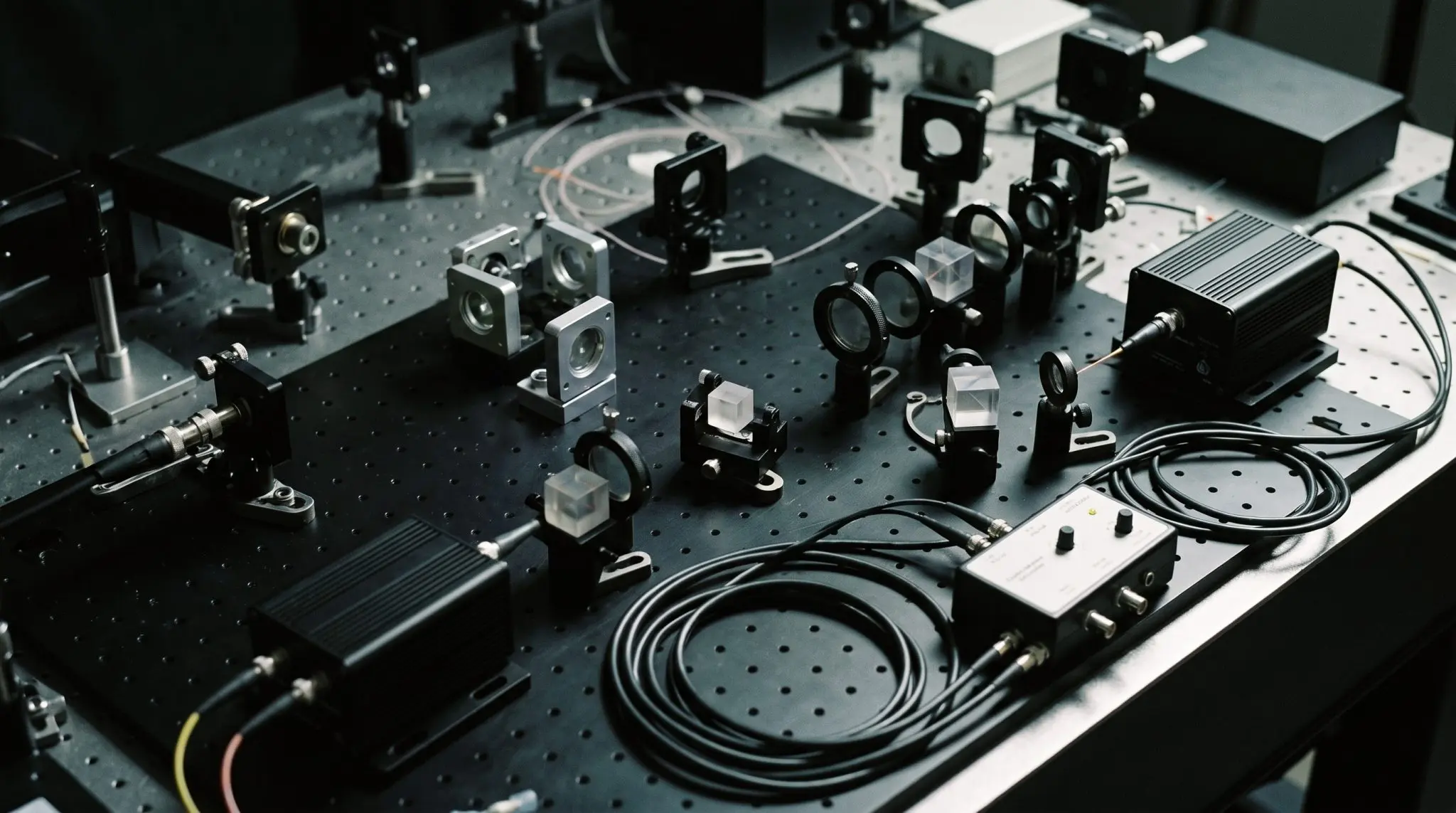
Researchers at Paderborn University have demonstrated a photonic controlled-not (C-NOT) gate with a fidelity of 93.8 ± 1.4%, a key step toward building practical quantum computers. The team’s design utilizes a time-multiplexed architecture, creating a fully reconfigurable quantum processor. By combining their C-NOT gate with a single qubit gate, the researchers successfully generated all four Bell states, proving the system can perform more complex quantum calculations and function as a building block for advanced quantum circuits.
Photonic Qubit Encoding and Quantum System Foundations
A fidelity of 93.8 ± 1.4% in a photonic C-NOT gate demonstrates a significant advance toward building practical quantum processors. Researchers at Paderborn University have achieved this level of accuracy, suggesting a potential pathway to more reliable quantum computation. The team’s success hinges on a time-multiplexed architecture, enabling a fully reconfigurable quantum processor, a departure from the fixed operational limitations of many existing systems. This allows for dynamic adjustment of the quantum circuit, offering greater flexibility and scalability as quantum systems grow in complexity. The foundation of this work lies in the manipulation of qubits, described as “the fundamental information unit consisting of a quantum system with two levels,” and the need for operations capable of altering their quantum state.
While various physical platforms, including charged particle spins, trapped ions, and superconducting systems, are being explored, the Paderborn team champions photonic quantum computing. They explain that in photonic quantum computing, photons are the carriers of quantum information, highlighting the advantage of excellent isolation from environmental interference and ease of manipulation. The C-NOT gate, essential for constructing any gate-based quantum circuit, is realized through a novel interferometric scheme leveraging time-bins separated by a variable delay. “By combining these two primitive elements, we implement a quantum circuit capable of generating the four Bell states,” demonstrating the system’s ability to perform more complex calculations. This platform, utilizing fast electro-optical modulators, allows for programming an optical interferometer in the time domain and offers a reconfigurable hardware solution for both single qubit rotations and two-qubit interactions, both essential requirements for the realization of a universal quantum computer.
The pursuit of practical quantum computation increasingly focuses on the controlled-not (C-NOT) gate as a foundational element, essential for realizing any quantum circuit alongside single qubit rotations. Recent work from Paderborn University details a significant advance in this field, demonstrating a post-selected C-NOT gate with a fidelity of 93.8 ± 1.4%, a result exceeding many previous photonic implementations. The team’s design leverages a time-multiplexed architecture allowing for a fully reconfigurable quantum processor. The system encodes qubits in the temporal degree of freedom of photons, allowing for multiplexing qubits on a series of temporal bins within a single spatial mode, streamlining the system’s architecture. Notably, the platform is fully and rapidly reconfigurable. The system’s ability to implement both C-NOT and single qubit operations, as demonstrated through Bell state generation, underscores its potential as a versatile building block for universal quantum computation.
Federico Pegoraro and colleagues at Paderborn University are pushing the boundaries of photonic quantum computing with a newly demonstrated, fully reconfigurable processor. Their work centers on a time-multiplexed architecture, a design choice enabling a level of flexibility currently uncommon in many quantum systems. The achieved fidelity of 93.8 ± 1.4% underscores the potential of photons as robust carriers of quantum information. Beyond simply achieving a high-performing C-NOT gate, the Paderborn team demonstrated the system’s capacity for more complex calculations, a capability essential for realizing a universal quantum computer, as the C-NOT gate, combined with single qubit rotations, can realize any quantum circuit.
The pursuit of scalable quantum computing received a boost with the demonstration of a highly reconfigurable photonic processor at Paderborn University, offering a pathway beyond the limitations of fixed-operation quantum systems. Researchers, led by Federico Pegoraro, achieved a fidelity of 93.8 ± 1.4%. The past decades witnessed significant advances in quantum computation and communication science, and in both cases, the light temporal degree of freedom has been used to demonstrate a post-selected C-PHASE gate. The team successfully demonstrated the system’s capabilities by generating all four Bell states, a crucial step beyond simply achieving a C-NOT gate.
The pursuit of practical quantum computation often clashes with the delicate nature of qubits; while many platforms exist, achieving high-fidelity operations remains a formidable challenge. A fidelity of 93.8 ± 1.4% represents a crucial benchmark for building reliable quantum circuits.
A fidelity of 93.8 ± 1.4% in a photonic C-NOT gate, achieved by researchers at Paderborn University, signals an advance in the pursuit of practical quantum computing. The core of their design involves manipulating photons within a looped interferometer, where “time-bins separated by a time Δτ” serve as the fundamental units for encoding quantum information. This system allows for interference between these time-bins, enabling the implementation of a C-NOT gate through a carefully programmed sequence of optical transformations.
The pursuit of stable and scalable quantum processors continues to drive innovation in qubit design and gate implementation, with photonic systems gaining prominence due to their inherent coherence. Researchers are increasingly focused on time-multiplexing as a pathway toward fully reconfigurable architectures. Paderborn University researchers have demonstrated a novel approach utilizing a time-bin interferometer, achieving a fidelity of 93.8 ± 1.4% in a photonic C-NOT gate, a critical benchmark for practical quantum computation. While previous work used time to encode the qubit’s degree of freedom with separated spatial inputs, this design allows for a more compact and potentially scalable configuration. The team’s architecture features a looped structure with short and long delay lines, connected by a variable beam splitter implemented with electro-optical modulators.
Unlike many photonic quantum computing approaches that rely on fixed circuit layouts, their system allows for dynamic reconfiguration of quantum operations, a capability demonstrated by achieving a fidelity of 93.8 ± 1.4% in a photonic C-NOT gate. The past decades witnessed significant advances in quantum computation and communication science. The researchers detail how their platform utilizes a looped interferometer, enabling interference between time-bins separated by a controlled delay.