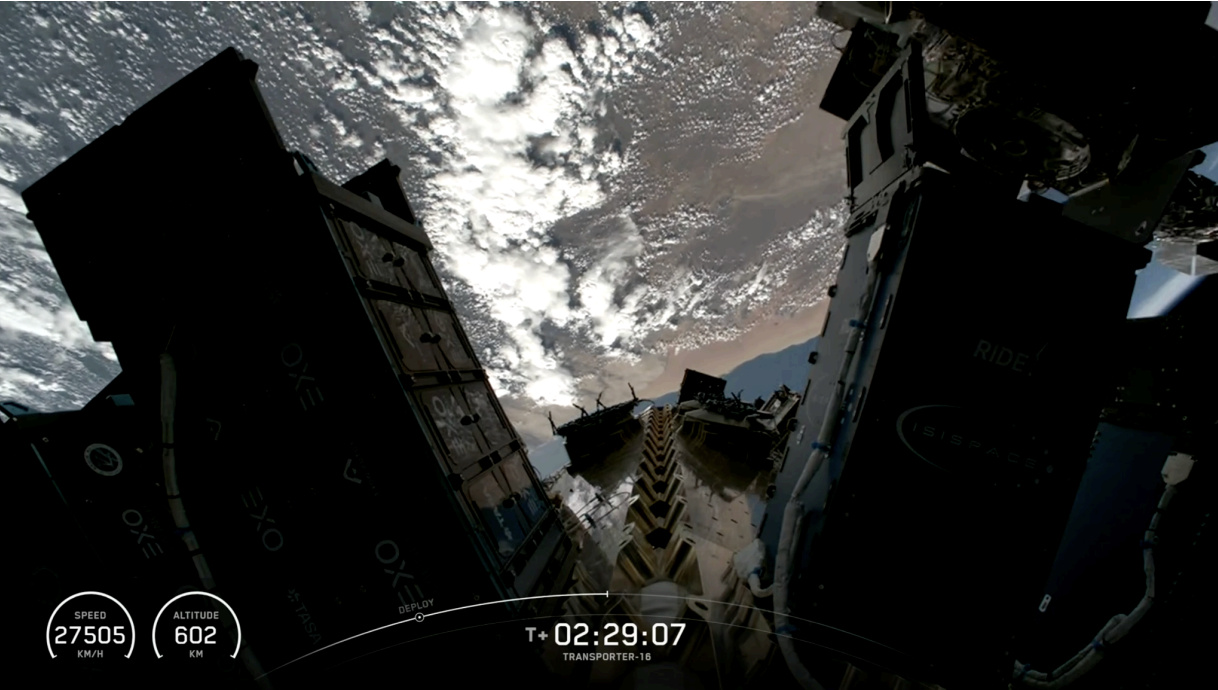
IonQ reports that its Acadia-10 satellite, launched in March, is now operational in low Earth orbit at an altitude of 600 kilometers, roughly 200 times higher than a passenger airplane, and is delivering sub-0.25-meter resolution imagery from LEO. This capability stems from Acadia-10 being the first commercial Synthetic Aperture Radar satellite to fly with an Optical Communications Terminal, designed to bypass a critical bottleneck in satellite intelligence. Traditional task-to-delivery cycles can span 3, 8 or more hours, but IonQ’s system aims to address this latency with space-based laser connectivity. The company states this transition “will replace traditional radio frequency (RF) boundaries with space-based laser connectivity,” enabling faster delivery of actionable intelligence.
Acadia-10 Validates Commercial Synthetic Aperture Radar in LEO
Flying at 600 kilometers, approximately 60 times the altitude of a passenger airplane, the Acadia-10 satellite is demonstrating a significant leap in Earth observation capabilities, validated following its launch aboard SpaceX’s Falcon 9 in March. SAR technology allows imaging regardless of sunlight or cloud cover, as the satellite emits its own signal and analyzes the return, achieving sub-0.25-meter resolution from Low Earth Orbit (LEO) and millimeter-level precision when measuring ground deformation via InSAR. The primary challenge facing advanced radar sensors has not been image fidelity, but rather the transmission of that data to the ground. The commercial sector has long struggled with operational delays; vital imagery often remains onboard satellites for hours awaiting a connection to a terrestrial ground station. IonQ notes that “Traditional task-to-delivery cycles can span 3–8 or more hours,” highlighting the vulnerabilities created by this latency.
Acadia-10’s OCT bypasses this limitation by utilizing space-based laser connectivity, effectively transitioning away from reliance on traditional radio frequency (RF) communication. This new system is currently executing operational tests at 2.5 gigabits per second. This shift is crucial given the physics governing RF networks; a satellite traveling at 7.5 kilometers per second has limited contact time with any given ground station, typically only 8, 12 minutes per orbit. The OCT allows data to be routed through an interconnected orbital mesh, handing off high-resolution data soon after capture and compressing delivery timelines from hours to minutes, ensuring first responders gain operational awareness and support response efforts during the critical 24-72 hour window. IonQ has also aligned its hardware to achieve compatibility with the U.S. Space Development Agency’s (SDA), a proliferated low-Earth orbit network intended to transmit data to and from operational defense forces using standardized Optical Inter-Satellite Links (OISLs). The satellite’s mass exceeding 175 kilograms and 700 watts of solar array power were critical to integrating the OCT, demonstrating a successful operational validation of this design.
Spotlight Ultra mode can require a 28-52-second dwell time to generate ultra-high-resolution imagery, with some spotlight collects producing more than 5 GB of raw SAR data per second before onboard processing and compression.
Optical Communications Terminal Overcomes RF Data Bottlenecks
The demand for rapid satellite imagery has long outpaced the ability to deliver it, creating a significant bottleneck for time-sensitive applications. Traditional reliance on radio frequency (RF) networks limits the speed at which this valuable intelligence reaches end-users, often resulting in delays of 3, 8 or more hours. Acadia-10 addresses this limitation with the successful deployment and validation of an onboard Optical Communications Terminal (OCT). This technology transitions data downlink from conventional RF communication to space-based laser connectivity, fundamentally altering the architecture of latency. The core issue with RF networks stems from orbital mechanics; a Low Earth Orbit (LEO) satellite has a limited window, approximately 8, 12 minutes, to connect with a ground station as it travels at 7.5 kilometers per second. For example, if valuable data is captured over Southeast Asia, the satellite may need to orbit the globe before a ground station is within range.
The OCT bypasses this constraint by utilizing free-space laser links between satellites, routing data to transport layer satellites positioned above ground stations, and circumventing weather-related interference. Currently executing operational tests at 2.5 gigabits per second, Acadia-10 is able to hand off its high-resolution data soon after capture. This near-real-time handoff compresses delivery timelines from hours to minutes, dramatically improving responsiveness in scenarios like rapid disaster response, confirmatory analysis, and precise tip-and-cue analysis. IonQ has also ensured compatibility with the U.S. Space Development Agency (SDA), a proliferated low-Earth orbit network intended to transmit data to and from operational defense forces using standardized Optical Inter-Satellite Links (OISLs).
High-Resolution SAR Data Enables Near-Real-Time Intelligence
Acadia-10, a Synthetic Aperture Radar (SAR) satellite launched in March via SpaceX’s Falcon 9, is redefining the speed at which critical Earth observation data reaches users. This new satellite achieves sub-0.25-meter resolution from LEO, and millimeter-level precision when measuring ground deformation via InSAR. The core innovation lies in Acadia-10’s Optical Communications Terminal (OCT), designed to overcome a significant bottleneck in the commercial satellite imagery market. The satellite’s velocity, approximately 7.5 kilometers per second, means a limited window of 8, 12 minutes per orbital pass for contact with ground stations, creating substantial delays, particularly when capturing data over remote regions. Acadia-10 bypasses this issue by utilizing space-based laser connectivity, routing data through an interconnected orbital mesh instead of relying solely on ground station access. The impact is particularly significant in time-sensitive scenarios, such as rapid disaster response, where actionable intelligence within the first 24, 72 hours is crucial, or confirmatory analysis for defense and intelligence operations.
Acadia-10 Aligns with SDA/NDSA for OISL Compatibility
The ability to rapidly deliver actionable intelligence from space is undergoing a fundamental shift, driven by the successful integration of commercial satellite capabilities with United States defense architecture standards. Acadia-10, launched in March via SpaceX Falcon 9, isn’t simply adding to the growing constellation of Synthetic Aperture Radar (SAR) satellites; it’s demonstrating compatibility with the U.S. Achieving this alignment required overcoming significant engineering challenges, particularly given the power demands and thermal loads inherent in advanced SAR payloads. The NDSA is a proliferated low-Earth orbit network utilizing standardized Optical Inter-Satellite Links (OISLs) to transmit data, and for commercial entities to participate, adherence to these technical protocols is essential. IonQ states, “Achieving this required solving many engineering hurdles,” highlighting the complexity of adapting existing satellite technology to meet stringent government requirements. This isn’t merely about technical compliance; it’s about establishing a pathway for commercial radar data to directly support a vital government backbone.
The implications extend beyond defense, promising benefits across multiple sectors. Rapid disaster response, for example, relies on timely SAR imagery to assess damage and coordinate relief efforts, and compressing delivery windows to less than 24-72 hours is transformative. Similarly, for defense and intelligence operators tracking dynamic targets, sub-hour delivery ensures commanders have current, actionable intelligence. Acadia-10 represents the “successful operational validation of this design,” and signals a move toward a future where Earth observation and quantum technology can converge, potentially delivering quantum-enhanced positioning, navigation, and timing (PNT) services that are far more resilient than current GPS-reliant systems.
Compressing delivery windows to less than 1 hour ensures first responders gain operational awareness and support response efforts.
See today’s quantum computing news on Quantum Zeitgeist for the latest breakthroughs in qubits, hardware, algorithms, and industry deals.