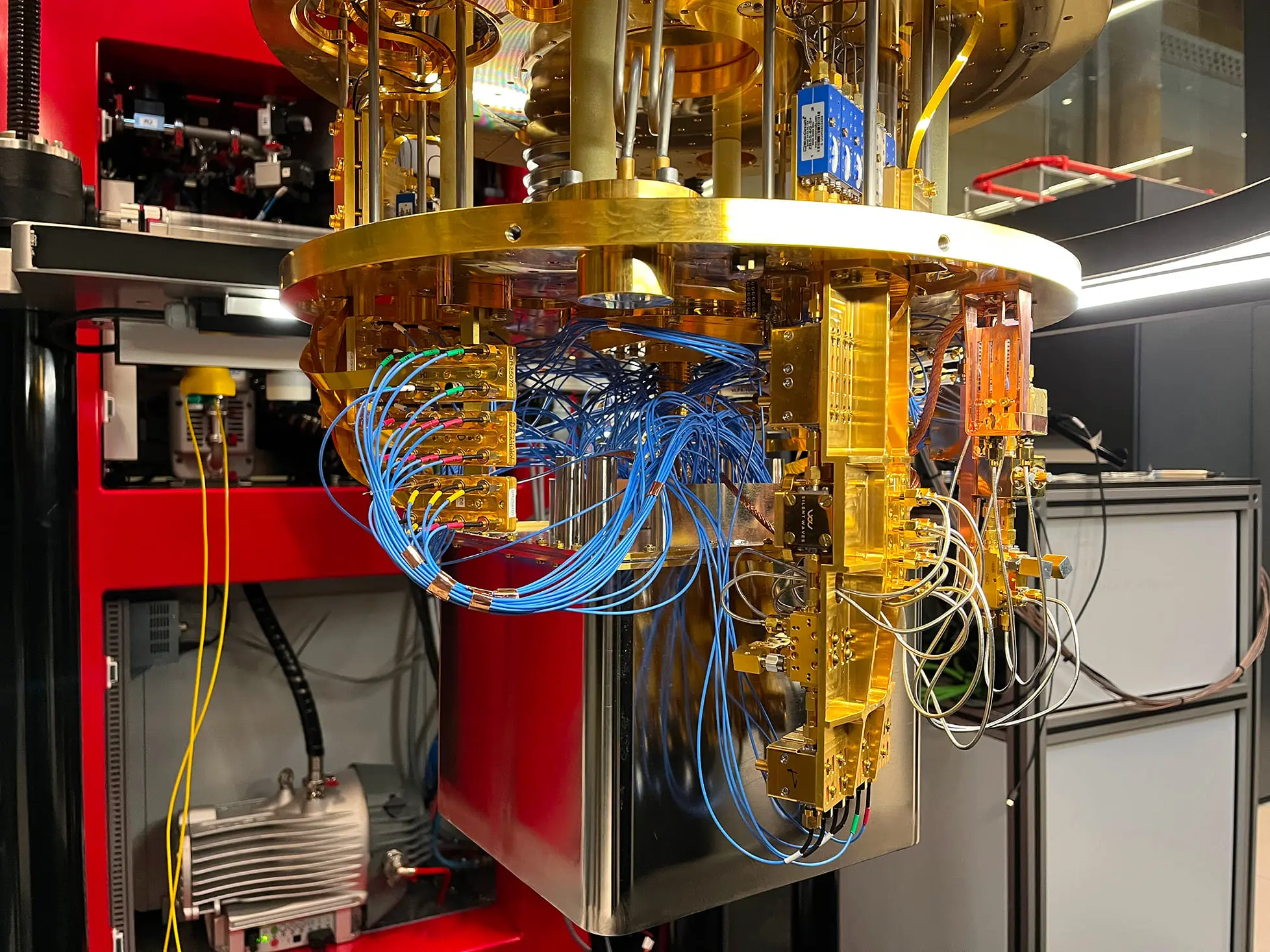
Researchers are already publishing scientific results from a newly completed 35-qubit quantum system at the Barcelona Supercomputing Center (BSC-CNS), demonstrating a rapid transition from theoretical potential to practical application. Built by Qilimanjaro and GMV and integrated into the MareNostrum 5 supercomputer as part of the Quantum Spain initiative, the system has amassed over 4,000 hours of computing time across more than 45 granted projects since becoming operational. This immediate utilization signals a shift toward operational quantum resources. Estarellas, CEO of Qilimanjaro, stated that Qilimanjaro, together with GMV and BSC, has demonstrated that Spain has the industrial capacity to produce, deploy, scale and maintain real quantum systems in production. Early research leveraging the system includes a quantum circuit cache achieving an 11.2 times speedup on real hardware by bypassing up to 89 percent of redundant subcircuit executions and a study applying quantum kernel methods to predict venture quality in life-science equity crowdfunding, marking the first published article resulting from access granted through the Red Española de Supercomputación.
MareNostrum-ONA Completes Quantum Spain Infrastructure with 35-Qubit Processor
Spain’s MareNostrum-ONA has moved beyond theoretical quantum computing with the completion of its 35-qubit processor installation, finalizing the Quantum Spain initiative driven by the Ministry for Digital Transformation and the Civil Service through SEDIA. Built and deployed by Qilimanjaro and GMV, the system’s immediate accessibility via the Red Española de Supercomputación (RES) signifies a shift toward operational quantum resources for the wider research community. Marta P. Estarellas, CEO of Qilimanjaro, explains that this system marks a transition from experimental to operational quantum computing, highlighting Spain’s growing industrial capacity in quantum system production and maintenance. Since becoming operational, the MareNostrum-ONA infrastructure has already supported over 45 projects, accumulating more than 4,000 hours of computing time, demonstrating substantial early adoption. This utilization is rapidly translating into peer-reviewed publications, with three recent studies showcasing the breadth of applications being explored.
Researchers at the Barcelona Supercomputing Center (BSC) developed Qdislib, a library for distributed quantum circuit cutting, achieving an 11.2 times speedup on the 35-qubit QPU by bypassing up to 89 percent of redundant subcircuit executions. Further demonstrating practical application, a team co-led by Massimiliano Ferrara, Santiago Forgas Coll, and Laura Sáez applied quantum kernel methods to a real business problem: predicting venture quality in life-science equity crowdfunding. Laura Sáez, a researcher at the Universitat de Barcelona, notes that working with real quantum hardware at MareNostrum‑ONA has been a valuable experience, especially for validating results beyond simulations, emphasizing the importance of open access to such infrastructure for accelerating real-world quantum applications.
Qdislib and Quantum Circuit Cache Optimize Hybrid Quantum-Classical Workflows
Recent advances at the Barcelona Supercomputing Center (BSC) are focused on maximizing the utility of existing quantum hardware through sophisticated software optimization, rather than simply achieving qubit counts. Researchers have developed Qdislib, a library designed to dissect large quantum circuits into manageable components, enabling parallel execution across diverse computing resources, CPUs, GPUs, and the quantum processing unit itself. This approach is crucial for hybrid quantum-classical high-performance computing environments like MareNostrum-ONA, allowing complex calculations to leverage the strengths of each processing type. Building on this foundation, the team also created a Quantum Circuit Cache, a system that identifies and eliminates redundant computations within these workflows. Evaluated on the 35-qubit MareNostrum-ONA processor, the Quantum Circuit Cache demonstrated an 11.2 times speedup by bypassing up to 89 percent of redundant subcircuit executions, a significant gain for resource-intensive quantum algorithms. A team co-led by Dr. Massimiliano Ferrara, Dr. Santiago Forgas Coll, and Dr. Laura Sáez Ortuño, amongst other researchers, applied quantum kernel methods to a real business problem: predicting venture quality in life-science equity crowdfunding.
This system marks the shift from experimental quantum computing to operational quantum computing.
Quantum Kernel Methods Predict Venture Quality on BSC’s Quantum Blue QPU
Researchers are increasingly turning to quantum kernel methods to assess the viability of early-stage ventures, and the Barcelona Supercomputing Center’s (BSC) Quantum Blue QPU is providing a crucial testing ground for these approaches. A team co-led by Massimiliano Ferrara, Santiago Forgas Coll, and Laura Sáez Ortuño, amongst other researchers, applied quantum kernel methods to a real business problem: predicting venture quality in life-science equity crowdfunding. This work, published as the first article stemming from the Red Española de Supercomputación (RES) access program, demonstrates a move beyond theoretical quantum computing toward practical application in financial analysis. The study’s direct implementation on the Quantum Blue QPU allowed researchers to move beyond simulations and validate their findings with real-world quantum processing. Beyond venture capital, the MareNostrum-ONA infrastructure is facilitating diverse research; evaluated on the 35-qubit QPU of MareNostrum-ONA, it achieved an 11.2 times speedup on real hardware by bypassing up to 89 percent of redundant subcircuit executions. These advancements, alongside the ongoing expansion with a new analog quantum processor, signal a growing ecosystem of quantum-HPC integration.
Reaching 35 qubits at MareNostrum-ONA has been a major step forward for our research.
Source: https://qilimanjaro.tech/quantum-spain-is-complete-heres-what-researchers-are-already-doing-with-it/



See today’s quantum computing news on Quantum Zeitgeist for the latest breakthroughs in qubits, hardware, algorithms, and industry deals.