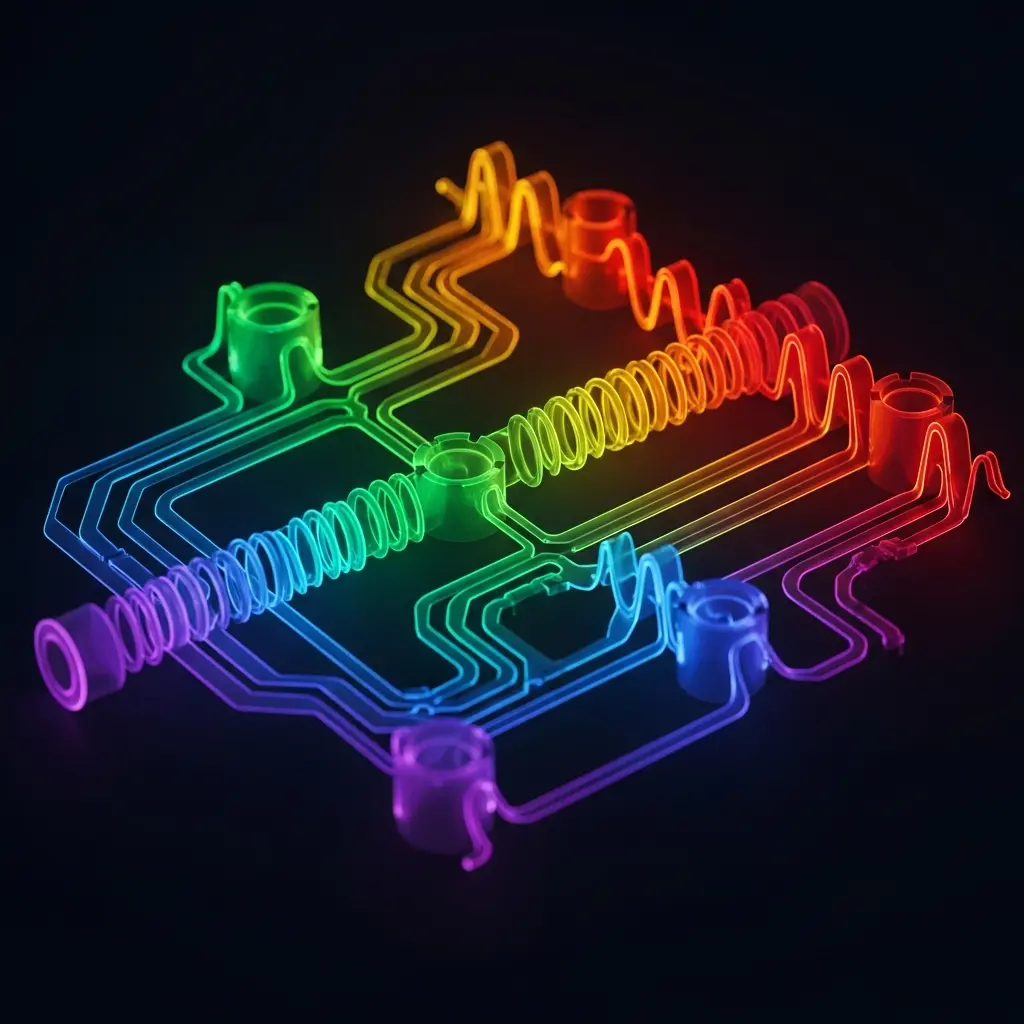
Researchers are increasingly focused on generating optical frequency combs on silicon chips for applications in precision metrology and spectroscopy. Pradyoth Shandilya, Shao-Chien Ou, and Alioune Niang, from the University of Maryland Baltimore County, alongside Gary Carter, Curtis R. Menyuk, and Kartik Srinivasan from the Joint Quantum Institute, NIST/University of Maryland, report the creation of a novel, universally bright integrated soliton molecule. Their work demonstrates a fundamentally new mechanism for binding bright pulses, specifically, a bright idler wave parametrically bound to a dissipative Kerr soliton, even in normal dispersion regimes. This achievement is significant because it bypasses limitations imposed by dispersion and visible wavelength pumping, potentially unlocking new avenues for extending frequency comb functionality towards visible wavelengths and enhancing spectroscopic capabilities.
Parametric generation of coherent idler waves in multi-pumped dissipative Kerr soliton microcombs
Achieving comb functionality into visible wavelengths
Achieving Visible Wavelengths via Parametric Soliton Interaction
Scientists have demonstrated a new approach to generating integrated optical frequency combs, achieving a bright-bright soliton molecule bound through parametric interaction. This work addresses a critical need for extending comb functionality towards visible wavelengths, overcoming limitations imposed by dispersion regimes and pumping wavelengths.
Researchers successfully created a multi-color dissipative Kerr soliton (DKS) microcomb, generating an idler wave fundamentally linked to the primary soliton. The study details the theoretical and experimental validation of this parametric binding, revealing a bright pulse idler that maintains coherence despite occurring in normal dispersion conditions.
This breakthrough centers on a multi-pumped DKS system, where a secondary pump interacts with the primary soliton to generate the idler wave at frequencies matching the resonator’s free spectral range. Unlike previous attempts at creating bound states relying on cross-phase modulation and dark pulse formation, this research establishes a parametric master-slave relationship.
The resulting idler pulse replicates the profile of the bright DKS, effectively translating the soliton’s characteristics to a new wavelength. Simulations accurately predicted the experimental outcomes obtained using an integrated octave-spanning microring resonator, confirming the formation of a bright pulse idler even in normal dispersion.
Unlocking Metrology Through Enhanced Spectral Comb Capabilities
Unlocking new metrology applications through spectral extension
The significance of this achievement lies in its potential to unlock new applications in metrology and spectroscopy. By eliminating the dependence on specific dispersion regimes or visible wavelength pumping, the parametric nature of this bright-bright state offers greater flexibility in comb design and conversion efficiency.
This allows for spectral extension of the DKS comb, enabling access to previously unreachable wavelengths and facilitating advancements in precision measurements of quantum systems. The research demonstrates two distinct states created when either the secondary pump or idler are free-spectral range matched, offering a comprehensive understanding of multi-pumped soliton bound states.
This work presents a comprehensive demonstration of multi-color bound states in a free-spectral range-matched, multi-pumped DKS microcomb, revealing a novel mechanism for generating and controlling optical frequency combs with enhanced performance and versatility. The ability to parametrically create such bound states through the idler opens avenues for innovative comb designs and expands the possibilities for precision optical measurements.
Simulating DKS Dynamics and Foundational Principles
Simulating DKS dynamics and system foundational principles
Simulating multi-pumped DKS dynamics and idler generation within integrated resonators
A multi-pumped dissipative Kerr soliton (DKS) forms the basis of this work, enabling investigation into on-chip integrated frequency comb generation for metrology applications. Researchers explored multi-color idler generation by theoretically and experimentally examining scenarios where the resonator free spectral range aligns with that of the DKS.
Simulations were performed using the open-source pyLLE package, initiating from numerical noise and sweeping the main pump detuning to establish a stable DKS before introducing a secondary pump. The secondary pump frequency detuning was then varied to explore both phase-matched and phase-mismatched regimes, utilising an integrated dispersion profile, Dint(μ) = ωres(μ) − (ω0 + μωrep), with two zero crossings.
Here, ωres(μ) represents the angular frequency of resonance for mode μ normalised to the pumped mode, ω0 is the main pump frequency at mode μ = 0, and ωrep is the repetition rate of the DKS. The study focused on a configuration where the secondary pump operates at μ−= −99, creating a comb tooth frequency mismatch of approximately −ω−≈ max(Dint(μ 0)), allowing the secondary pump detuning to independently control the phase-matching conditions of the idler.
By sweeping the secondary pump detuning from positive to negative values across six conditions, the spectral evolution of the DKS, secondary pump, and generated idler comb was observed. Corresponding azimuthal profiles of the idler field were then analysed, revealing a transformation into a bright sech pulse as phase matching was prevented.
The idler spectrum transitioned from synthetic dispersive waves at positive detuning to a broadband bright pulse at negative detuning, demonstrating the formation of a parametrically bound bright-bright state. Comparison of the idler and DKS azimuthal profiles confirmed that the parametric idler replicates the bright pulse nature of the master soliton when phase matching is inhibited, distinguishing this interaction from coupling between independent solitons.
Multi-pumped soliton interactions generate parametrically coupled idler pulses in micro-ring resonators
Researchers demonstrate the generation of a bright pulse bound to a dissipative Kerr soliton (DKS) through multi-pumped soliton interactions within an integrated octave-spanning micro-ring resonator. Simulations and experiments reveal the formation of this bound state, where an idler pulse arises from parametric interaction with the DKS, even in normal dispersion conditions.
The idler bright pulse exhibits characteristics fundamentally linked to the primary DKS, functioning as a replica rather than an independent pulse. Specifically, the work focuses on a regime outside of Kerr-induced synchronization, allowing for a decomposition of the field into distinct colour components.
Analysis of the modified Lugiato-Lefever equation reveals that when the secondary pump frequency offset exceeds the integrated dispersion across all modes, the idler experiences a frequency shift due to cross-phase modulation. This interaction creates an effective dark pulse whose width is dependent on the phase mismatch with the closest azimuthal mode.
Importantly, the study unveils a bright-bright state arising from nonlinear interaction between the soliton and the secondary pump, irrespective of dispersion at the idler’s central mode. Under conditions where the secondary pump is deliberately mismatched to avoid dispersive wave generation, the parametric interaction leads to the consistent generation of a bright pulse.
The azimuthal field of the idler, A+ (μ −μ+), is expressed as a spectral translation of the main soliton’s azimuthal component, resulting from four-wave mixing Bragg scattering. This process preserves the properties of the DKS, including its bright pulse nature, and establishes a master-slave binding between the two pulses.
The derived equation demonstrates that the idler field is directly proportional to the square of the nonlinear coefficient, divided by the total losses and dispersion, and is dependent on the driving fields. This parametric nature eliminates dependence on dispersion regime or visible wavelength pumping, opening possibilities for metrology and spectroscopy towards visible wavelengths.
Bright soliton binding extends visible spectrum frequency comb generation
Multi-pumped dissipative Kerr solitons enable the generation of integrated frequency combs with constant frequency offsets between components, a regime particularly useful for spectral extension via nonlinear mixing and idler wave generation. Researchers have now demonstrated the theoretical and experimental creation of bright idler pulses fundamentally bound to a primary bright soliton through parametric interaction, even in normal dispersion conditions.
This achievement relies on preventing phase matching to ensure the idler forms only where the soliton is intense, resulting in a bright pulse despite the dispersive environment. The formation of these multi-color bound states, including a previously observed bright-dark molecule and the newly demonstrated bright-bright molecule, is explained by cross-phase modulation and parametric four-wave mixing.
This process translates the soliton envelope to a new spectral region, extending the comb spectrum towards visible wavelengths relevant to atomic transitions of rubidium and cesium. The resulting bright pulses exhibit minimal spectral background, simplifying filtering and improving coupling to atomic systems for applications like optical atomic clocks and precision spectroscopy.
While current work utilises standard microring resonators, future improvements may involve dispersion engineering via photonic-crystal corrugations to further control idler wavelength range. Furthermore, the parametric binding mechanism allows for indirect stabilization of the entire multi-color system through all-optical trapping of the primary soliton, expanding the operational parameter space for integrated optical clocks and frequency synthesizers.
🗞 Universal Bright-Bright Integrated Soliton Molecule via Parametric Binding
🧠 ArXiv: https://arxiv.org/abs/2602.06711



See today’s quantum computing news on Quantum Zeitgeist for the latest breakthroughs in qubits, hardware, algorithms, and industry deals.