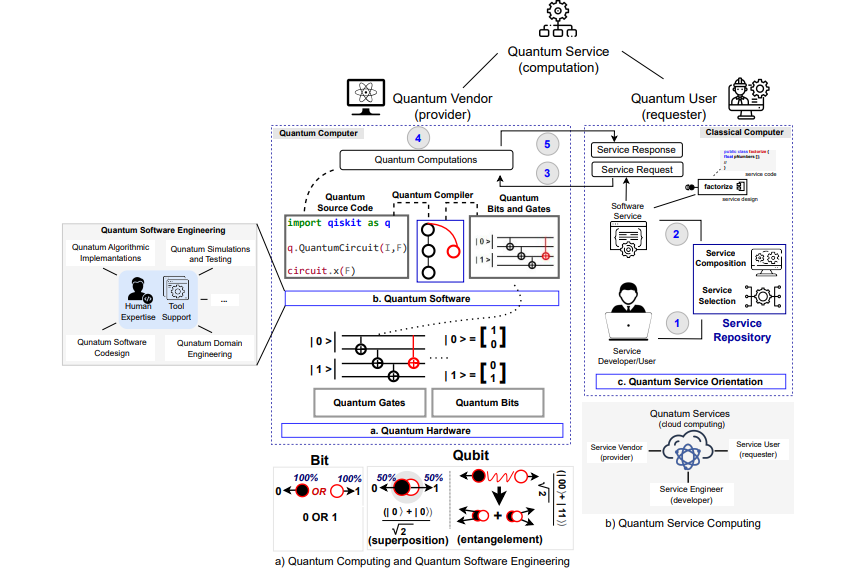
Quantum computing represents a disruptive technology with the potential to revolutionise computation, and researchers are actively developing both the hardware and software needed to realise this potential. Aakash Ahmad from University of Derby, Muhammad Waseem from Tampere University, Bakheet Aljedaanic from Umm Alqura University, and colleagues, investigate how to deliver quantum computing as a service, known as QCaaS, to make this powerful technology accessible to a wider audience. Their work adopts a software engineering perspective, focusing on the processes and architectures needed to offer quantum resources as a utility, similar to existing cloud services. By systematically analysing existing research and developing a layered reference architecture, the team identifies a four-phased development lifecycle and key requirements for engineering QCaaS, paving the way for practical and commercially viable quantum computing solutions.
Representative Study Data Extraction Summary
This document presents a structured summary of the research conducted, based on a predefined data extraction template. Due to the extensive nature of the study, encompassing forty-one individual investigations, a representative sample of the findings is presented here for brevity.
Quantum Service Lifecycle and Reference Architecture
This research establishes a process-driven and architecture-focused approach to deliver Quantum Computing as a Service, or QCaaS, offering a software engineering perspective on providing quantum resources as utility computing. The study employed a systematic review of existing research and subsequent architecture-based development to define a four-phased quantum service development lifecycle and integrate it into a supporting reference architecture. This analysis revealed a detailed understanding of quantum-specific requirements, modelling techniques, relevant patterns, supported programming languages, and suitable deployment platforms. These elements were integrated into a layered reference architecture designed to effectively engineer QCaaS.
The research also identifies areas for future investigation, including classifying quantum-specific requirements, enabling model-driven quantum service engineering, and integrating large language models into the quantum service development process. This work focuses on quantum service-orientation, providing empirically grounded findings, highlighting patterns for knowledge reuse, and offering a reference architecture as a blueprint for developing software for QCaaS. This approach aims to address the challenges of programming, operating, and maintaining quantum computers, offering a systematic process and tool support for this emerging field.
Engineering Quantum Computing as a Service Lifecycle
This research delivers a systematic understanding of Quantum Computing as a Service, or QCaaS, establishing a software engineering perspective on this emerging technology. The work identifies a four-phased development lifecycle for quantum services, encompassing conception, modelling, assembly, and deployment. A comprehensive systematic review of forty-one peer-reviewed studies defined these phases and integrated them into a layered reference architecture designed to engineer QCaaS. The study details quantum-specific requirements, modelling notations, relevant patterns, programming languages, and deployment platforms, all of which can be integrated within the reference architecture to facilitate the development of robust and scalable quantum services.
The research highlights the potential for leveraging existing knowledge and best practices from classical service engineering, such as microservices and established architectural patterns, to accelerate the development of efficient quantum software. Furthermore, the study reveals significant investment in quantum computing technologies, with public and private funding reaching $35. 5 billion by 2022 and projected global investments of up to $55 billion in 2024, demonstrating the growing economic interest and potential of QCaaS as a viable business model. The findings provide a blueprint for software developers to encapsulate data and computations into reusable modules, enabling efficient execution of tasks on quantum computing platforms and paving the way for broader adoption of quantum technologies.
QCaaS Lifecycle and Reference Architecture
This research presents a software engineering perspective on enabling Quantum Computing as a Service, or QCaaS, by establishing a process-centric and architecture-driven approach. Through a systematic review of existing research and subsequent architecture-based development, the team identified a four-phased service development lifecycle specifically tailored for quantum computing applications. This lifecycle incorporates key requirements, modelling notations, established patterns, relevant programming languages, and suitable deployment platforms, all integrated into a layered reference architecture designed to facilitate the engineering of QCaaS. The findings provide a foundational framework for developing and deploying quantum services, offering practitioners valuable references for reusable patterns, effective representation techniques, and prototyping implementations. This research bridges the gap between quantum computing and established software engineering principles, offering a structured approach to harness the potential of quantum technology as a service.
🗞 Quantum Computing as a Service – a Software Engineering Perspective
🧠 ArXiv: https://arxiv.org/abs/2510.04982



See today’s quantum computing news on Quantum Zeitgeist for the latest breakthroughs in qubits, hardware, algorithms, and industry deals.