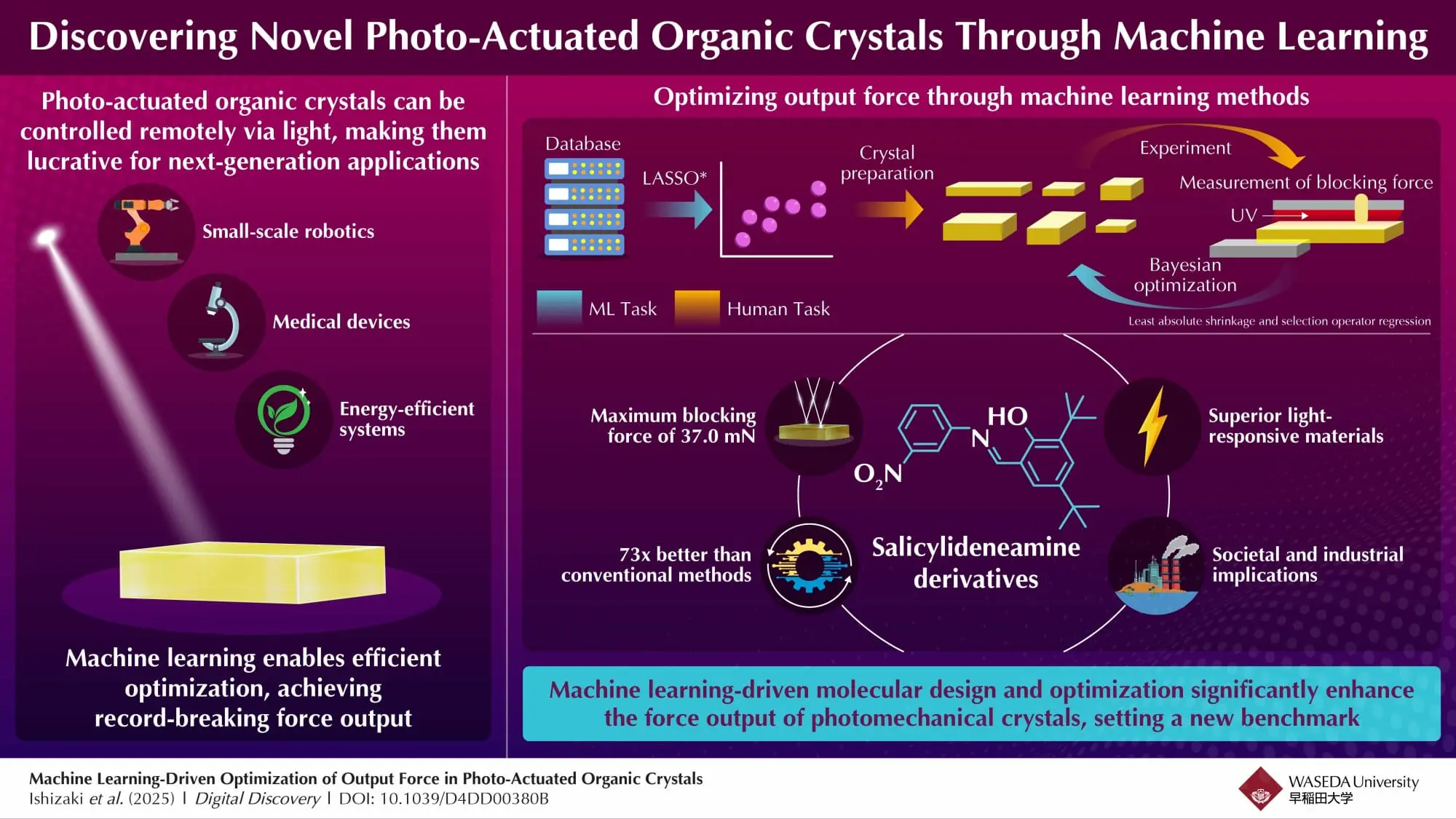
Researchers from Waseda University have developed a machine learning workflow using LASSO regression and Bayesian optimization to optimize the output force of photo-actuated organic crystals, achieving a maximum blocking force of 37.0 mN, 73 times more efficient than conventional methods. This advancement could lead to applications in remote-controlled actuators for medical devices and robotics, including minimally invasive surgery and precision drug delivery.
Photomechanical crystals are a class of materials that deform in response to light, making them highly valuable for use as actuators. These actuators convert external stimuli into mechanical motion, which is crucial for applications in robotics and medical devices. The performance of these crystals is measured by their blocking force, the maximum force exerted when deformation is restricted.
Achieving high blocking forces has been a significant challenge due to the complex interplay between molecular structures, crystal properties, and experimental conditions. Conventional methods have struggled to efficiently optimize these factors, often relying on trial-and-error approaches that are time-consuming and resource-intensive.
Recent advancements in machine learning have introduced innovative solutions to this problem. Techniques such as LASSO regression and Bayesian optimization are being employed to systematically enhance the performance of photomechanical crystals. These methods enable researchers to identify optimal molecular substructures and experimental conditions with unprecedented efficiency, significantly improving the blocking force compared to traditional approaches.
By integrating machine learning into the development process, scientists can now accelerate the discovery and optimization of high-performance materials. This approach not only enhances the precision and reliability of photomechanical crystals but also provides a scalable framework for future innovations in materials science.
Machine Learning in Crystal Optimization
LASSO regression has been utilized to identify critical molecular structures within photomechanical crystals, allowing researchers to predict and optimize mechanical output more effectively. This technique highlights the most influential components affecting crystal performance, providing a targeted approach for improvement.
Bayesian optimization complements this by refining experimental conditions systematically. Through iterative testing and adjustment of variables, researchers have achieved a 73-fold increase in efficiency compared to conventional methods. This systematic approach significantly improves blocking force output, demonstrating the potential of machine learning in accelerating material optimization.
The optimized photomechanical crystals hold promise for advancing actuators in medical devices and robotics. Their enhanced performance enables more precise and reliable mechanical motion, essential for applications requiring fine control, such as surgical robots or prosthetics.
This systematic optimization process not only accelerates the discovery of high-performance materials but also underscores the importance of data-driven approaches in advancing materials development and their practical applications.
More information
External Link: Click Here For More
See today’s quantum computing news on Quantum Zeitgeist for the latest breakthroughs in qubits, hardware, algorithms, and industry deals.