Quantum computing requires a thermal environment with significantly lower fluctuations than the energy level differences in qubits, making room temperature control impractical for large-scale quantum computing. Recent progress in neutral atom-based platforms suggests that rectangular addressing may balance control granularity and flexibility for 2D qubit arrays. This method addresses qubits on the intersections of rows and columns, reducing controls but potentially increasing depth. A conceptual architecture using rectangular addressing is presented, along with a method for achieving depth-optimal rectangular addressing. The article concludes with a discussion on the future of fault-tolerant quantum computing.
Quantum Computing and Control Complexity
Quantum computing requires a thermal environment with significantly lower fluctuations than the energy level differences in qubits. Solid-state platforms such as superconducting circuits or semiconductor quantum dots can only operate in cryogenic environments. Controlling a quantum processor entirely from room temperature becomes impractical for large-scale quantum computing where the requirement of millions of physical qubits exceeds the capacity of dilution refrigerators supporting only hundreds of coaxial cables. One viable strategy is manipulating multiple qubits with one signal.
Rectangular Addressing in Quantum Computing
Recent progress in neutral atom-based platforms suggests that rectangular addressing may strike a balance between control granularity and flexibility for 2D qubit arrays. This scheme allows addressing qubits on the intersections of a set of rows and columns each time. While quadratically reducing controls, it may necessitate more depth. The depth-optimal rectangular addressing problem is formulated as exact binary matrix factorization, an NP-hard problem also appearing in communication complexity and combinatorial optimization.
Quantum Architecture Employing Rectangular Addressing
A conceptual architecture where qubits can be addressed using rectangles formed by intersections of rows and columns is presented. Compared to a single address line, there are both row and column address lines and an additional switch for each row. This setting provides an advantage in each clock cycle, the row and column address lines transmit only the square root of the total bits required in a single address line configuration at the expense of possible layer execution time.
Rectangular Addressing in Neutral Atom Arrays
The motivation stems from recent successful large-scale experiments on the neutral atom arrays platform that highlights the effect of reducing control complexity by rectangular addressing. The acoustooptic deflector (AOD) illuminates a product of rows and columns. Quantum gates induced by specific pulses modulated by the AOD address qubits at the row and column intersections. AODs prove effective for implementing gates and qubit movements.
The Coarser Granularity of Rectangular Addressing
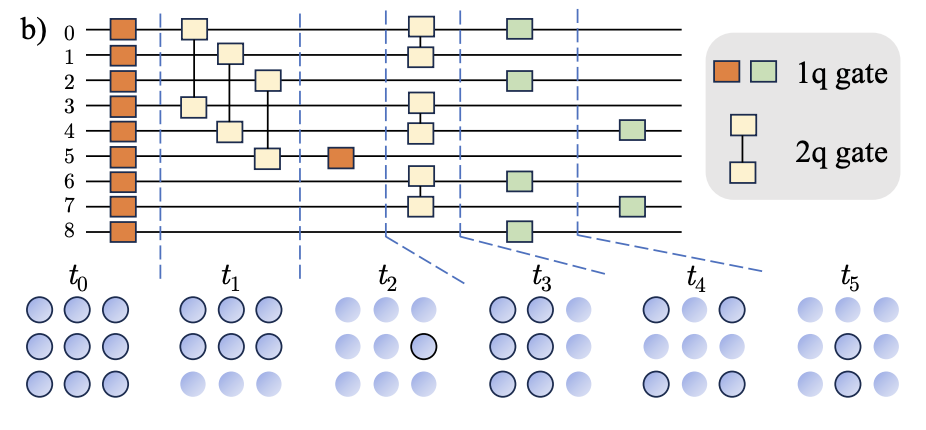
The coarser granularity of rectangular addressing may reduce control complexity at the cost of increasing depth. A more general problem is given by the matrix where the qubits to address are represented by the 1s. This matrix can be partitioned into five rectangles, each designated by distinct markers. Consecutively, each rectangle receives a modulated Rz pulse through specific AOD configurations. Minimizing the number of rectangles to partition arbitrary binary matrices becomes crucial.
Achieving Depth Optimal Rectangular Addressing
The problem of achieving depth-optimal rectangular addressing is formulated as exact binary matrix factorization. A satisfiability modulo theories (SMT) extension of SAT formulation for this problem and an effective heuristic dubbed row packing is presented. The combined algorithm SAP (SMT and packing) finds high-quality heuristic solutions quickly and then iteratively approaches the optimal solution.
Future of Fault-Tolerant Quantum Computing (FTQC)
For future fault-tolerant quantum computing (FTQC), the problem may exhibit a product structure. This implies that we can solve limited-size problems on multiple levels and then combine the solutions. The paper concludes with a review of mathematical concepts related to this problem across various contexts and applications.
The article titled “Depth-Optimal Addressing of 2D Qubit Array with 1D Controls Based on Exact Binary Matrix Factorization” was published on January 24, 2024. The authors of this article are Daniel Bochen Tan, Shuohao Ping, Jason Cong. The article was sourced from arXiv, a repository managed by Cornell University. The article can be accessed through the DOI reference https://doi.org/10.48550/arxiv.2401.13807.
See today’s quantum computing news on Quantum Zeitgeist for the latest breakthroughs in qubits, hardware, algorithms, and industry deals.