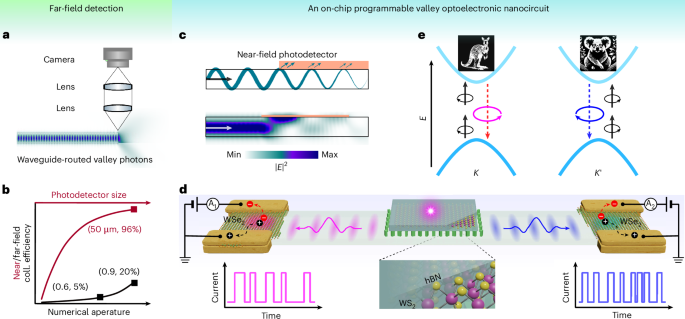
Researchers created an on-chip programmable valley optoelectronic nanocircuit, integrating photodetectors with transition metal dichalcogenides to address a longstanding challenge in the field. The circuit achieves in situ generation, selective routing, and electrical readout of valley-dependent chiral photons, a feat previously unresolved, and demonstrates a direct link between light polarization and a material property called “valley.” At room temperature, the purposely designed meta-waveguide device generates near-unity valley-dependent chiral photons, achieving a polarization selectivity of 0.97. This breakthrough, anticipated in Nature Photonics, bridges a critical gap in lightwave valleytronics, enabling compact, programmable, and scalable valley information processing and fostering the development of light-based valleytronic quantum technologies.
Tungsten Disulfide Meta-Waveguide Generates Chiral Photons
Transition metal dichalcogenides couple valley-polarized excitons to valley-dependent chiral photons, a phenomenon now harnessed in a newly developed on-chip circuit with implications for ultrafast, light-driven electronics. Researchers successfully created a valley-driven hybrid optoelectronic nanocircuit integrating meta-waveguide photodetectors with tungsten disulfide, addressing a previously unresolved challenge in the field of valleytronics. The core of this innovation lies in a purposefully designed meta-waveguide device fabricated from a monolayer of encapsulated tungsten disulfide. At room temperature, this device generates photons with near-unity valley dependence during second-harmonic generation. The meta-waveguide selectively couples these chiral photons to unidirectional waveguide modes, achieving a polarization selectivity of 0.97. This control over photon direction is vital for building complex optical circuits. These valley-dependent waveguide modes are then detected by atomically thin layers of tungsten diselenide, functioning as photodetectors exclusively sensitive to the upconverted photons. This all-on-chip processing of valley-multiplexed images represents a significant leap forward.
Selective Routing of Valley-Dependent Second-Harmonic Generation
Recent advances in manipulating valleys, quantum mechanical properties of electrons, within two-dimensional materials have focused on harnessing these states for novel electronic devices. Transition metal dichalcogenides are central to this field, as they directly couple valley-polarized excitons to chiral photons, potentially enabling ultrafast, light-driven electronics known as valleytronics. However, creating a fully integrated system capable of generating, directing, and reading out these valley-dependent photons on a single chip remained a significant hurdle. Researchers demonstrated an on-chip programmable valley optoelectronic nanocircuit that addresses this challenge. The core of the device is a meta-waveguide, meticulously designed to generate valley-dependent chiral photons through second-harmonic generation from a monolayer of tungsten disulfide. The device achieves a polarization selectivity of 0.97, selectively coupling these photons to unidirectional waveguide modes. This allows for all-on-chip processing of valley-multiplexed images, a capability previously unrealized. The ability to read out the valley state opens possibilities for compact, programmable devices and potentially, light-based quantum technologies, representing a substantial step toward practical valleytronics.
Researchers are exploring a new approach to valleytronics, focusing on the unique properties of tungsten diselenide to manipulate light and information at the nanoscale. Detection of these upconverted photons relies on atomically thin layers of tungsten diselenide, chosen for their exclusive responsiveness to above-bandgap light.
On-Chip Valley Information Processing & Potential Applications
The pursuit of smaller, faster, and more energy-efficient computing has led researchers to explore the potential of valleytronics, manipulating information using the valley property of electrons in certain materials. Recent advances demonstrate a functional, integrated circuit capable of generating, routing, and electrically reading these valley-dependent signals, moving beyond theoretical concepts toward practical applications. This on-chip system leverages transition metal dichalcogenides, materials where the valley degree of freedom directly couples to light polarization, enabling ultrafast, light-driven electronics. This all-on-chip processing enables the creation of concepts with implications for advanced imaging and data processing, and the potential extends to light-based quantum technologies, offering a new paradigm for information processing.



See today’s quantum computing news on Quantum Zeitgeist for the latest breakthroughs in qubits, hardware, algorithms, and industry deals.