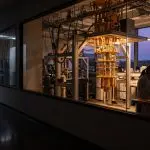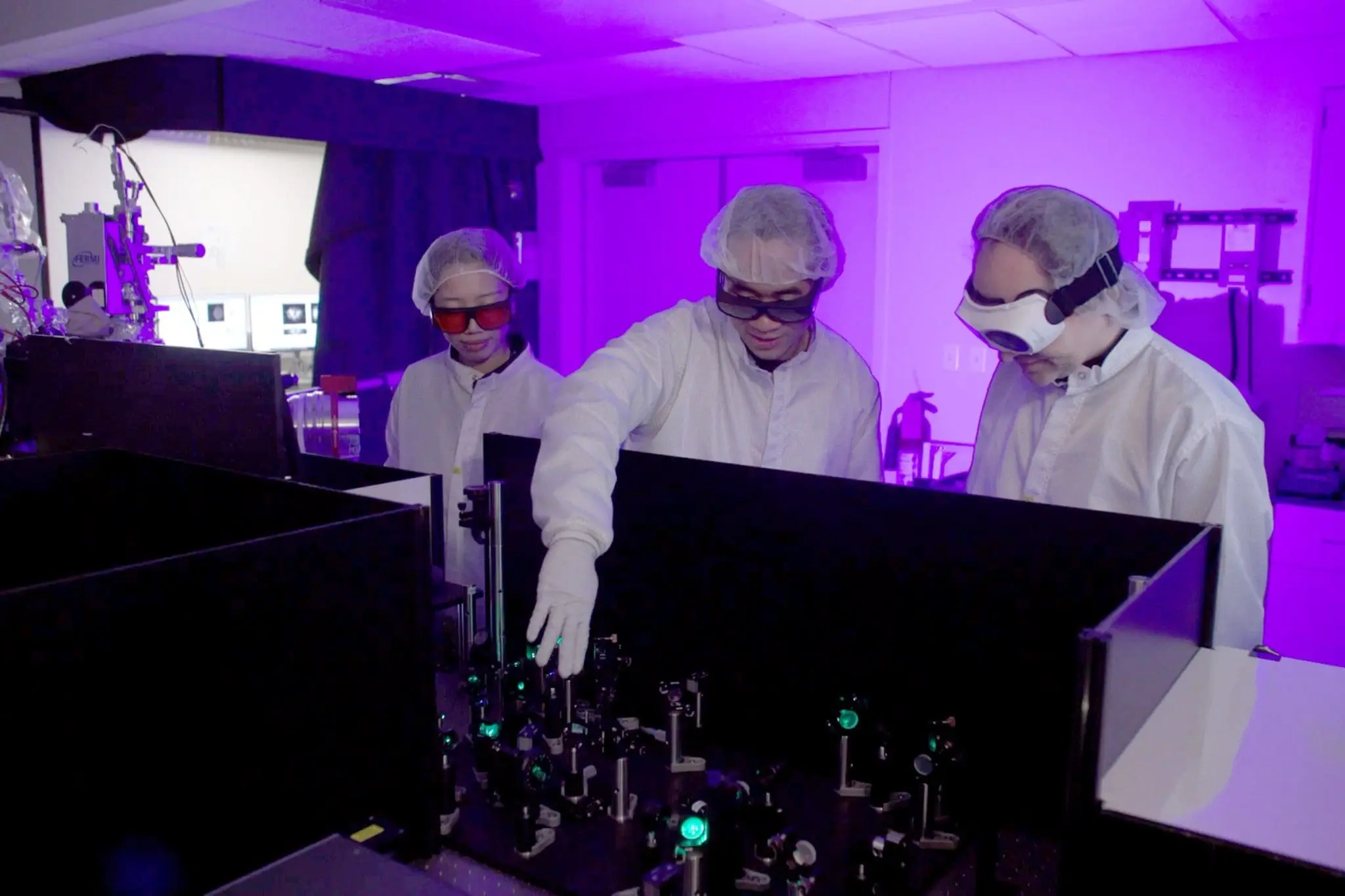
The University of Texas at Austin is expanding its quantum research infrastructure with a new underground facility within Welch Hall, the institution’s largest academic building, following the opening of the Love, Tito’s Quantum Materials Characterization Lab. This investment builds on decades of quantum discoveries at UT, dating back to the 1970s, and reflects the growing importance of harnessing the behavior of atoms and electrons for advanced technologies. Understanding quantum mechanics previously allowed researchers to anticipate electron behavior in silicon, which in turn enabled the development of semiconductors and all the computing devices that use them. “Quantum science plays a leading role in your everyday experiences in the modern world,” highlighting the pervasive impact of this field, from MRIs to GPS, and the potential for further advances in computing, medical science, and clean energy.
Wheeler’s Legacy: Quantum Demolition and Early Computing
The foundations of modern quantum computing were unexpectedly laid through a process of deliberate disruption. Physicist John A. Wheeler, during his tenure at The University of Texas at Austin, formalized the concept of measurement in quantum mechanics. Wheeler described how this type of measurement provides data about a system but inevitably alters the quantum state being observed, a principle that profoundly shaped subsequent research. Wheeler did not work in isolation; the group of graduate and postdoctoral students he mentored also contributed significantly to the burgeoning field, most notably David Deutsch, later recognized as the “father of quantum computing” for his mathematical principles outlining a universal quantum computer. The term “qubits,” used to describe quantum computing units of information, was coined at UT Austin by Benjamin Schumacher. This historical connection underscores the practical implications of seemingly abstract quantum investigations. This commitment to quantum research extends beyond computation.
Physicist Allan MacDonald, the Sid W. Richardson Foundation Regents Chair in Physics #1 at UT, made a significant discovery fifteen years ago involving graphene, a single-layer carbon atom material. MacDonald and postdoctoral researcher Rafi Bistritzer published findings detailing the unusual behavior of electrons when two sheets of graphene are stacked with a slight rotational offset, a phenomenon now known as twistronics. Their simulations, conducted using supercomputers at UT’s Texas Advanced Computing Center, revealed that at a precise 1.1-degree twist, electrons slow dramatically, spawning the field of twistronics. “This greater control of twist angles offers a new and powerful way of changing the properties of electrons inside two-dimensional materials and the interaction of those properties with light,” MacDonald said, suggesting potential advancements in fiber-optic data transfers and quantum computing. The implications of this work are substantial, as evidenced by MacDonald sharing the Wolf Prize in Physics and the Frontiers of Knowledge Award for his twistronics research, demonstrating the enduring influence of Wheeler’s initial insights and the continued momentum of quantum science at UT Austin.
Schumacher worked out more than just a clever name [qubit]; he proved a theorem about how qubits could be used to quantify the quantum information sent through a communication channel.
Science News
MacDonald’s Twistronics Discovery and “Magic Angle” Graphene
The field of twistronics continues to reshape materials science, building upon decades of quantum mechanical foundations and now benefiting from dedicated, expanding research infrastructure at institutions like the University of Texas at Austin. While the principles governing electron behavior in materials like silicon have long been understood and exploited in semiconductor technology, recent discoveries reveal that manipulating the arrangement of two-dimensional materials offers a new dimension of control. This is particularly evident in the work surrounding graphene, a single-layer sheet of carbon atoms, and the surprising phenomena unlocked by precisely controlling its orientation when layered with another sheet. Theoretical physicist Allan MacDonald, the Sid W. Richardson Foundation Regents Chair in Physics #1 at UT, conducted simulations that revealed a critical finding: “at a precise 1.1-degree twist, electrons slow dramatically and behave in unusual ways,” a discovery that subsequently launched the field of twistronics.
This wasn’t merely an academic curiosity; in 2019, researchers at the Massachusetts Institute of Technology confirmed that graphene arranged at MacDonald’s “magic angle” could exhibit superconductivity at temperatures significantly lower than those required for conventional superconductors. This research extends beyond simply identifying a specific angle, offering the potential to revolutionize fiber-optic data transfers and accelerate progress in quantum computing.
Metrology has been identified by the U.S. Department of Commerce as the key enabling technology for the semiconductor industry.
Defining Quantum Supremacy with Aaronson’s Theoretical Work
Scott Aaronson, the David J. Bruton, Jr. Rather than focusing on the immense engineering challenge of constructing a functional quantum computer, Aaronson’s research group concentrates on a fundamental question: “What can we do and what can we not do with a quantum computer?” This approach, prioritizing theoretical exploration, allows them to leverage the most advanced quantum hardware available globally to test their hypotheses. Aaronson’s work is central to understanding quantum supremacy, a concept he helped develop, which describes the point at which a quantum device can solve a problem intractable for even the most powerful conventional computers within a reasonable timeframe. His contributions extend beyond simply defining this benchmark; he has demonstrated how principles of computational complexity theory can illuminate key aspects of quantum physics, effectively mapping the limits and potential of quantum computation.
In recognition of this work, Aaronson received the ACM Prize in Computing and was recently elected to the National Academy of Sciences, solidifying his position as a leading authority in the field. He isn’t merely charting a path to quantum supremacy, but defining what it means. This theoretical framework is particularly crucial given the rapid advancements in quantum hardware. Aaronson explains that his group’s methodology involves formulating experiments and then collaborating to analyze the results. This collaborative approach, combined with rigorous theoretical analysis, allows them to push the boundaries of what’s possible, even without possessing their own large-scale quantum processor.
The implications of achieving quantum supremacy extend far beyond academic curiosity, promising breakthroughs in diverse sectors like pharmaceuticals, semiconductor development, and clean energy, while simultaneously reshaping the very landscape of computing. “Most of what we do is theory,” Aaronson stated, emphasizing the foundational nature of their work, but the ability to experimentally validate those theories remains paramount. His work, alongside the historical contributions of figures like John A. Wheeler and Benjamin Schumacher, who coined the term “qubit”, demonstrates UT Austin’s enduring commitment to unraveling the mysteries of the quantum world and defining the future of computation.
We like to say we’re at the onset of the second quantum revolution.
UT’s Quantum Facilities: Materials Characterization and Research
This investment underscores a commitment to not only theoretical exploration but also the practical realization of quantum phenomena in tangible materials. Physicist Edoardo Baldini and his team are already leveraging the lab’s capabilities to push the boundaries of quantum discovery. This focus on materials science builds upon a legacy of understanding how quantum mechanics dictates the behavior of electrons in everyday substances, now shifting towards more exotic materials and manipulating their quantum properties for enhanced functionality. Work on the underground facility has already begun. A pivotal discovery originating from UT, led by theoretical physicist Allan MacDonald, exemplifies the power of this materials-focused approach. The ongoing research at UT aims to build upon these successes and forge new partnerships to accelerate quantum innovation across the state.
The first quantum revolution happened last century, and that’s made a lot of technology possible.
Source: https://news.utexas.edu/2026/07/02/inside-uts-quantum-ecosystem-from-breakthroughs-to-possibilities/


See today’s quantum computing news on Quantum Zeitgeist for the latest breakthroughs in qubits, hardware, algorithms, and industry deals.