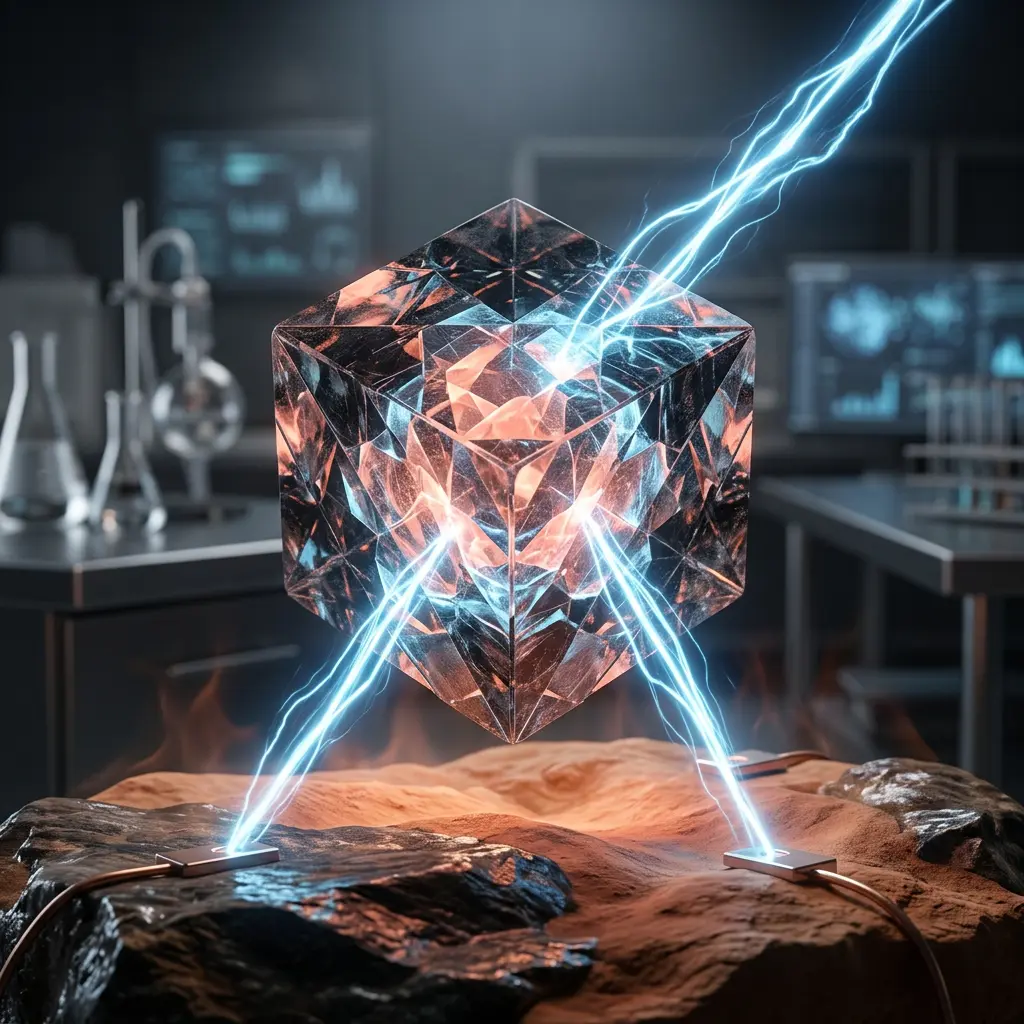
Researchers at Princeton University have developed a novel integrated ultrahigh vacuum (UHV) cluster tool designed for the comprehensive study of shallow nitrogen-vacancy (NV) centres in diamond. Zhiyang Yuan and colleagues constructed a system facilitating in situ diamond surface preparation, characterisation, and single NV centre dynamics measurements, all within a single, interconnected platform. This innovative approach enables a direct correlation between the surface chemistry of diamond and the behaviour of NV centres, providing a versatile platform for investigating surface-induced decoherence and charge dynamics, crucial for advancing quantum technologies.
Prolonged Vacuum Preservation Enables Direct Correlation of Diamond Surface Chemistry
Scientists at Princeton University have achieved a significant enhancement in diamond surface preservation, maintaining contamination-free conditions for over one month. This represents a substantial improvement compared to previous limitations, which typically restricted high vacuum preservation to approximately nineteen hours. The new ultrahigh vacuum (UHV) cluster tool, integrating diamond surface preparation, characterisation, and single nitrogen-vacancy (NV) centre measurements on a single platform, enabled this extended preservation period. The ability to maintain such pristine conditions is vital, as even minute surface contamination can drastically alter the properties of NV centres, impacting their performance in quantum applications.
Previously, investigations necessitated the transfer of samples between disparate systems, a process inevitably exposing them to atmospheric contaminants like hydrocarbons and oxygen. These contaminants adsorb onto the diamond surface, creating surface states that can trap or release charge, influencing the NV centre’s spin and optical properties. The integrated system circumvents this issue, allowing for direct correlation between diamond surface chemistry and the resulting NV spin and charge properties, offering a flexible means to study surface-induced decoherence and charge dynamics for shallow NV centres. Shallow NV centres, located closer to the diamond surface, are particularly susceptible to surface effects, making this direct correlation especially valuable. Spin coherence, a critical measure of how long an NV centre can maintain quantum information, was extended by a factor of 2.6 when utilising a specific pulse sequence, a Ramsey sequence optimised for reducing sensitivity to low-frequency noise, compared to a simpler, single-pulse measurement. This improvement demonstrates the system’s capability for detailed quantum characterisation and highlights the potential for mitigating decoherence through careful control of the experimental parameters.
Locally increased laser-induced photoluminescence, a phenomenon indicating the presence of surface defects or contaminants, appeared around nitrogen-vacancy (NV) centres on diamond surfaces immediately after loading into the UHV system. This initial observation suggests that despite precautions, some surface contamination was present even before the commencement of the experiment. Subsequent annealing of the diamond at 350°C within the UHV chamber effectively eliminated this enhanced glow, indicating the removal of surface contaminants through thermally activated desorption. However, after nineteen hours within a high vacuum load-lock chamber, maintained at a pressure of 6×10⁻⁸ mbar, the effect partially reappeared, suggesting re-contamination even under these ostensibly clean conditions. The load-lock chamber, while providing initial pumping, does not achieve the same level of vacuum as the main UHV chamber. This highlights the difficulty of achieving truly pristine surfaces and underscores the importance of the new UHV system for long-term preservation and detailed surface studies. The system’s ability to perform surface treatments in situ, within the UHV environment, is a key advantage, allowing for iterative cleaning and characterisation cycles without breaking vacuum.
Correlating diamond surface quality with nitrogen-vacancy centre performance for enhanced quantum
The team’s new platform promises a route to stable, reproducible quantum sensors by directly linking diamond surface condition to the behaviour of nitrogen-vacancy centres. Understanding how surface imperfections introduce unwanted noise, known as decoherence, that degrades the sensitivity of these sensors remains a persistent challenge in the field of quantum sensing. Decoherence arises from interactions between the NV centre and its environment, including fluctuating electric fields caused by surface charges and defects. Fully eliminating surface-induced noise remains an important consideration for realising practical quantum sensors, as it limits the achievable coherence times and thus the complexity of quantum algorithms that can be implemented. This ability to control the diamond surface and correlate it with sensor performance represents a major step towards reliable, reproducible devices for diverse applications including nanoscale sensing and imaging, precision magnetometry, and quantum information processing.
The system allows for controlled modification and analysis of diamond surfaces alongside precise measurements of individual NV centres, all within a single apparatus. Surface modification techniques, such as hydrogen termination or oxidation, can be employed to engineer the surface dipole layer and tune the charge state of the NV centre. Characterisation techniques, including X-ray photoelectron spectroscopy (XPS) and low-energy electron diffraction (LEED), can be used to assess the chemical composition and structural order of the diamond surface. By combining these techniques with NV centre measurements, researchers can establish a comprehensive understanding of the relationship between surface properties and NV centre performance. Furthermore, the UHV environment allows for the deposition of thin films onto the diamond surface, enabling the creation of novel heterostructures with tailored quantum properties. The integration of these capabilities within a single platform significantly streamlines the research process and facilitates the development of advanced quantum technologies. The potential for creating highly sensitive and stable quantum sensors relies heavily on the ability to precisely control and characterise the diamond surface, and this new UHV cluster tool provides a powerful platform for achieving that goal.
The researchers successfully built a specialised ultrahigh vacuum system to study nitrogen-vacancy centres in diamond. This instrument uniquely combines surface preparation and analysis tools with a cryogenic confocal microscope, allowing direct links to be established between the diamond surface and the NV centre’s performance. Understanding this relationship is important because surface properties currently limit the performance of these centres in quantum sensing applications. The authors state the tool facilitates systematic studies of surface-induced decoherence and charge dynamics, paving the way for more reproducible surface engineering.
👉 More information
🗞 An integrated ultrahigh vacuum cluster tool for diamond surface science and single nitrogen-vacancy center measurements
🧠 ArXiv: https://arxiv.org/abs/2606.13961



See today’s quantum computing news on Quantum Zeitgeist for the latest breakthroughs in qubits, hardware, algorithms, and industry deals.