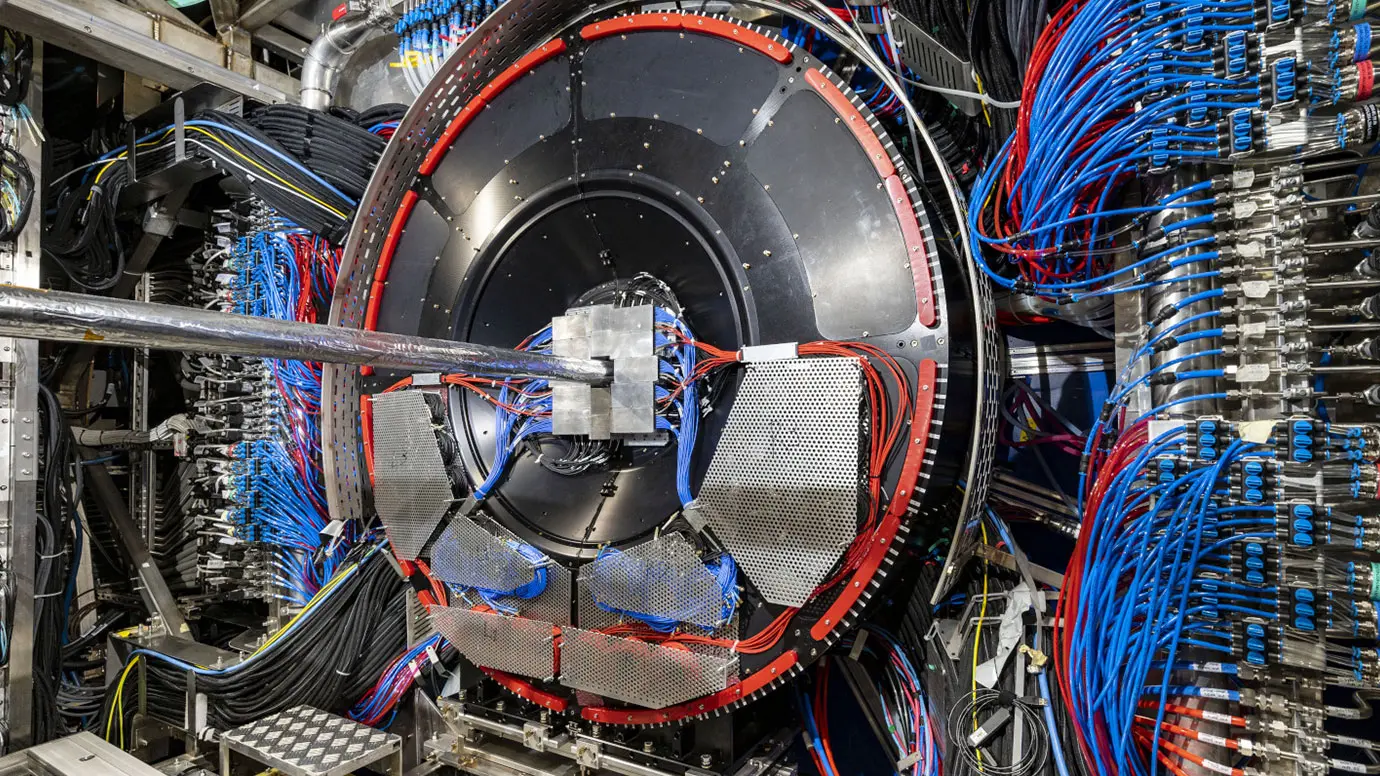
Assistant student Zixin Ding led a UChicago team to a best paper award at the ICML 2026 Workshop on AI for Physics by developing an artificial intelligence filter for data collected at CERN’s Large Hadron Collider. The team, collaborating with researchers from the University of Michigan and Fermilab, tackled the challenge of preserving collision data amidst an overwhelming volume of information.
David Miller of UChicago’s Department of Physics said, “Thankfully, we can work together with scientists studying complex computational approaches to exactly these kinds of problems in other contexts to develop novel and exciting ways to overcome these challenges and bring sophisticated solutions to bear so discoveries will not be missed.” Their work demonstrates how computer science methods can adapt to the constraints of real-world scientific instruments.
AI Filter Addresses LHC Data Overload
This system addresses a critical constraint: the collider generates collisions at a rate exceeding storage capacity, demanding real-time decisions about data preservation. The AI doesn’t simply increase the volume of saved data, but refines the selection process to prioritize potentially significant events amidst a flood of background noise.
A key innovation lies in the system’s ability to operate within strict operational boundaries, a challenge often overlooked in artificial intelligence development. Unlike many reinforcement learning methods that prioritize average performance, this AI was designed to avoid rule-breaking scenarios, important for maintaining the integrity of the experiment; accepting too much irrelevant data risks overwhelming the detector and obscuring valuable signals.
The team achieved successful transfer of the system from simulated data to live collision data without requiring additional fine-tuning, a feat that addresses a common limitation of AI systems deployed in demanding scientific environments, according to Chen. “The community has learned to discount RL results that live in simulation,” he said.
This project represents a growing collaboration between computer science and physics, extending beyond a single institution through collaboration between researchers at UChicago, the University of Michigan, and Fermilab. The team’s approach allows scientists to concentrate on the fundamental questions driving their experiments, rather than being bogged down in data management.
Making these decisions well, often with incomplete information and staggering operational constraints, can mean the difference between a Nobel-Prize-winning discovery and just another day at the office.
David Miller, Prof. of Physics at UChicago
Adaptive System Transfers from Simulation to Collider Data
Maintaining operational stability amidst fluctuating conditions presented a significant challenge, successfully addressed by the newly developed system; the Large Hadron Collider’s trigger system traditionally relies on manually adjusted thresholds to determine which collision data to retain, a process susceptible to drift as beam intensity and background patterns evolve. This adaptive AI filter automatically recalibrates those thresholds, ensuring optimal data capture without human intervention. The system doesn’t simply react to changes in collision rates, but proactively diagnoses the cause of any drift, allowing for more precise and efficient adjustments.
The ability to transition a system trained in simulation to live collider data without further refinement proved particularly noteworthy, overcoming a common obstacle for artificial intelligence applications in demanding scientific environments. This successful transfer demonstrates the robustness and adaptability of the team’s approach.
Explained David Miller, “By building a system that can learn and adapt to the experimental conditions, we can not only optimize our instruments more effectively and efficiently, but also allow the scientists to focus on the broader questions about why and what our experiments should be measuring to make the next discovery.” The stakes are exceptionally high; the Large Hadron Collider’s trigger system makes split-second decisions about which collisions to save, and a discarded collision is lost forever, potentially eliminating data containing evidence of a discovery.
This project extends beyond a single instance of AI implementation, representing a growing collaboration between physics and computer science, and fostering a collaborative environment where expertise from different fields can converge to tackle complex scientific challenges.
The trigger system decides, in real time, which collisions to keep and which to throw away forever, and a discarded collision is gone for good.
Chen
Source: https://news.uchicago.edu/story/uchicago-led-team-builds-ai-data-filter-cerns-particle-collider




See today’s quantum computing news on Quantum Zeitgeist for the latest breakthroughs in qubits, hardware, algorithms, and industry deals.