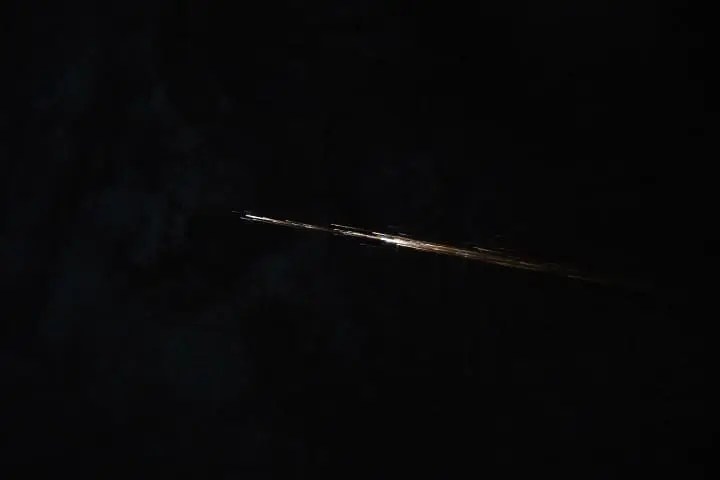
An astronaut aboard the International Space Station captured a surprising sight on April 27: a bright object visibly disintegrating in Earth’s atmosphere, initially mistaken for an incoming cargo ship. The event occurred within a crowded orbital environment, where NASA tracks tens of thousands of trackable objects, including satellites and debris, in the thermosphere and exosphere. While Progress 95 (also called Progress MS-34) docked successfully that same day, the astronaut documented the breakup with three sequential photographs taken 30 to 40 seconds apart. “I saw its tail grow and then split apart into a shower of smaller pieces,” the crew member later wrote on social media, describing “quite a light show!” Determining the exact source, whether a spent rocket stage, defunct satellite, or even meteoric material, remains difficult, highlighting the constant influx and decay of objects orbiting our planet.
On April 27, an astronaut aboard the ISS captured a sequence of three photographs, taken between 30 and 40 seconds apart, revealing an object visibly disintegrating within Earth’s atmosphere. Initially, the crew member anticipated sighting Progress 95, an incoming cargo craft, but instead observed a bright streak below. NASA scientists believe the observed disintegration could have been caused by the reentry of the rocket stage used to launch the cargo ship, another rocket body, a satellite, or other space debris, though meteoric material remains a possibility. Determining the precise source is difficult without knowing the exact camera orientation at the time of the images. Most large orbital debris originates from fragmented satellites and launch vehicles, concentrated within 2,000 kilometers of the surface and traveling at approximately 25,000 kilometers per hour, according to NASA’s Orbital Debris Program Office.
Some debris can remain in orbit for centuries, but objects below 600 kilometers typically fall back to Earth within a few years, heating to extreme temperatures and breaking apart as they encounter the atmosphere. The ISS Crew Earth Observations Facility continues to provide valuable imagery, making these observations freely available to scientists and the public.
This includes operational satellites alongside a growing population of space debris, supplemented by the daily influx of dozens of tons of meteoric material. NASA scientists believe the astronaut may have observed the reentry of a rocket body, defunct satellite, or other human-made debris, but determining the precise source remains difficult without knowing the camera’s exact orientation. As debris descends, atmospheric compression heats it to extreme temperatures, ultimately causing it to break up and vaporize; this process is a constant, visually dramatic feature of the near-Earth environment.
Researchers at NASA’s Crew Earth Observations office are meticulously analyzing images captured from the International Space Station to understand an unusual atmospheric event witnessed on April 27th. An astronaut, anticipating the arrival of Progress 95, also known as Progress MS-34, instead observed a bright object disintegrating in the upper atmosphere directly below the station. However, Progress MS-34 successfully docked as planned that same day, confirming the observed event was separate. The source of the disintegration remains uncertain, but possibilities include the reentry of a spent rocket stage, a defunct satellite, or even naturally occurring meteoric material. As debris descends, atmospheric compression and drag generate intense heat, ultimately causing the object to break apart and vaporize.



See today’s quantum computing news on Quantum Zeitgeist for the latest breakthroughs in qubits, hardware, algorithms, and industry deals.