Since their discovery in 1934, perfluoroalkyl and polyfluoroalkyl substances, or PFAS, have seen expanding use, now becoming critical in surging semiconductor manufacturing despite growing environmental concerns, SandboxAQ says. Semiconductor component maker Brewer Science notes PFAS are used in crucial processes like photolithography, etching, and cleaning, prompting exemptions from recent state bans due to a lack of readily available alternatives. SandboxAQ aims to change that, receiving $500 million through the CHIPS and Science Act to deploy artificial intelligence in researching new chemistries.
“SandboxAQ has a goal to find alternative candidates in two to four years using advanced computational methods,” said Stefan Leichenauer, VP of engineering. The Silicon Valley startup will also explore alternatives for rare-earth-free magnets, catalysts, and batteries.
SandboxAQ Targets Semiconductor PFAS with Advanced Computation
The semiconductor industry’s reliance on PFAS is facing a focused challenge. SandboxAQ is applying advanced computation to discover PFAS-free alternatives, a pursuit spurred by a $500 million investment through the CHIPS and Science Act. While state lawmakers increasingly ban perfluoroalkyl and polyfluoroalkyl substances, or PFAS, in numerous products, semiconductor manufacturing currently receives an exemption due to a lack of viable replacements for critical processes like photolithography and etching.
This exemption underscores the complex interplay between environmental regulations and the demands of a rapidly growing, technologically dependent world. SandboxAQ’s approach centers on large quantitative models, or LQMs, a proprietary system combining computational physics, chemistry, and artificial intelligence. Stefan Leichenauer, vice president of engineering at SandboxAQ, explained the company’s core strength lies in tackling exceptionally difficult problems, including the development of new materials and the mitigation of supply chain risks.
The team isn’t simply relying on existing AI tools; they’ve built a system designed to avoid the pitfalls of large language models, which are prone to generating inaccurate information. Instead, SandboxAQ generates its own high-quality data using established computational methods, then feeds this data into AI models specifically trained to understand the nuances of physics and chemistry. This allows the system to reliably identify potential PFAS replacements without the inaccuracies common in models trained on broad internet datasets.
The LQMs are designed to provide quantitative answers, outputs describing real-world properties, enabling objective verification of results. “Fundamentally, it’s because we can objectively see if the answer is right or wrong, because we can check,” Leichenauer said, describing the self-correcting loop built into the system.
The company’s initial work involved a record-setting 1 million CPU hour simulation in the cloud to model PFAS molecules, demonstrating the computational capacity needed to address the challenge. This foundational research has paved the way for a more ambitious goal: identifying candidate replacements within two to four years. SandboxAQ intends to focus on four key areas beyond PFAS, including catalysts, rare-earth-free magnets, and battery systems, all crucial components within the semiconductor manufacturing ecosystem.
The team acknowledges the complexity of the task, recognizing that some fluorochemicals may prove irreplaceable, but maintains a focused timeline for delivering viable alternatives. The development of LQMs represents a departure from conventional AI approaches, prioritizing data generated through rigorous scientific methods over information scraped from the internet. This focus on verifiable data is critical for a field where accuracy is paramount.
SandboxAQ’s strategy isn’t merely about finding a replacement for PFAS; it’s about discovering formulations that replicate the desired properties without the associated environmental drawbacks, according to the company. “So our secret sauce, our claim to fame, is this thing that we call the large quantitative models, LQMs,” Leichenauer said. “It’s a kind of computational physics and computational chemistry combined with AI in order to do this new materials discovery.”
However, the urgency to find alternatives is now driven by growing environmental concerns and legislative action. SandboxAQ believes its computational approach offers a viable pathway to eliminate these chemicals from a critical industry, ultimately aiming to drive adoption of PFAS-free materials throughout the semiconductor supply chain. “This is not a 20-year goal,” Leichenauer affirmed. “This is a two- to four-year goal that we have to really find candidate replacements using our computations and show with real-world testing that they can actually work.”
CHIPS Act Funds 2-4 Year PFAS Alternative Timeline
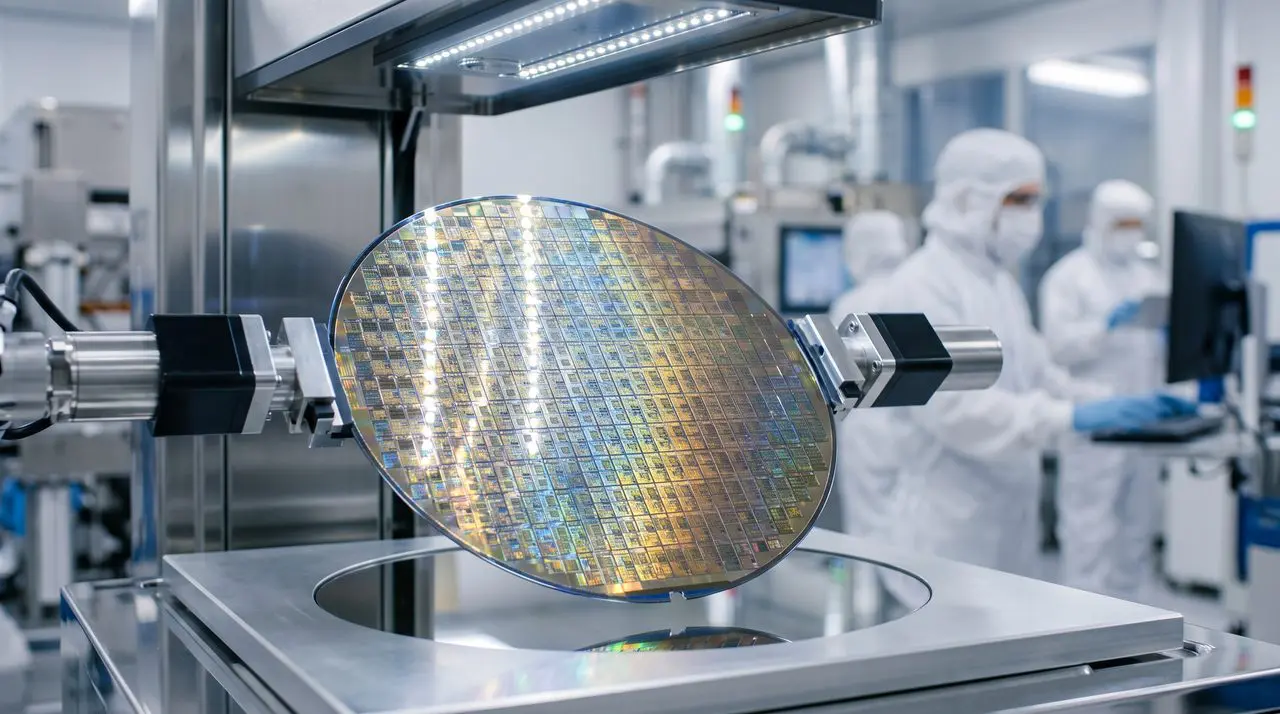
The semiconductor industry currently operates under a unique exemption from growing PFAS restrictions, a situation stemming from a lack of viable alternatives for critical manufacturing processes. Brewer Science notes that photolithography, etching, and cleaning steps presently require these chemicals to achieve necessary performance levels. This reliance, despite mounting environmental concerns, underscores the complexity of transitioning away from PFAS in a sector vital to modern technology.
Even the most advanced chipmaking techniques, such as extreme ultraviolet lithography (EUV), depend on PFAS chemicals within photoresists and anti-reflective coatings, demonstrating the pervasiveness of the issue beyond older manufacturing methods. This strategy extends beyond PFAS alternatives to encompass research into rare-earth-free magnets, battery systems, and catalysts, all crucial components within the semiconductor supply chain.
The company’s timeline for delivering candidate PFAS replacements is ambitious, aiming for results within two to four years, a timeframe significantly shorter than the timeline of three to 25 years stated by the Semiconductor Industry Association’s PFAS Consortium. Central to SandboxAQ’s approach is the development of what they term LQMs. Leichenauer clarified that while large language models can offer answers to complex questions, they are prone to generating incorrect or nonsensical responses.
SandboxAQ’s LQMs, however, are trained on data created through scaled-up but verifiable computational physics, allowing for objective validation of results. This emphasis on verifiable data is critical; the team can objectively assess the accuracy of a proposed molecular structure or formulation, using non-AI methods to confirm its properties and correct the model if necessary. This self-correcting loop, generating data, training, checking, and retraining, is a core component of their methodology.
The development of these LQMs is a combination of computational physics, computational chemistry, and artificial intelligence, enabling a new approach to materials discovery, the company says. The team can define desired characteristics and then computationally search for molecules or formulations that meet those criteria. This process is iterative, involving laboratory testing and refinement based on the results.
PFAS Simulation Validates SandboxAQ’s Computational Capabilities
Beyond PFAS, SandboxAQ’s research extends to rare-earth-free magnets, catalysts, and battery systems, all areas crucial to the semiconductor supply chain. The urgency to find PFAS replacements stems from the chemicals’ persistence in the environment and growing health concerns, yet their unique properties have made them indispensable in semiconductor fabrication. SandboxAQ’s strategy diverges from traditional materials science by prioritizing computational modeling, generating vast datasets through scaled-up computational physics methods rather than relying on internet-sourced information. Unlike large language models, LQMs are not trained on broad internet data but on rigorously generated, physics-based simulations.
This allows the team to objectively validate the accuracy of computational predictions through non-AI methods, establishing a self-correcting loop of data generation, training, checking, and refinement, SandboxAQ reports. Leichenauer clarified that the research is not merely theoretical; the company has already conducted preliminary work on PFAS, though not specifically for replacements.
He stated, “We have worked on PFAS before.” If a proposed molecule fails validation through non-AI methods, the model is retrained, ensuring continuous improvement and minimizing the risk of inaccurate predictions. The company acknowledges the difficulty of the task, but believes its computational methods offer a viable path toward eliminating PFAS from semiconductor manufacturing, and ultimately, to get rid of PFAS once and for all.



See today’s quantum computing news on Quantum Zeitgeist for the latest breakthroughs in qubits, hardware, algorithms, and industry deals.