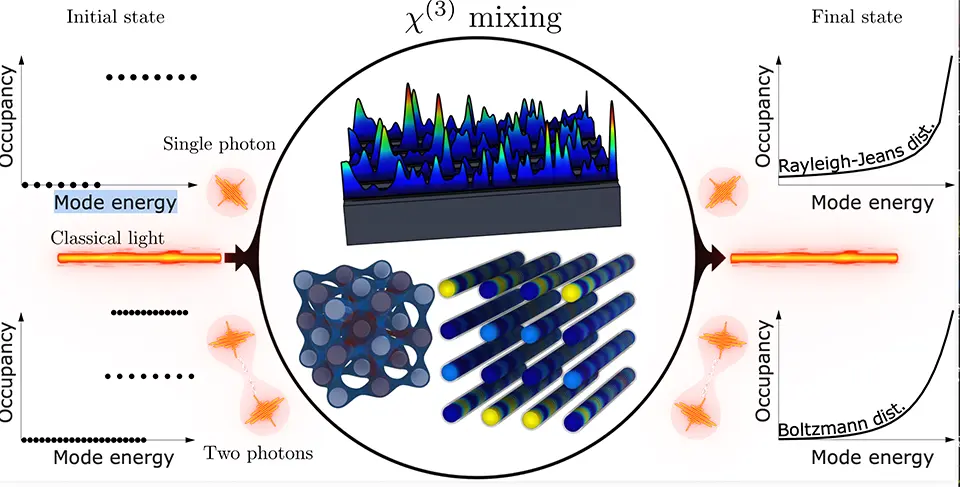
Researchers from Saint Louis University, the Max Born Institute and Humboldt-Universität zu Berlin report demonstrating that classical light’s nonlinear dynamics can influence quantum states, a surprising connection between traditionally separate fields. Published in Science Advances, the international team harnessed multimode nonlinear optical platforms to induce thermalization in single- and two-photon states.
“By leveraging the intense classical wave dynamics to mediate effective interactions, the system bridges the gap between macroscopic nonlinear optics and microscopic,” explains Armando Perez-Leija, research scientist at Saint Louis University. This approach offers a new way to simulate complex quantum systems using accessible optical technology, bypassing the need for difficult-to-fabricate materials.
Nonlinear Optics Induce Quantum Thermalization of Photons
This outcome challenges the conventional understanding of photon behavior, as photons typically avoid direct interaction, a limitation overcome by embedding them within intense classical light fields. Şahin K. Özdemir of Saint Louis University explained that this work lowers the experimental barriers required to study complex quantum photon interactions. This achievement bypasses the need for exotic materials traditionally required to induce strong photon interactions. Instead, the researchers used standard, readily available classical optical structures to achieve quantum thermalization.
Ramy El-Ganainy, also of Saint Louis University, emphasized the broader implications, stating, “The implications of this work extend far beyond foundational optics, reaching deep into statistical mechanics and condensed matter physics.” The ability to simulate quantum behaviors previously considered inaccessible offers a powerful, controllable testbed for investigating open quantum systems and many-body thermodynamics.
This platform allows researchers to explore complex quantum phenomena, including quantum phase transitions, within standard laboratory optical settings. The research extends beyond simply observing thermalization; it provides a means to study how statistical equilibrium emerges in quantum systems. According to El-Ganainy, the framework established by this work offers researchers a highly controllable environment for probing these complex interactions.
The title of the published study, “Thermalization of quantum light induced by classical nonlinear wave dynamics,” encapsulates the core finding of the investigation. The team’s success in achieving effective quantum thermalization using accessible optical technology represents a step toward simulating complex quantum systems, offering a pathway to explore previously intractable problems in physics and potentially leading to advancements in quantum technologies.
By lowering the experimental barriers required to study complex quantum photon interactions, the research opens fresh avenues for light dynamics and deepens our fundamental understanding of how statistical equilibrium emerges in quantum systems.
Ozdemir




See today’s quantum computing news on Quantum Zeitgeist for the latest breakthroughs in qubits, hardware, algorithms, and industry deals.