


Sumit Chongder, Institute of Technology Jodhpur, reports a key advance in quantum error correction, improving logical accuracy from 99.21% to 99.81% at a confidence threshold of 0.95. Real-time decoding previously presented a major obstacle to scaling quantum computing. An adaptive confidence-gated framework now rapidly processes syndrome measurements using a neural network. The approach routes only 3.3%-6.2% of syndromes to a more detailed refinement stage, achieving a decoding throughput of 4.6 times 105 samples s-1. The Indian Institute of Technology Jodhpur team has refined a method for correcting errors in quantum computers by combining artificial intelligence with established techniques. This new approach uses a neural network to quickly assess most error signals, known as syndromes, and only subjects a small fraction, between 3.3% and 6.2%, to a more thorough analysis.
Consequently, logical accuracy improved from 99.21% to 99.81%, representing a step towards building more reliable quantum systems. The Institute of Technology Jodhpur team has made progress in tackling a vital challenge in quantum computing: error correction. The team has developed a new decoding framework that combines the speed of artificial intelligence with the precision of traditional methods, specifically a technique called minimum-weight perfect matching, which efficiently connects pairs of errors like linking cities with the shortest road network. By intelligently processing readings taken from qubits, analogous to a doctor checking a patient’s temperature, the framework improved logical accuracy from 99.21% to 99.81%. This advancement raises the possibility of further optimising this hybrid approach to achieve even greater stability and scalability in quantum systems.
Adaptive neural network boosts quantum error correction accuracy and throughput
A dramatic improvement in logical accuracy was observed, rising from 99.21% to 99.81% at a confidence threshold of 0.95, representing a strong leap in quantum error correction performance. This surpasses previous neural-only decoding baselines, enabling more reliable quantum computations, as achieving comparable accuracy previously demanded significantly more computational resources. Quantum Information and Co, alongside the Indian Institute of Technology Jodhpur, accomplished this by intelligently combining a fast neural network with a more precise, albeit slower, refinement stage.
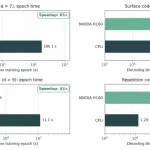
The adaptive confidence-gated framework routes just 3.3% to 6.2% of error syndromes to the refinement stage, achieving a decoding throughput of 4.6 times 105 samples s-1 on standard CPU hardware, a key step towards scalable quantum computing. Researchers at Quantum Information and Co and the Indian Institute of Technology Jodhpur benchmarked this approach on rotated surface codes, varying code distances from three to eleven, and simulated depolarising noise using the Stim stabiliser simulator, a software package for quantum simulation. Reaching 4.6 times 105 samples s-1 on standard CPU hardware indicates the neural network’s speed does not limit performance for larger codes beyond a distance of seven. However, the improvements do not yet demonstrate performance on actual quantum hardware, nor do they address the challenges of optimising the system for multiple types of noise simultaneously.
Accelerating quantum decoding through selective error analysis
Quantum error correction is computationally intensive, and identifying ways to accelerate the decoding process, quickly spotting and fixing errors, is important for building larger, more reliable quantum computers. A pathway to faster correction without substantially sacrificing accuracy has been demonstrated by intelligently routing only a small fraction of potential errors to a more complex analysis stage, marking a vital step forward. This establishes a new decoding approach for quantum error correction, intelligently combining a rapid neural network with a more detailed, but slower, refinement stage utilising minimum-weight perfect matching, a technique for efficiently pairing errors.
The team at Quantum Information and Co and the Indian Institute of Technology Jodhpur have demonstrably improved the speed of quantum error correction, a vital step towards building practical quantum computers. Their current simulations, while thorough, rely on an idealised environment, and the team acknowledges that real-world quantum hardware introduces noise patterns and device limitations not fully captured by the Stim stabiliser simulator. Despite relying on simulations rather than physical hardware, the team’s achievement remains significant. Routing only a small percentage of error signals to the computationally intensive refinement process improved logical accuracy to 99.81% at a confidence threshold of 0.95.
The research successfully demonstrated an improved method for decoding quantum error correction, achieving 99.81% logical accuracy with a confidence threshold of 0.95. This matters because faster and more accurate decoding is crucial for scaling up quantum computers and making them more reliable. The team achieved this by using a neural network to quickly assess most error signals, and only sending 3.3%-6.2% to a more detailed analysis. They indicate that the neural network’s speed is not a limiting factor for codes beyond a distance of seven, and have released their benchmarking pipeline and models for wider use.
👉 More information
🗞 Latency-Constrained Hardware-Aware Quantum Error Correction Co-Design with Adaptive Confidence-Gated Neural Decoding for the Rotated Surface Code
✍️ Sumit Chongder
🧠 ArXiv: https://arxiv.org/abs/2607.05814


See today’s quantum computing news on Quantum Zeitgeist for the latest breakthroughs in qubits, hardware, algorithms, and industry deals.



