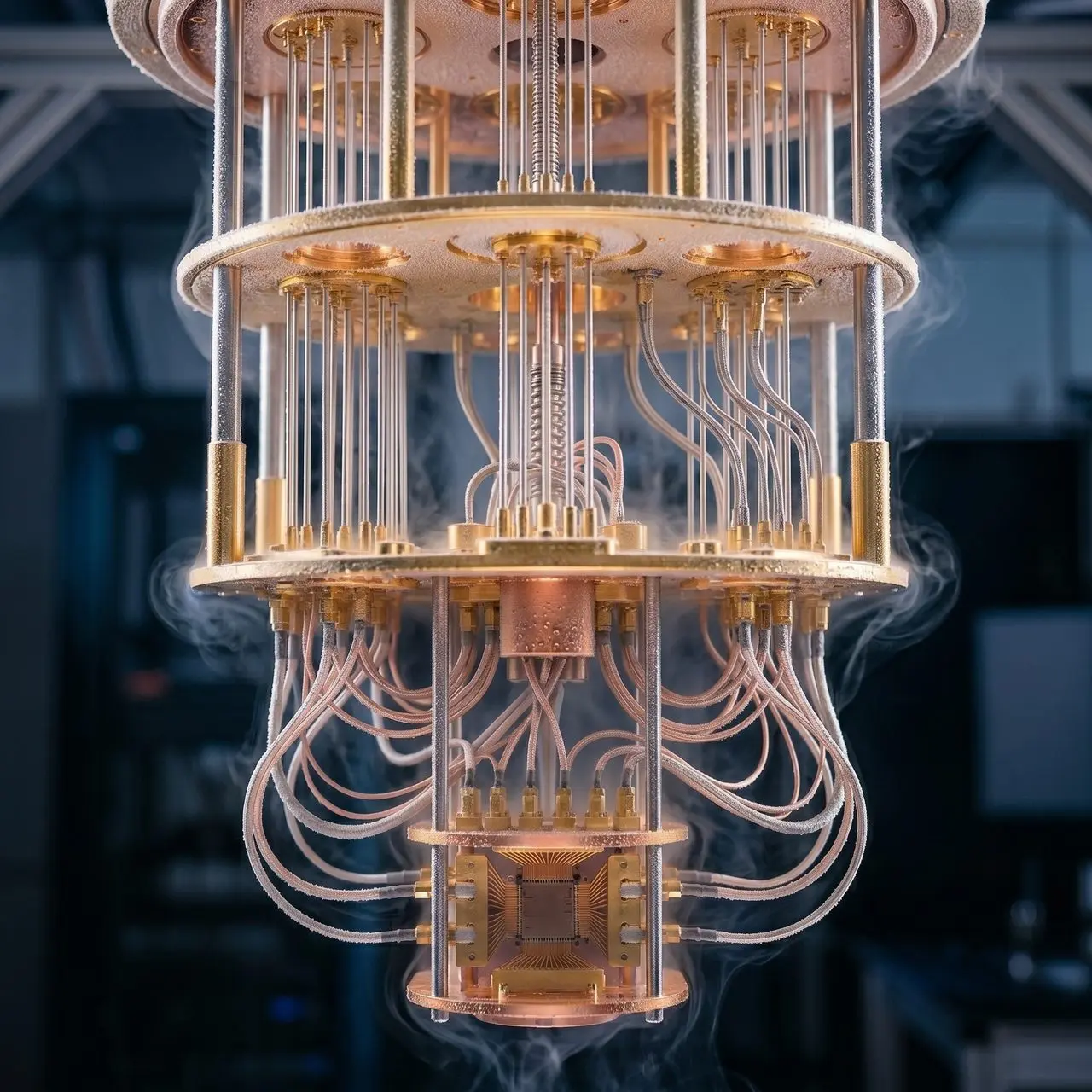
Alpine Quantum Technologies joins a €122 million project led by QUDORA to build a 1,000-qubit fault-tolerant quantum computer, advancing Germany’s national technology agenda. The NFQC-1k project, funded by Germany’s Federal Ministry of Research, Technology and Space, unites seven research institutions and industry partners in a bid to create one of Europe’s most advanced quantum computers using trapped-ion technology.
Germany’s Federal Minister Dorothee Bär emphasizes that “quantum computers are among the most important key technologies of our time and will take computing power to a new level.” The consortium aims for a system usable in Germany and Europe long-term.
NFQC-1k Project: €122 Million Investment in 1,000-Qubit Development
This investment emphasises Germany’s commitment to establishing a leading position in quantum technology, prioritizing it as the second of six key technologies within its High-Tech Agenda Deutschland. The project’s ambitious goal extends beyond simply increasing qubit count. It focuses on achieving a demonstrator with at least 1,000 individually addressable physical qubits and, critically, 50 logical qubits exhibiting a logical gate error rate below 0.01%. This performance benchmark will be verified through the implementation of a Quantum Fourier Transform (QFT), a fundamental operation for many quantum algorithms and applications.
Simultaneously, the consortium intends to establish a pilot line for high-performance quantum processing units (QPUs) based on ion-trap technology. QUDORA, as the consortium lead, will oversee the development and integration of the complete system, using the specialized expertise of each partner.
Hannover and the Technical University of Braunschweig will contribute fundamental research, while NXP Semiconductors Germany GmbH brings its expertise in semiconductor technology to the collaboration, the company says. Physikalisch-Technische Bundesanstalt, Germany’s national metrology institute, will contribute to the project. This large interdisciplinary research center will also advance the project’s objectives.
“Fault tolerance is not a milestone achieved by improving a single qubit,” said Amado Bautista-Salvador, CEO of QUDORA. “What truly matters is building an architecture in which thousands of resilient qubits can be controlled and operated reliably, without the system falling apart as it scales.” The funding, allocated through the BMFTR’s “Mission-Driven Hardware Competition: Fault-Tolerant Quantum Computing with Pilot Line Development,” will support the project for up to five years.
Henning Hahn, COO of QUDORA, stated, “NFQC-1k builds on our NFQC technology to develop a fault-tolerant quantum computer alongside leading German research institutions and companies. That our project has been selected shows the confidence of the German government in our technology and the expertise of our partners.” Their role specifically centers on contributing to the demonstrator’s ability to control a significant number of logical qubits at extremely low error rates, demonstrating the maturity of their trapped-ion technology.
The consortium’s ultimate aim is to create a quantum computer system that can be deployed for economic use within Germany and across Europe, solidifying the region’s position in the rapidly evolving field of quantum computation. Following a successful outline phase, the consortium will now submit a full application to begin the concrete implementation of the NFQC-1k project.
NFQC-1k builds on our NFQC technology to develop a fault-tolerant quantum computer alongside leading German research institutions and companies. That our project has been selected shows the confidence of German government in our technology and the expertise of our partners.
Henning Hahn, COO of QUDORA


See today’s quantum computing news on Quantum Zeitgeist for the latest breakthroughs in qubits, hardware, algorithms, and industry deals.