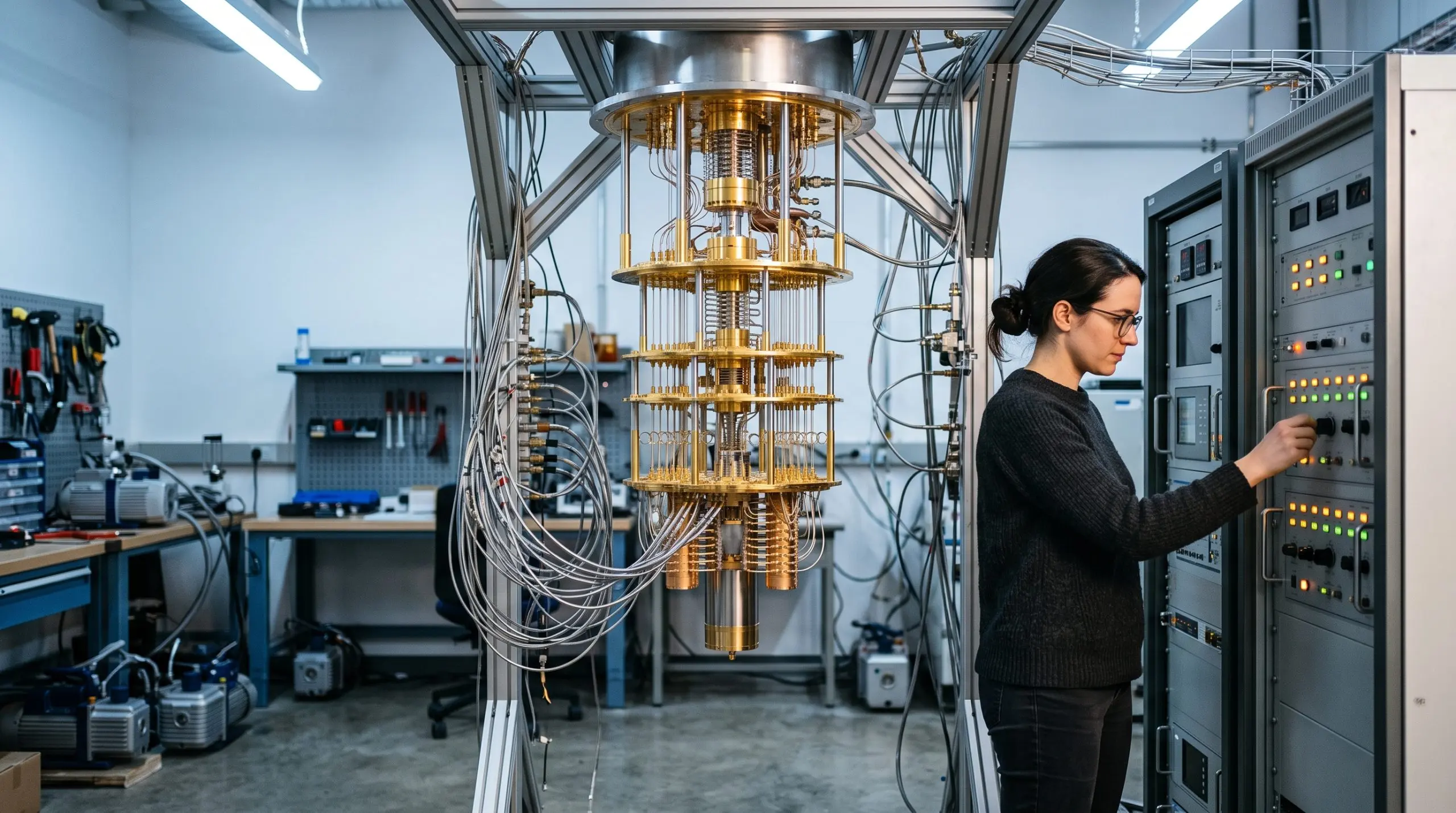
IonQ is now facing a critical test of its quantum system under DARPA’s Quantum Benchmarking Initiative, moving beyond capability demonstrations to assess real-world return on investment, the company says. DARPA first calculated the potential industrial value of quantum computing, then set a timeline for achieving it, a methodology focused on quantifiable benefit.
“People have been putting a large investment into quantum technologies for a long time, and what the Quantum Benchmarking Initiative (QBI) wants to answer is whether those technologies are worth more than they cost,” says Dr. Rick Muller, IonQ’s Chief Scientist for IonQ Federal, as the company enters Stage C, requiring validation of its “walking cat” architecture on real hardware.
DARPA’s Quantum Benchmarking Initiative: Validating Quantum Value
DARPA’s approach to evaluating quantum computing prioritizes quantifiable industrial benefit, beginning with an assessment of potential applications and calculating the time required for a quantum computer to solve relevant problems. The agency first identified sectors where quantum computers could offer a distinct advantage, then estimated the economic value of solving specific challenges within those industries.
The Quantum Benchmarking Initiative (QBI) aims to establish a standardized metric for comparing diverse quantum technologies, ranging from photonic to superconducting approaches. Dr. Rick Muller of IonQ Federal explained that each company currently presents metrics favoring its own system, creating a fragmented landscape of performance claims.
QBI seeks to resolve this by applying a common set of benchmarks, specifically focusing on the “cost-to-solution” of industrially relevant problems, allowing for objective comparison and informed investment decisions. This independent testing is intended to reveal which technologies offer the most promise for practical applications. IonQ’s long-term roadmap aligns with the principles underpinning DARPA’s QBI, demonstrating a proactive approach to addressing the initiative’s requirements, according to the company.
The company’s internal development focused on qubit design and performance, anticipating the need for rigorous validation against external standards. This preparation is particularly critical for IonQ as it enters Stage C of the QBI, a phase dedicated to real-world hardware validation. “All of the results that IonQ have been publishing over the last year really have come from the type of long-term roadmapping thinking that went into DARPA’s Quantum Benchmarking Initiative,” Muller stated.
A key concern driving IonQ’s participation in QBI is the evolving threat to current encryption standards, specifically those protecting financial transactions. For decades, the company believed the timeline for quantum computers to break existing security protocols was distant. However, the QBI process is now verifying that the timeframe for potential compromise is rapidly approaching. This highlights the urgency of developing quantum-resistant cryptography. Stage C of the QBI represents a critical “prove it” phase, demanding that ambitious plans translate into demonstrable results.
The analogy to boxing, invoked by Muller referencing Mike Tyson, highlights the importance of performance under pressure. “Everybody has great plans. Mike Tyson once said that everybody’s got a plan until they get hit in the mouth,” he said.
This stage requires IonQ to demonstrate the practical value of its quantum system, moving beyond theoretical potential to tangible outcomes. The implications of successful Stage C validation extend beyond IonQ, informing policymakers about the current state of quantum technology. The initiative provides a clear assessment of which technologies are genuinely poised for near-term deployment, enabling strategic investment and policy decisions.
Stage C Validation: Real-World Hardware and “No-Go” Conditions
Stage C validation demands IonQ demonstrate quantifiable value from its quantum system, establishing “no-go” conditions that must be met by 2033 to prove the technology’s viability. This phase moves beyond theoretical roadmaps and fidelity measurements to assess whether IonQ’s hardware can deliver computational advantages exceeding its cost, a critical benchmark for sustained investment.
The initiative began by identifying key industrial applications and calculating the timeframe for quantum computers to solve problems within those sectors, effectively defining a return-on-investment target. The core of Stage C lies in independent verification, a process designed to establish a common yardstick for evaluating the diverse approaches within quantum computing.
Rick Muller of IonQ Federal explains, “What the independent testing in the Quantum Benchmarking Initiative is intended to do is put them all on that same yardstick – on a similar set of metrics, like cost-to-solution of these important problems – so that the government actually knows what the most promising technologies really are.” This standardized assessment addresses the challenge of comparing technologies using photons, atoms, or superconducting circuits, each with its own performance metrics. The reputation for rigorous testing extends the impact beyond the U.S., providing a globally recognized signal of technological maturity.
IonQ’s recent advancements in gate fidelity, its “walking cat” architecture, and cryptographic resource modeling are not isolated achievements, but rather interconnected building blocks supporting its Stage C objectives. The company’s work on elliptic curve cryptography exemplifies this integrated approach, optimizing a specific problem to estimate the resources required for meaningful computation.
Jeff Rothblum notes that this progression mirrors the development of conventional computers, enabling input, algorithm execution and application deployment, the company says. “So it seems like what you’re saying is all of these steps that we’ve taken have basically been the building blocks to getting to a computer that someone would understand as a normal computer,” Rothblum observed. Beyond cryptography, the potential of quantum computing extends to materials science, medicine and energy, promising to accelerate the design of new materials, pharmaceuticals and sustainable technologies.
Muller highlights that quantum mechanics underpins much of the physics used in these fields, and quantum computers excel at simulating these complex quantum effects. However, this advancement also introduces risks to existing internet security protocols, prompting IonQ to focus on defensive measures.
Muller, with experience in both government and industry, highlights the importance of rapid advancement within the U.S, the company states. to maintain a strategic advantage. The success of Stage C validation will not only determine IonQ’s future but also inform policymakers and shape the trajectory of quantum computing worldwide.
Fidelity and Architecture: IonQ’s Path to Fault Tolerance
IonQ’s recent fidelity measurements demonstrate what the company asserts are the most accurate qubits currently undergoing industry testing, a key component in its pursuit of fault tolerance. These results, combined with the company’s “walking cat” architecture, address a critical question: can these high-performing qubits be assembled into a system capable of correcting the inherent errors in quantum computation and achieving reliable results. The architecture’s flexibility allows for tuning to specific applications, a feature highlighted as essential for practical quantum computing.
The progression of the Quantum Benchmarking Initiative’s stages, A, B, and C, represents a significant escalation in validation requirements, and stage A focused on conceptual viability, while Stage B assessed initial implementation. Stage C, however, demands a comprehensive demonstration of a system’s ability to tackle relevant problems with quantifiable benefits.
This rigorous testing isn’t solely a domestic concern. The results are closely watched by international allies, signaling technological leadership on a global scale. IonQ’s recent work on elliptic curve cryptography illustrates how these elements converge. The company optimized a well-studied problem, signatures used in blockchain additions, using its “walking cat” architecture and fidelity measurements.
Jeff Rothblum, a Director of Global Government Affairs at IonQ, described this as building toward a “normal computer”, one capable of accepting input, running algorithms and executing applications. IonQ anticipates a “superpower” in accelerating the development of new materials, pharmaceuticals, solar cells and even computing architectures.
However, this same capability poses a risk to existing internet security, prompting a parallel focus on developing defenses before adversaries can exploit the technology. “Now, IonQ also know the other thing that quantum computers can do well is solve some of the mathematical equations that go into internet security,” Muller stated. This creates a clear imperative for the U.S. and its allies to lead in quantum technology development.
The company’s commitment to winning this “very real race” is reflected in its strategic investments. This focus on quantifiable industrial benefit, as determined by initial assessment of applications and timelines, highlights a shift toward practical value.

See today’s quantum computing news on Quantum Zeitgeist for the latest breakthroughs in qubits, hardware, algorithms, and industry deals.