

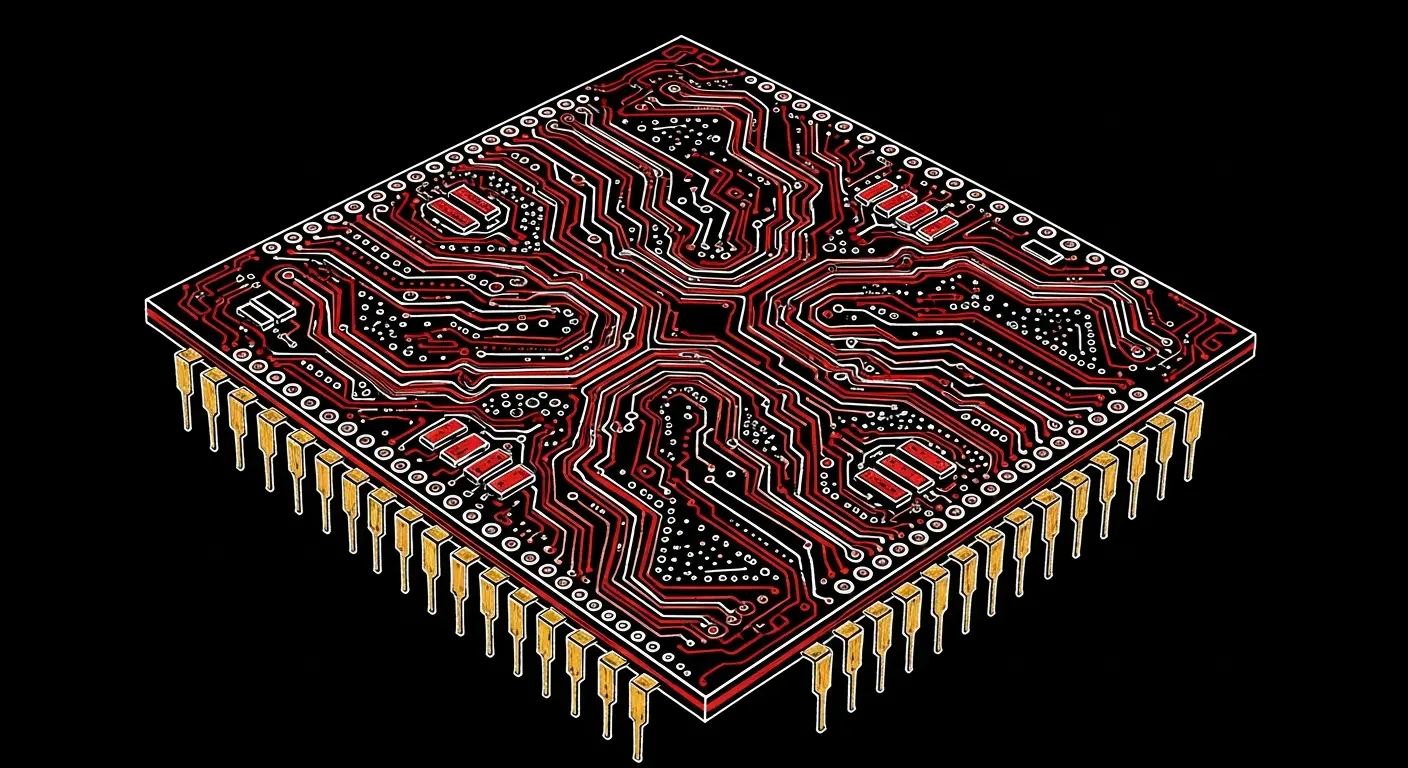
Scientists at the University of Delaware, led by Kien X. Nguyen, have developed a new approach to qubit routing that addresses a fundamental computational difficulty in quantum compilation. They present QAP-Router, which frames qubit routing as a dynamic Quadratic Assignment Problem. The method substantially improves upon existing techniques by modelling both logical interactions and hardware topology within a unified objective, and employing a solution-aware Transformer network alongside a lookahead mechanism. Results demonstrate significant reductions in CNOT gate count, achieving 15.7% on MQTBench, 30.4% on AgentQ, and 12.1% on QUEKO datasets when compared to current industry-standard compilers, representing a considerable advance for practical quantum computation.
Optimised qubit routing significantly reduces quantum circuit complexity
A 30.4% reduction in CNOT gate count on the AgentQ dataset has surpassed the performance of current industry-standard quantum compilers. This addresses a longstanding challenge in quantum computation, where efficiently mapping operations onto physical hardware has remained a significant hurdle. Previously, complex quantum circuits demanded excessive gate counts, hindering scalability and increasing error rates. The core issue stems from the NP-hard nature of qubit routing, meaning the computational effort required to find the optimal solution grows exponentially with the number of qubits. Existing heuristic methods often rely on local rules with limited lookahead, leading to suboptimal routing decisions that propagate and compound throughout the circuit. QAP-Router, the new method, frames qubit routing as a dynamic Quadratic Assignment Problem, a mathematical framework enabling a more holistic and optimised approach to information flow. The Quadratic Assignment Problem (QAP) traditionally deals with assigning facilities to locations, minimising overall transportation costs; here, it’s adapted to assign logical qubits to physical qubits, minimising the ‘cost’ of interactions based on physical distance and connectivity.
Circuits from the MQTBench dataset also showed a 15.7% reduction in gate count, alongside the 30.4% achieved on AgentQ, indicating consistent performance gains across varied quantum workloads. This consistency is crucial, as different quantum algorithms and applications exhibit varying connectivity requirements. The QAP-Router system utilises a novel approach, modelling logical interactions as ‘flow matrices’ and hardware layout as a ‘distance matrix’ to optimise information flow; this captures the relationship between qubit interactions and their physical distance on the processor. The flow matrix represents the frequency and strength of interactions between logical qubits, while the distance matrix quantifies the physical separation and connectivity between physical qubits. Incorporating a ‘lookahead mechanism’ further improves circuit efficiency by weighting near-term interactions more heavily than those further in the future, preventing short-sighted routing decisions. This mechanism considers the impact of current routing choices on future qubit placements, optimising for long-term circuit performance. While these results represent a substantial improvement in reducing computational overhead, performance on significantly larger, more complex circuits, those required for fault-tolerant quantum computation involving hundreds or thousands of qubits, remains to be demonstrated. The current evaluation focuses on benchmark datasets, and real-world applications may present additional challenges.
Scaling quantum circuits requires adaptable routing policies for increased efficiency
QAP-Router reduces the number of CNOT gates needed to execute quantum circuits, but a key question remains regarding its adaptability to different quantum architectures. The current implementation necessitates training a separate routing policy for each specific quantum processor size, potentially creating a bottleneck as quantum computers scale upwards. This reliance on custom policies limits the technique’s broader application and introduces a significant engineering challenge, as each new processor demands a fresh learning process. The Transformer network, a key component of QAP-Router, learns to map logical qubit interactions to physical qubit placements based on the training data. Retraining this network for each new processor size is computationally expensive and time-consuming. Future research could explore techniques for transfer learning or meta-learning to enable the model to generalise across different architectures with minimal retraining. This would significantly enhance the scalability and practicality of the approach.
Fewer gates translate directly into shorter runtimes and reduced error rates on near-term quantum hardware. The reduction in CNOT gates is particularly significant, as these gates are prone to errors and contribute substantially to circuit overhead. By optimising how quantum information flows across a processor, QAP-Router reframes qubit routing as a dynamic Quadratic Assignment Problem. Considering both logical requirements and hardware limitations simultaneously, the system models interactions between quantum gates as ‘flow matrices’ and the physical layout as a ‘distance matrix’. This holistic approach to routing decisions demonstrably reduces the number of CNOT gates, essential operations in quantum computing, across benchmark datasets. The underlying principle is to minimise the total ‘cost’ of communication between qubits, where cost is determined by both the logical interaction strength and the physical distance between qubits. The solution-aware Transformer network plays a crucial role in learning this complex relationship and generating efficient routing solutions. The implications of this work extend beyond simply reducing gate counts; it paves the way for more efficient quantum algorithms and the development of larger, more powerful quantum computers.
The research demonstrated a 15.7%, 30.4% and 12.1% reduction in CNOT gate counts across three quantum circuit datasets, MQTBench, AgentQ and QUEKO, when compared to current industry compilers. This matters because fewer gates mean shorter processing times and fewer errors on quantum computers. QAP-Router achieves this by modelling qubit routing as a dynamic Quadratic Assignment Problem, considering both the logical interactions of quantum gates and the physical layout of the hardware. The authors suggest future work could focus on techniques to allow the model to adapt to new processor architectures with less retraining.
👉 More information
🗞 QAP-Router: Tackling Qubit Routing as Dynamic Quadratic Assignment with Reinforcement Learning
🧠 ArXiv: https://arxiv.org/abs/2605.12365



See today’s quantum computing news on Quantum Zeitgeist for the latest breakthroughs in qubits, hardware, algorithms, and industry deals.



