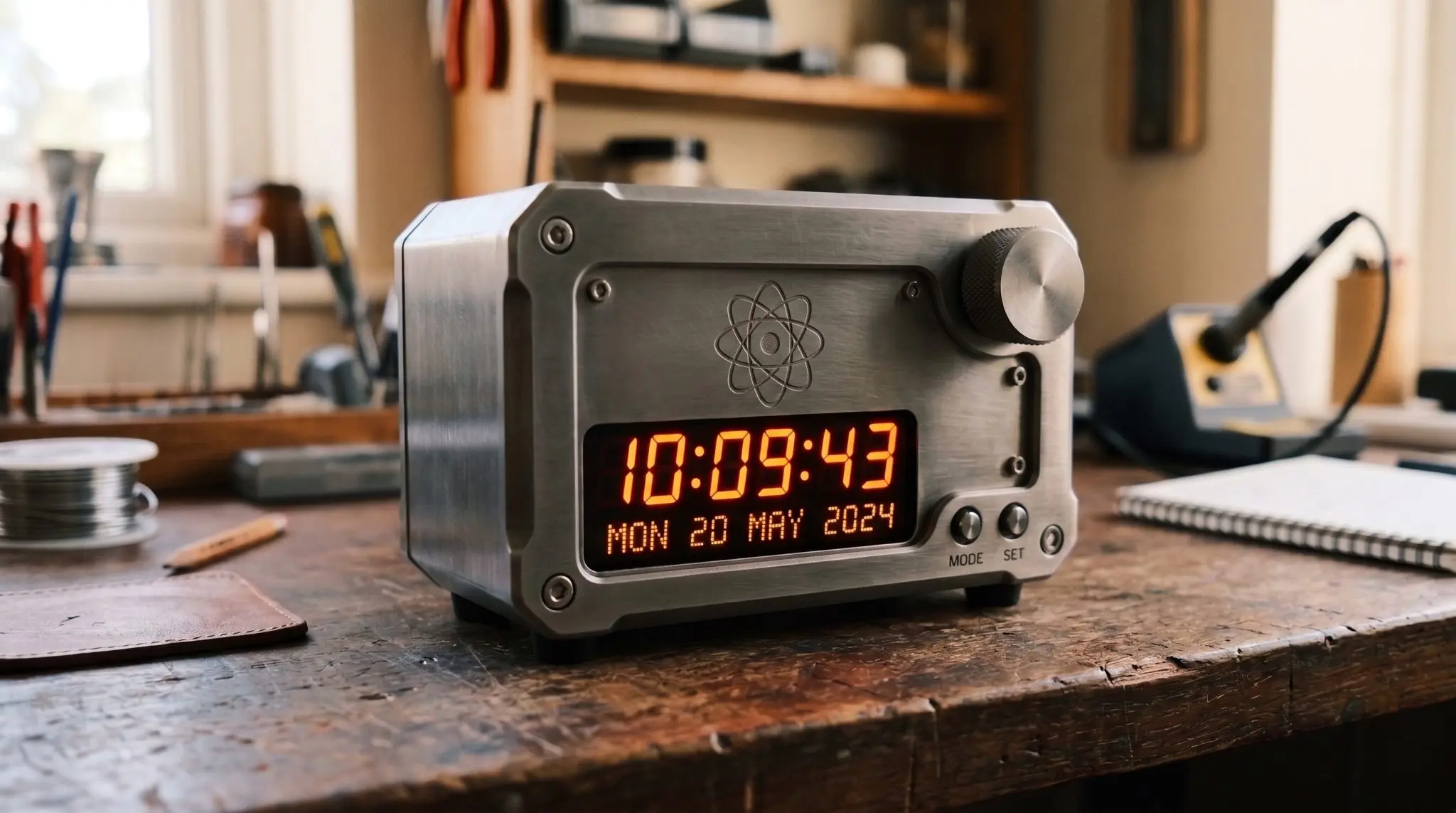
Quantum X Labs has demonstrated a new atomic clock system achieving fractional frequency stability of 1 × 10⁻¹³ at 1 second, a level of precision that signals an advance in compact timing technology. The company reports this milestone coincides with a projected expansion of the atomic clock market, reaching $965 million by 2030 from $512.7 million in 2024, driven by increasing demand for resilient positioning, navigation, and timing systems. This need is underscored by identified threats to GPS, including jamming, spoofing, and cyber risks, as highlighted by the U.S. Government Accountability Office. Nir Sharon, Chief Scientist of Quantum X Labs, discussed how the technology is key to future aerospace, defense, and critical infrastructure applications.
Ramsey-CPT Platform Achieves 1 x 10⁻¹³ Frequency Stability
This level of stability, achieved in a system designed for future miniaturization, suggests the possibility of highly accurate timing systems smaller than current standards. The demonstrated performance highlights the platform’s promise for applications demanding precise timekeeping, extending beyond traditional scientific uses into increasingly critical infrastructure. Atomic clocks are becoming essential for resilient positioning, navigation, and timing (PNT) across multiple sectors. Intent Market Research estimates the global atomic clock market at approximately $512.7 million in 2024, a figure projected to surpass $965 million by 2030, representing an 11.1% compound annual growth rate. This expansion is mirrored in the chip-scale atomic clock market, anticipated to grow from $47 million in 2023 to $86 million by 2030, according to QYResearch.
The increasing demand is driven by a growing awareness of vulnerabilities in existing timing infrastructure, particularly reliance on the Global Positioning System. The U.S. Government Accountability Office has identified significant threats to GPS, including “jamming, spoofing, cyber risks and anti-satellite weapons,” prompting a search for alternative PNT solutions. Quantum X Labs’ development arrives as defense initiatives, such as DARPA’s Robust Optical Clock Network (ROCkN) program, emphasize the need for precision timekeeping in contested environments. The program recognizes that “modern warfare often requires synchronization down to billionths of a second” and that critical systems, missiles, sensors, and aircraft, depend on atomic clocks for nanosecond timing accuracy. Prof.
Our quantum atomic clock represents a foundational component of Quantum X Labs’ broader quantum sensing strategy. Together with our optical gyroscopes, inertial sensing technologies and other quantum sensing platforms under development, the Ramsey-CPT atomic clock leverages the same core competencies in atomic physics, photonics, precision lasers and quantum control.
Prof. Nir Sharon, Chief Scientist of Quantum X Labs



See today’s quantum computing news on Quantum Zeitgeist for the latest breakthroughs in qubits, hardware, algorithms, and industry deals.