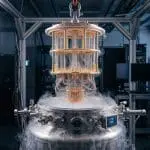
Researchers at Imperial College London have contributed to an advance in the quest to detect dark matter and gravitational waves, overcoming a technical hurdle that previously rendered long-baseline atom interferometers unusable. These devices work by splitting clouds of atoms with lasers and then recombining them to measure minute changes in motion, potentially revealing the subtle influence of dark matter fields shifting the energy levels of the atoms. A significant obstacle has been phase noise from the lasers, noise larger than the signals researchers were attempting to detect, but a new study published in Nature demonstrates a differential approach where comparing two interferometers cancels out shared noise. “Although each individual measurement appeared random, the correlation between them revealed the underlying behaviour of the system,” explain the researchers from the Atom Interferometer Observatory and Network (AION) collaboration, enabling future detectors capable of probing the Universe, which is thought to be composed of around 95% dark matter and dark energy, the nature of which remains one of the biggest unsolved questions in physics.
Long-Baseline Atom Interferometers for Dark Matter & Gravitational Waves
These highly sensitive instruments exploit the wave-like properties of atoms to detect minute shifts in motion, potentially revealing interactions with dark matter fields or the passage of gravitational waves, changes manifested as alterations in atomic energy levels. A hurdle to realizing this potential has been phase noise emanating from the lasers essential for manipulating the atoms, a disturbance previously exceeding the faint signals researchers sought to measure. The research team explains, “The results provide the first experimental validation of a key principle underlying long-baseline atom interferometers, helping to resolve a central challenge in their design.” The team, led by Imperial College London, constructed a tabletop prototype utilizing ultracold strontium-87 atoms and a single ultrastable clock laser, deliberately introducing substantial phase noise to simulate the conditions anticipated in larger, future detectors. Individually, each interferometer’s signal was overwhelmed, effectively erasing the interference patterns needed for measurement.
Remarkably, comparing the two instruments allowed for the recovery of a clear signal, operating at the fundamental limit dictated by quantum physics and confirming the efficacy of the noise cancellation technique. Further validation came with the introduction of an oscillating signal mimicking a gravitational wave or dark matter interaction, which remained detectable even when individual interferometers were unusable. Jack Sander, Project Engineer for AION, said, “Oxford has contributed substantial engineering expertise and senior leadership to the AION-10 project,” highlighting the collaborative effort driving this technology forward. Professor Christopher Foot added, “These findings build on years of progress on quantum technology within the AION programme in lasers and ultracold strontium physics, advances that made the experiment possible.”
Oxford has played a significant role in the success of the AION-10 project, providing both substantial engineering expertise and senior leadership. In particular, our engineers helped define and realise designs underpinning a long baseline atom interferometer, translating ambitious physics requirements into practical, deliverable solutions.
Jack Sander, Project Engineer for AION
Differential Interferometry Cancels Laser Phase Noise
The pursuit of dark matter and gravitational waves has driven innovation in quantum sensing, specifically in the development of long-baseline atom interferometers; however, a persistent challenge has plagued these devices, laser phase noise exceeding the sensitivity of the instruments themselves. Until recently, this noise rendered the technology largely unusable for detecting the subtle signals indicative of dark matter or gravitational disturbances. This setup utilized macroscopically separated clouds of ultracold strontium-87 atoms, interrogated by a single ultrastable clock laser. Crucially, the team deliberately amplified the phase noise to levels expected in long-baseline detectors, effectively obscuring the signal in each individual interferometer. Researchers observed, “Individually, each interferometer became unusable, with its signal obscured by noise,” highlighting the severity of the initial problem. This success isn’t merely a noise reduction technique; it validates a core principle for future detectors, operating at the fundamental limit set by quantum physics.
The laser lab in Oxford uses an ultrahigh vacuum system that was constructed collaboratively within the AION project; this is designed to be suitable for future generations of devices even taller that the 100m instruments currently envisaged.
Strontium-87 Prototype Validates Quantum Noise Cancellation
Researchers at Imperial College London led a recent demonstration validating a critical technique for future dark matter and gravitational wave detectors; the team successfully suppressed laser noise in a prototype long-baseline atom interferometer utilizing strontium-87. To realistically simulate operating conditions, the AION team deliberately amplified this phase noise to levels exceeding those typically produced by stable clock lasers. While individual measurements from each interferometer were rendered unusable due to the artificially induced noise, a clear signal emerged when comparing the two, confirming the effectiveness of the differential approach to noise cancellation. This success isn’t simply about reducing noise; it experimentally validates a core principle for long-baseline atom interferometers, paving the way for detectors capable of probing previously inaccessible phenomena.
See today’s quantum computing news on Quantum Zeitgeist for the latest breakthroughs in qubits, hardware, algorithms, and industry deals.