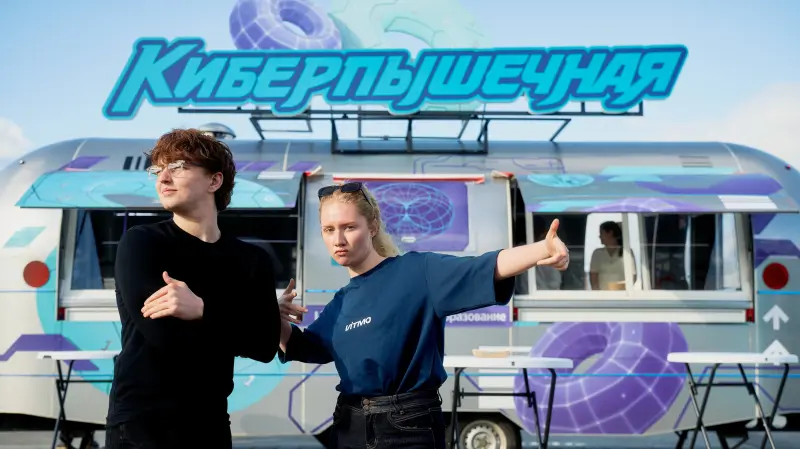
Over 4,000 kilometers and 6,400 donuts fueled a recent science outreach program as ITMO and Yandex Education brought quantum physics to five Russian cities. The 2.5-week tour, dubbed Kiberpyshechnaya, combined popular science with urban culture, rewarding participants with an internal currency for attending lectures and games.
These tokens could then be exchanged for prizes, with a Sony PlayStation 5 game console as the grand prize; project organizers explained that participants could earn the treats, merchandise, or other prizes. The custom-made food truck also functioned as a mobile branch of ITMO’s Admission Office, offering career tests alongside the science lessons.
Kiberpyshechnaya Tour: 5 Cities & 6,400 Donuts
The Kiberpyshechnaya tour distributed one PlayStation 5 game console in each of the five cities visited, Moscow, Nizhny Novgorod, Kazan, Yekaterinburg, and St. Petersburg, plus an additional console awarded to participants in the project’s online component. Winners were determined by engagement with lectures, performance on a science quiz, and participation in interactive games throughout the 2.5-week program.
Elizaveta Kochina of Nizhny Novgorod secured a console by submitting a video detailing her vision for using artificial intelligence in pharmaceutical development, fulfilling a requirement to share technological aspirations on social media. Interactive stations at each stop allowed visitors to engage with engineering concepts by controlling pneumatic manipulators, deciphering codes, and constructing molecular models from their chemical formulas; these hands-on experiences were designed to complement the lecture series, which explored complex topics through accessible analogies and real-world applications.
Lectures during the Kiberpyshechnaya tour covered a broad range of advanced physics topics, including the potential for quantum computing to run demanding software like Grand Theft Auto 6, the company says. Researchers from ITMO’s Faculty of Physics also discussed how astronomical observation can aid in the discovery of new particles, the challenges of survival in extreme environments like Arrakis, and the role of AI in advancing quantum mechanics research.
Egor Spirin, head of ITMO’s Applied Agents Lab, explained how large language models acquire the tools and knowledge necessary to solve complex problems, while Viktor Sergeev, a senior developer at Yandex Market, detailed the creation of digital twins for recommendation systems. The project’s core concept, the St. Petersburg pyshka, a traditional fried donut, was integrated into the tour’s game mechanics as a unique internal currency.


See today’s quantum computing news on Quantum Zeitgeist for the latest breakthroughs in qubits, hardware, algorithms, and industry deals.