A multi-Mpemba effect has been experimentally observed by Gang Xia and colleagues from College of Science and University of Nottingham and National University of Defence Technology and Hefei National Laboratory and Hunan Normal University. The observation, within a trapped-ion system, reveals multiple trajectory crossings in the quantum Mpemba effect, a counterintuitive phenomenon where systems initially further from equilibrium can relax faster than those closer to it. Initial relaxation speed, governed by the fastest decay mode alongside the overlap with the slowest decay mode, dictates the observed dynamics, challenging conventional explanations focused on long-term behaviour. This framework offers a more thorough understanding of transient quantum relaxation and expands the current picture of the quantum Mpemba effect.
Reconstructing quantum states via multi-axis qutrit state tomography of a trapped ion
Qutrit state tomography was employed to reveal the subtle dynamics at play, thoroughly measuring the quantum state of a three-level system, analogous to fully mapping the position and momentum of a particle. Unlike traditional methods that only observe the final state, the density matrix, a mathematical object describing all possible quantum states and their probabilities, was carefully reconstructed at multiple points in time. This detailed reconstruction demanded precise control over the trapped ion’s internal energy levels using a series of laser pulses, requiring nine separate measurements probing the system along different axes in its quantum state space.
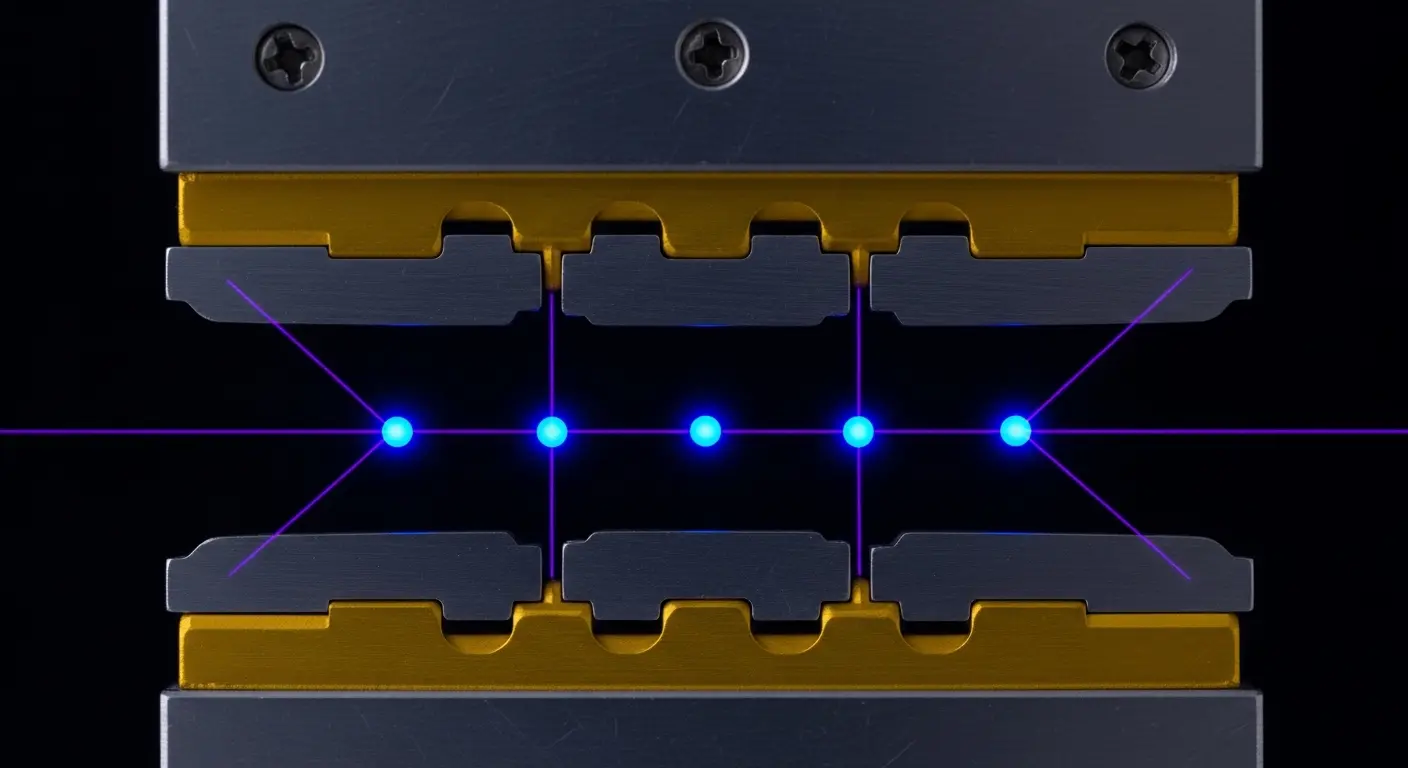
The experiment achieved a mean phonon number of approximately 0.05 by preparing a trapped ion in its motional ground state through EIT cooling. A three-level, or qutrit, system was utilised to observe quantum behaviour, with initial state preparation involving a unitary transformation realised with a series of laser rotations. This approach accounted for phase shifts during both preparation and measurement, proving key for accurate state reconstruction.
Quantum relaxation reversal via multi-Mpemba effects and transient dynamics
A surprising reversal of conventional quantum relaxation occurred, with multiple trajectory crossings, a ‘multi-Mpemba effect’, appearing when the initial state overlap with the slowest decay mode (SDM) increased to a value previously thought to preclude such behaviour. Conventional theory predicts faster relaxation from states with smaller overlap with the SDM, but the multi-Mpemba effect was revealed even when |a1| is substantial, challenging the long-held assumption that initial proximity to the steady state dictates relaxation speed. To accurately predict and understand these complex behaviours, this observation necessitated a new theoretical framework focusing on transient dynamics, rather than solely long-time limits.
At time zero, relaxation velocity correlates directly with the amplitude of the fastest decaying mode, as demonstrated by analysis of time scales. However, at intermediate times, relaxation is instead governed by the slower, secondary decay modes. Specifically, when time exceeds 1/τ3, the relaxation speed becomes dominated by the second-slowest decay mode, eventually transitioning to dependence on the slowest decay mode when time surpasses τ2. Experiments utilising a trapped 40Ca+ ion revealed instances of multiple trajectory crossings; one pair of initial states, differing by 0.25π radians, exhibited a single crossing at a time less than τ2, while another pair, separated by 0.15π radians, showed two crossings, avoiding a typical Mpemba effect. These findings align with observations of a phase diagram revealing both the occurrence and types of quantum Mpemba effects witnessed in their experiments, and provide further validation of the timescale analysis, confirming that initial relaxation speed is governed by the fastest decay mode.
Counterintuitive relaxation dynamics observed in a trapped ion system
Researchers are refining our understanding of how quantum systems settle into stability, revealing striking nuances in the process of energy dissipation. A ‘multi-Mpemba effect’ was demonstrated, where systems initially further from equilibrium can, counterintuitively, relax faster than those starting closer to a stable state. However, the study remains confined to a specific experimental setup, a trapped ion, leaving open whether these observations hold true across other quantum platforms.
Although this work uses a trapped ion, a highly controlled but specific quantum system, its importance lies in establishing a more subtle understanding of quantum relaxation. Identifying the roles of both fastest and slowest decay modes offers a key step towards predicting and controlling quantum behaviour more effectively, and provides a foundation for investigating similar effects in other, less isolated quantum platforms like superconducting circuits or photonic systems. By carefully tracking the transient dynamics of a trapped ion, multiple trajectory crossings, termed a ‘multi-Mpemba effect’, were revealed, offering a more complete picture than focusing solely on long-term behaviour. A new understanding of quantum relaxation was established, demonstrating that systems can relax faster even when initially aligned with the slowest decay mode, and this framework, based on the interaction between fastest decay modes and overlap with slower modes, predicts and explains these complex behaviours, moving beyond conventional models and offering a more nuanced perspective on energy dissipation.
Researchers observed a ‘multi-Mpemba effect’ in a trapped ion, where a system further from stability relaxed faster than one closer to stability. This challenges the conventional understanding of quantum relaxation, which typically focuses on long-term behaviour and the overlap with the slowest decay mode. The study demonstrates that initial relaxation speed is governed by the fastest decay mode, alongside the influence of slower modes, providing a more comprehensive framework for describing transient quantum relaxation. This refined understanding offers a key step towards predicting and controlling quantum behaviour, and may be applicable to other quantum platforms.
👉 More information
🗞 Observation of quantum multi-Mpemba effect in a trapped-ion system
🧠 ArXiv: https://arxiv.org/abs/2604.21320




See today’s quantum computing news on Quantum Zeitgeist for the latest breakthroughs in qubits, hardware, algorithms, and industry deals.