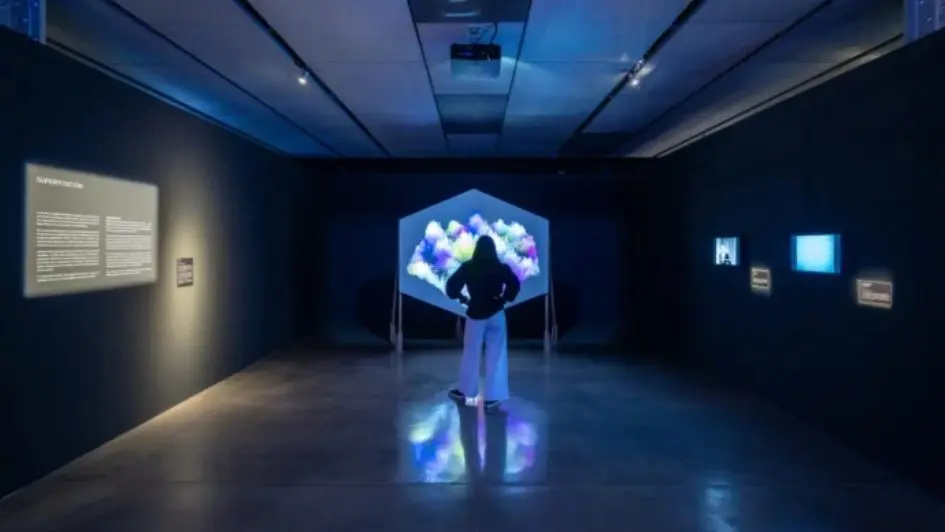
Fundación Telefónica Space in Madrid is currently hosting an exhibition designed to bridge the gap between complex physics and public understanding through a combination of historical artefacts, videos, and interactive displays. The exhibition explores the idea that the act of observing a quantum system isn’t separate from the system itself, a concept resonating with Roberto Valentín Carrera, Product Manager in Marketing at GGCC Empresas in Telefónica de España, who notes that when we measure, observe, or try to understand, the act of observing does not seem entirely separate from what is being observed. A conversation at the opening featuring Sonia Fernández-Vidal, a PhD in Information and Quantum Optics and science communicator, and Fernando Cucchietti, head of the Data Analysis and Visualisation group at the BSC, highlighted a cross-disciplinary approach to interpreting these concepts. By uniting science and art, the exhibition suggests a renewed exploration of how we perceive reality and our place within it.
Quantum Reality & The Observer’s Role
The act of measurement fundamentally alters the quantum world, a concept vividly explored at the exhibition hosted by Fundación Telefónica Space in Madrid. The exhibition integrates historical artefacts, videos, and interactive elements to broaden accessibility, prompting visitors to consider the implications of quantum mechanics for understanding reality itself. The exhibition examines the counterintuitive nature of quantum reality, where particles at the smallest scales do not behave as expected in the macroscopic world. This connection is further illustrated by the exhibition’s inclusion of Schrödinger’s cat experiment, a thought experiment designed to demonstrate the principle of superposition, the idea that a quantum system can exist in multiple states simultaneously until measured.
Carrera cautions against overinterpretation, stating that Schrödinger’s cat does not suggest that our mind magically creates reality, but emphasizes its value as a powerful image reminding us that reality is far less simple than it might seem. The exhibition implicitly asks whether this inherent uncertainty in the quantum realm offers a new language for expressing ancient intuitions about the nature of existence, prompting a re-evaluation of how we perceive and interact with the world around us.
This approach acknowledges that communicating the counterintuitive nature of quantum physics requires multiple avenues of engagement, extending beyond traditional scientific discourse. Carrera notes that until recently, knowledge was not as fragmented as it is today, with science, art, philosophy, and spirituality united by a common goal: understanding reality. This historical context informs the exhibition’s design, which doesn’t merely present scientific findings but also invites contemplation on broader philosophical questions regarding consciousness and perception.
Quantum Physics in Contemporary Inner Exploration
These discussions highlight a growing trend of exploring quantum ideas beyond the confines of physics laboratories. He notes that science and art have always intersected, a connection historically evident in figures like Leonardo da Vinci, who seamlessly blended artistic expression with scientific inquiry. This historical perspective is crucial, as Carrera points out that suggesting a more holistic approach to understanding the world was once commonplace. This resurgence of interest in interconnectedness extends beyond academic circles, with quantum physics increasingly appearing in discussions surrounding introspection, personal growth, and the search for meaning.
“Letting Go” & Transforming Interpretation of Experience
Carrera observed a convergence between quantum principles and internal processes, noting that the exhibition’s blend of scientific explanation with historical artefacts, videos, and interactive elements fostered this connection. He highlights a shift in how individuals are approaching meaning, moving beyond traditional frameworks toward introspection and a search for inner connection. This trend sees quantum physics increasingly referenced within diverse spiritual and philosophical traditions, not as proof of belief, but as a modern language for articulating ancient intuitions about interconnectedness and the limits of perception. This line of thought led Carrera to David R. Hawkins’ book, Letting Go: The Path to Freedom, which he sees as a secular approach to inner exploration.
He finds a compelling parallel between Hawkins’ proposal to observe thoughts and emotions without resistance, allowing their energy to dissipate, and the quantum emphasis on the observer’s role. “Not because Hawkins needs to rely on quantum physics,” Carrera explains, “but because he refocuses attention on the observer.” He suggests that transforming how we interpret experience may be more impactful than attempting to control reality itself, leaving the ultimate question of the observer’s identity open for further consideration.
when we measure, when we observe, when we try to understand, the act of observing does not seem to be entirely separate from what is being observed.


See today’s quantum computing news on Quantum Zeitgeist for the latest breakthroughs in qubits, hardware, algorithms, and industry deals.