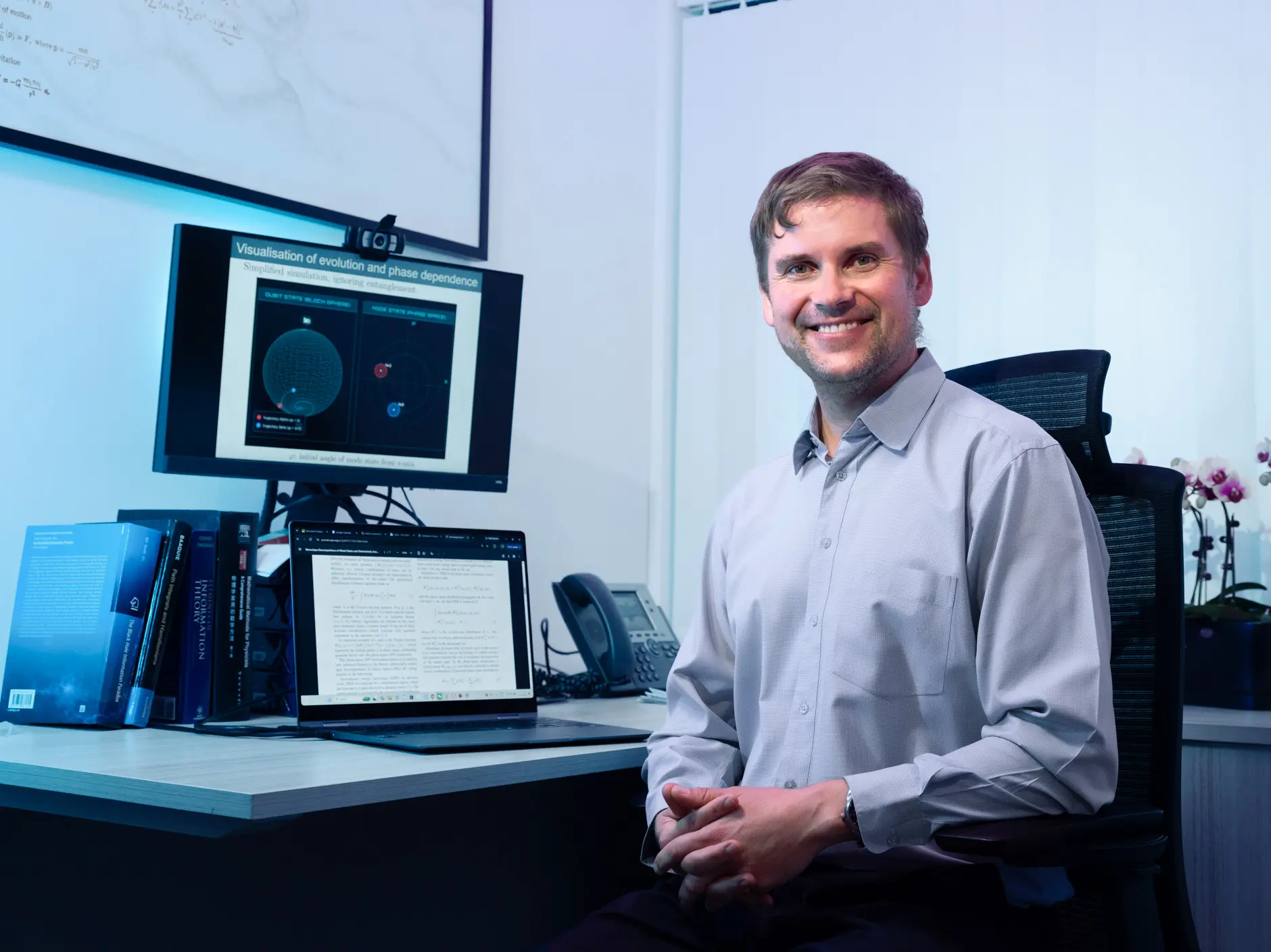
Researchers at City University of Hong Kong have demonstrated a pathway to harvest energy with certainty from fluctuating sources, defying established physical limitations. The team led by Professor Oscar Dahlsten, Associate Professor at CityUHK, initially aimed to prove a theoretical constraint on energy transfer, but instead uncovered a quantum solution using the principle of “non-unique decomposition of mixed states.” This allows for “deterministic energy harvesting (DEH),” where a quantum harvester charges reliably as long as the source induces one of multiple superposition states.
Non-Unique Decomposition of Mixed States Enables Deterministic Energy Harvesting
The research, detailed in Physical Review Letters under the title “Nonunique Decompositions of Mixed States and Deterministic Energy Transfers”, hinges on the ability to bypass entropy transfer during energy harvesting. Conventional energy conversion processes inevitably lose power to randomness, hindering efficient charging of devices. However, the CityUHK team demonstrated a theoretical pathway where energy can move from a source to a harvester without a corresponding increase in disorder.
This is achieved through the exploitation of a quantum phenomenon where a system’s state isn’t defined by a single configuration, but rather a superposition of possibilities. Central to this process is the concept of multiple intermediate superposition states within the quantum harvester. Unlike traditional methods where energy transfer relies on a specific pathway, the harvester can be charged via several distinct quantum routes.
As long as the energy source induces one of these transitions, the final outcome, a fully charged harvester, is guaranteed, a characteristic the researchers term. This certainty contrasts sharply with probabilistic energy harvesting, where charging success depends on the likelihood of a specific event occurring. The implications extend beyond fundamental physics, potentially impacting the design of low-power technologies for a range of applications. The framework developed by the CityUHK team could reduce energy losses in conventional AC-to-DC rectifiers, components that convert alternating current from power outlets into the direct current used by electronic devices.
This improved efficiency could be particularly valuable for powering Internet-of-Things devices, wearable sensors, smart-city infrastructure and the next generation of 6G wireless technology, all of which demand low-power operation and reliable energy sources. The research was supported by a Research Grants Council General Research Fund, enabling the exploration of this unconventional approach to energy harvesting.
We initially set out to show that such a protocol might be impossible. To our surprise, our efforts led us to a quantum solution that could achieve exactly the deterministic energy transfer we were looking for.
Professor Oscar Dahlsten, Associate Professor at the Department of Physics at CityUHK
Source: https://www.cityu.edu.hk/media/news/2026/10/20/cityuhk-researchers-shatter-physical-limitations



See today’s quantum computing news on Quantum Zeitgeist for the latest breakthroughs in qubits, hardware, algorithms, and industry deals.