Filippo Radicchi at Indiana University and colleagues have achieved quantum communication protocols operating across networks containing hundreds of millions of nodes. The protocols address a key gap in quantum network research by applying to arbitrary network topologies, moving beyond previous limitations restricted to simpler arrangements. A thorough analysis of both real and synthetic graphs, alongside analytical proof for scale-free networks, suggests the Quantum Internet could achieve a comparable ultra-large-scale growth to the existing classical internet, representing a sharp step towards practical, widespread quantum communication.
Quantum communication sustained across networks approaching internet scale
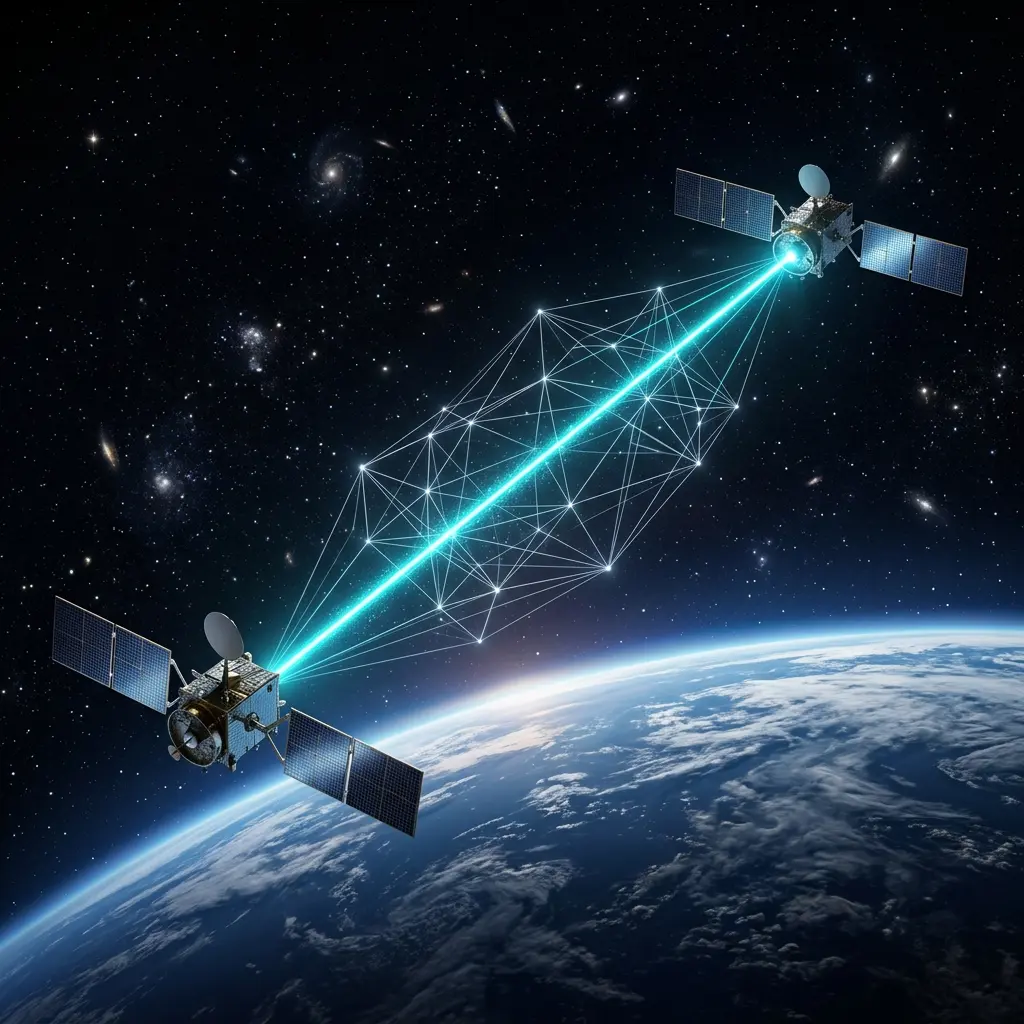
Scientists at Indiana University have demonstrated quantum communication protocols functioning across networks containing up to 20 billion nodes, a substantial increase over previous, smaller arrangements. This breakthrough surpasses a critical threshold, enabling viable communication in networks once considered impossible and paving the way for a future Quantum Internet. The protocols apply to networks with arbitrary topology, utilising entanglement, a quantum phenomenon linking two particles, and classical network theory to map quantum connections onto a classical graph representation.
Systematic analysis of both real and synthetic networks revealed that sustainable quantum communication operates in complex, large-scale systems mirroring the existing internet’s structure. Examining the Zachary Karate Club network, with 34 nodes, showed entanglement values of 0.41 using the QEP protocol, while CEP achieved 0.12. The h1QEP protocol resulted in 0.59 entanglement, and h2QEP yielded 0.79. Protocol performance quantified the Area Under the Curve, or AUC, with values of 0.55 for QEP, 0.42 for CEP, 0.61 for h1QEP, and 0.60 for h2QEP; this metric assesses communication effectiveness across varying edge entanglement levels. These results provide evidence for scalability and effectiveness in complex systems, though they currently depend on idealised conditions and do not yet address maintaining entanglement fidelity over physical distances or the impact of real-world noise.
Quantum communication protocols for arbitrarily-topologised networks at scale
Previously, viable network-wide communication established only for specific topologies like regular lattices. No practical communication protocols developed for real network topologies, except for relatively small networks. A family of quantum communication protocols devised applicable to networks with arbitrary topology, potentially comprising hundreds of millions of nodes. Systematic analysis on both real and synthetic graphs shows these proposed protocols are sustainable on heterogeneous networks.
Viable quantum communication persists in the thermodynamic limit for random scale-free graphs, as analytically proven. These findings suggest the Quantum Internet will be capable of ultra-large-scale growth, comparable to that of its classical predecessor. Sustaining network-wide communication at scale is key to the Internet’s success, a human-made infrastructure that grew from the tiny ARPANET with four nodes in 1969 to a massive network of almost hundreds of thousands of autonomous systems and over twenty billion devices in 2025. Advances in hardware and software, along with a distinctive network structure, enable this capability.
The Internet, a result of collective effort without centralised control, is a scale-free, small-world network similar to many self-organised networks observed in nature. From this perspective, microscopic details, such as computer functionality, are not essential to understanding macroscopic, system-wide network properties, including growth, durability, resistance to viruses, adaptability, and support for searching and routing. A major breakthrough comparable to the Internet will likely occur with the advent of the Quantum Internet, an infrastructure using quantum mechanics to enable a new frontier of communication.
Although the theoretical foundations of quantum communication predate ARPANET, the actual realisation of quantum communication networks is occurring now. These small-scale networks represent precursors to an infrastructure with unprecedented capabilities. Distributed quantum sensing, distributed quantum computing, and information-theoretically secure communication are among the anticipated applications of the Quantum Internet. This work begins with the mapping proposed by Acin et al., which views a quantum network as a classical weighted graph.
The presence of an edge (i, j) indicates the state |λi, j⟩ is composed of partially entangled qubits with Schmidt coefficient λi, j ∈[1/2, 1] [i.e., Eq.]. The edge weight (i, j) equals the entanglement of the state |λi, j⟩, i.e., E(|λi, j⟩) = 2(1 −λi, j), as seen in Eq. This mapping treats entanglement swapping and distillation as transformations of the classical graph’s edges, detailed in the Appendix and SM. Each protocol within the family operates on a weighted annealed graph to establish rules for creating a quantum communication channel between nodes s and t. Common components include: (i) a greedy selection of optimal paths between chosen nodes; (ii) application of entanglement swapping, i.e., Eq., to create new states between distant nodes; (iii) application of entanglement distillation, i.e., Eq., to enhance the overall quantum communication channel quality. The protocols differ based on how the communication channel between nodes s and t is constructed. In the standard Quantum Entangled Percolation (QEP) protocol, paths between nodes s and t are formed to maximise entanglement via swapping.
Classically, this is a greedy algorithm for the disjoint-edge shortest path problem, relevant for routing applications. QEP can also be seen as a non-trivial generalisation of the protocol proposed by Malik et al. to approximate st-concurrence percolation, which considered all paths self-avoiding and of identical length. Malik et al.’s method applied to networks up to size N = Building on prior work on path percolation, the proposed protocol overcomes these limitations and can be efficiently applied to much larger networks.
The standard QEP is generalised into a heterogeneous version, denoted as hxQEP protocol, with x = 0, 1, 2. In hxQEP, high-degree nodes rs and rt in the neighbourhoods of s and t are selected to segment the communication channel s →t into three sub-channels: s →rs, rs →rt, and rt →t. The rationale is that the channels s →rs and rt →t sustain short-range communication, while rs →rt serves potentially long-range communication. The parameter x denotes the radius of the neighbourhoods, tuning the range of the short-distance sub-channels. For x = 0, the heterogeneous QEP protocol is identical to the standard QEP. A protocol based on Classical Entanglement Percolation (CEP) is also considered, using no entanglement swapping or distillation.
Quantum communication is assessed using methods from network theory by representing a quantum network as a classical graph. Sufficient conditions for network-wide communication have only been established for specific topologies like regular lattices, and practical communication protocols have not been developed for real network topologies beyond relatively small networks. A family of quantum communication protocols is devised applicable to networks with arbitrary topology, even those composed of hundreds of millions of nodes.
Systematic analysis on both real and synthetic graphs demonstrates these protocols are sustainable on heterogeneous networks. For random scale-free graphs, viable quantum communication persists in the thermodynamic limit, suggesting the Quantum Internet could experience growth comparable to the classical Internet. This capability relies on a network structure similar to the Internet, which grew from four nodes in 1969 to over twenty billion devices.
The proposed protocols require a heterogeneous and small-world network structure, and their effectiveness is supported by numerical study and theoretical analysis. The approach maps a quantum network to a classical weighted graph, treating entanglement swapping and distillation as transformations of the graph’s edges. The analysis begins with an initially un-weighed network, then identical weights 0 ≤Eedge ≤1 are added to all edges while studying protocol performance.
Figs0.1b, c and d display the paths identified by the QEP, h1QEP and h2QEP protocols. The paths found by CEP are the same as those found by QEP. It is stressed that QEP uses no repeaters, while the repeaters used in h1QEP differ from those used in h2QEP. These examples are valid for a specific value of Eedge, and for a specific pair of nodes s and t. To estimate the performance of a generic protocol “prot,” the average entanglement over many randomly selected node pairs s and t is computed, denoted as ⟨Eprot⟩, as Eedge varies, see Eq. As shown in Fig0.1e, there is large variability in performance between protocols. For example, CEP cannot generate perfect quantum communication channels in networks composed of non-maximally entangled states, i.e., ⟨ECEP⟩ 0.8, denoting that maximum entanglement can be reached even in networks that are not formed by maximally entangled states; the performance of h1QEP and h2QEP reaches such a saturation point for even smaller values of Eedge. The area under the curves (AUCs) of Fig0.1e is computed as a standardised metric of performance, i.e., Eq. In the Zachary Karate Club’s network, h2QEP and h1QEP have nearly identical performance, followed by QEP and CEP. Next, the performance of the protocols is systematically studied on instances of the uncorrelated configuration model with power-law degree distribution K.
Mapping entanglement strength onto classical networks for scalable quantum communication
Scientists at Indiana University have demonstrated a pathway towards sustaining quantum communication across networks mirroring the scale and complexity of the modern internet. While the team’s protocols successfully navigate arbitrary network topologies, a reliance on ‘edge weights’, representing the strength of quantum entanglement between nodes, introduces a tension. The researchers mapped quantum networks onto classical graphs using these weights, but acknowledging that sustaining entanglement across millions of connections presents genuine economic and technical hurdles is important for realistic expectations. Nevertheless, the Indiana University team’s work remains significant because it demonstrates a viable protocol, even if large-scale implementation requires further innovation in entanglement distribution and management. Establishing a pathway, even with acknowledged limitations, is a vital step towards realising a functional Quantum Internet capable of mirroring classical network growth.
Scientists demonstrated quantum communication protocols capable of functioning across networks containing hundreds of millions of nodes. This finding suggests that a future Quantum Internet could potentially scale to a size comparable with the current classical internet. The protocols operate by mapping quantum networks onto classical graphs, utilising ‘edge weights’ to represent entanglement strength between nodes. Although sustaining entanglement across such large networks presents challenges, this research establishes a viable communication method for heterogeneous network topologies and proves persistent communication in large, random networks.
👉 More information
🗞 Enabling quantum communication in ultra-large-scale networks
🧠 ArXiv: https://arxiv.org/abs/2606.08326



See today’s quantum computing news on Quantum Zeitgeist for the latest breakthroughs in qubits, hardware, algorithms, and industry deals.