A new quantum key distribution (QKD) system operates over a deployed 303km fibre link, addressing the key need for secure communication networks capable of operating over long distances and integrating with existing infrastructure. Martin Clason and colleagues at Linköping University, in collaboration with KTH Royal Institute of Technology, Stockholm University, and Chalmers University of Technology, have combined single-mode fibre with a 33km multicore fibre segment. The system successfully integrates commercial QKD systems with external detectors to overcome limitations in standard technology. This research demonstrates that operating QKD alongside classical Ethernet traffic and optical noise within a dynamically reconfigurable network is feasible. It highlights the practical challenges of using QKD-generated keys for applications like image encryption due to limited throughput and the need for efficient compression algorithms.
Extended range quantum key distribution utilises dynamic fibre switching
A new record of 303 kilometres has been established for trusted-node quantum key distribution, exceeding previous demonstrations by over sixty kilometres and enabling secure communication across greater metropolitan areas. Combining deployed single-mode fibre with a 33 kilometre multicore fibre segment effectively emulated a high-capacity metropolitan access link previously unattainable for quantum networks. The system actively switched the quantum channel between two cores within this multicore fibre while simultaneously transmitting Ethernet traffic and optical noise, proving its durability in a realistic network environment. This achievement is particularly significant as it moves QKD beyond controlled laboratory conditions and into a functioning, albeit emulated, metropolitan network environment, mirroring the complexities of real-world deployments.
This active switching, alongside data transmission, demonstrates a robust system capable of functioning within existing network infrastructure. Tests using generated keys revealed that image transmission quality is heavily reliant on the amount of key material available and the efficiency of data compression techniques, stressing that even with secure key exchange, practical application faces ongoing challenges. Dynamic reconfiguration, coupled with the use of sensitive detectors, overcomes limitations in signal strength and allows for integration with existing telecommunications infrastructure. In particular, the system employed external superconducting nanowire single-photon detectors (SNSPDs), overcoming the limitations of standard detectors and enabling operation despite significant signal loss over these distances. SNSPDs offer substantially improved sensitivity and lower dark count rates compared to silicon avalanche photodiodes, crucial for detecting the faint quantum signals attenuated over 303km of fibre. The signal attenuation is primarily due to Rayleigh scattering and absorption within the silica fibre, necessitating highly sensitive detection methods. Further analysis focused on the relationship between key rates and data transmission, revealing that secure key exchange alone doesn’t guarantee seamless integration with data-intensive applications. The key rate, measured in kilobits per second, is directly impacted by fibre loss, detector efficiency, and background noise, creating a trade-off between security and usability.
Balancing secure key generation with data transmission demands for practical quantum networks
Scientists continue to refine quantum key distribution, seeking practical applications beyond laboratory settings. A key tension exists between key generation rates and real-world usability, while this demonstration establishes a new record for distance utilising existing fibre. This limitation isn’t merely a technical hurdle, but a fundamental challenge for QKD-based encryption. Acknowledging the limitations around key rates and image transmission highlights a vital point: this demonstration isn’t about immediately replacing existing encryption methods. Current symmetric encryption algorithms, such as AES, remain highly efficient and secure when used with sufficiently long keys, but QKD offers a fundamentally different approach to key distribution, guaranteeing security based on the laws of physics rather than computational complexity.
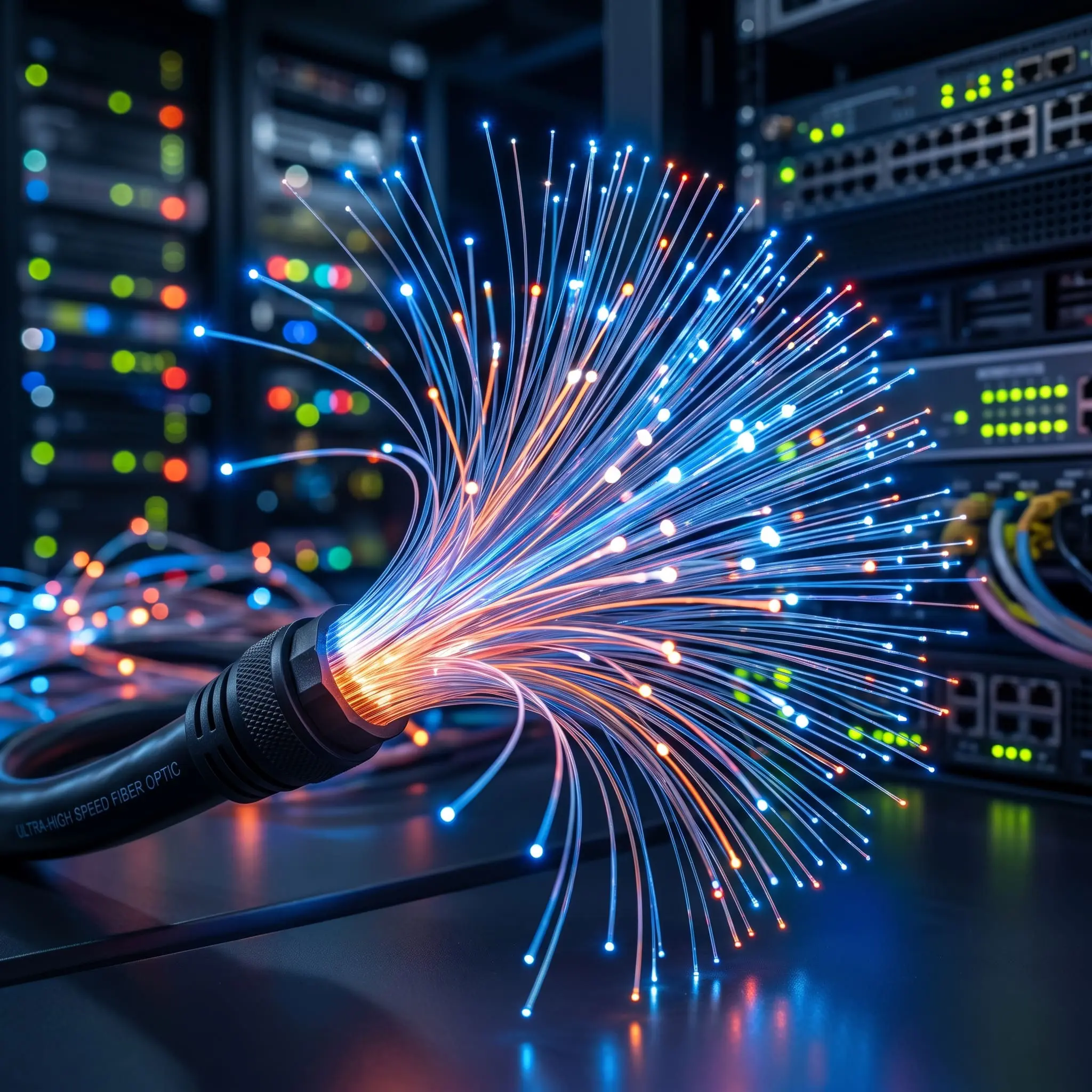
Instead, the results prove QKD can function within a complex, real-world network alongside conventional data traffic and optical noise. Successfully integrating quantum technology with established fibre infrastructure, even with these constraints, represents a major step towards future hybrid networks capable of enhanced security. This deployment confirms the feasibility of integrating quantum key distribution with currently functioning fibre networks, extending secure communication over a record 303 kilometres. A cable containing multiple pathways for light, the multi-core fibre segment, allowed the team to bypass distance limitations and emulate a high-capacity metropolitan network when combined with standard single-mode fibre. Multi-core fibre increases the overall fibre capacity by allowing multiple wavelengths to be transmitted simultaneously, reducing congestion and improving data throughput. Actively switching the quantum signal between cores within the multi-core fibre, while simultaneously transmitting conventional data and simulated interference, demonstrated a strong and adaptable system, paving the way for hybrid quantum-classical networks. The trusted-node architecture employed in this demonstration relies on secure physical infrastructure at intermediate points, a pragmatic approach for extending QKD range beyond the limitations of direct transmission. However, future research will focus on developing repeaterless QKD systems to eliminate the need for trusted nodes and achieve truly end-to-end secure communication. The implications of this work extend beyond secure communication, potentially influencing the development of secure cloud computing, financial transactions, and critical infrastructure protection. Further optimisation of the system, including improved data compression algorithms and more efficient detectors, will be crucial for realising the full potential of QKD in practical applications.
The researchers successfully demonstrated trusted-node quantum key distribution over a total distance of 303 kilometres of deployed fibre, including a 33 kilometre multi-core fibre segment. This achievement proves that QKD can integrate with existing fibre infrastructure and function alongside classical data traffic and optical noise. The study highlights how the rate of key generation impacts secure image transmission using one-time pads, demonstrating application-level challenges for QKD-based encryption. The authors intend to focus on developing repeaterless QKD systems to remove the need for trusted nodes in future work.
👉 More information
🗞 Deployed trusted-node quantum key distribution over 300 km with a multi-core fiber access link
🧠 ArXiv: https://arxiv.org/abs/2606.06107


See today’s quantum computing news on Quantum Zeitgeist for the latest breakthroughs in qubits, hardware, algorithms, and industry deals.