A prototype quantum sensor developed at Imperial has demonstrated a crucial principle for recovering signals obscured by interference, enabling the development of detectors of gravitational waves and dark matter. Researchers achieved this breakthrough by comparing two long-baseline atom interferometers, effectively cancelling experimental noise and allowing signals to be recovered even when individual measurements are overwhelmed. The study, published in Nature, details how this differential approach overcomes a major obstacle in building large-scale quantum sensors under realistic conditions. This work, part of the Atom Interferometer Observatory and Network (AION) collaboration led by Imperial, marks a significant step towards probing the early universe and elusive dark matter.
Differential Atom Interferometry Cancels Quantum Noise
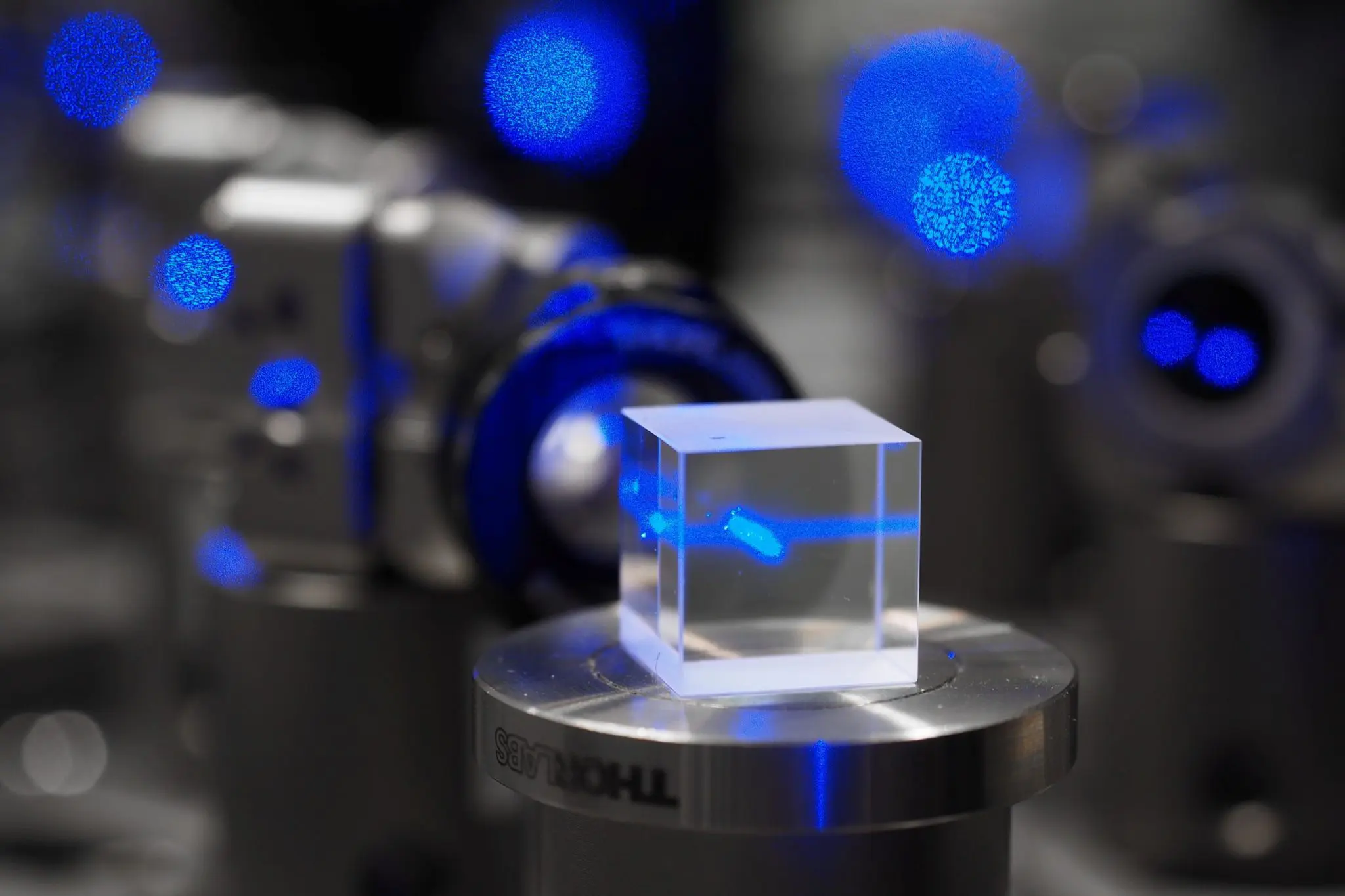
Comparing two long-baseline atom interferometers effectively cancels experimental noise, a feat recently demonstrated by a team led by Imperial College London and detailed in Nature. This breakthrough allows researchers to recover signals previously obscured by noise, opening new avenues for detecting gravitational waves from the early universe and elusive forms of dark matter. The prototype sensor, built in the Imperial Ultracold Strontium Laboratory, represents a critical step toward realizing large-scale quantum sensors capable of probing previously inaccessible regions of the cosmos. The core innovation lies in a differential approach; rather than relying on a single atom interferometer, an instrument using lasers to measure atomic behavior, the team constructed a system with two macroscopically separated clouds of ultracold strontium-87 atoms. Both clouds were interrogated by a single, ultrastable clock laser, deliberately introducing significant phase noise, far more than clock lasers naturally produce, to simulate the challenging conditions expected in future, larger detectors.
Individually, each interferometer became unusable, with its signal obscured by noise; the interference patterns that normally allow measurements to be made were effectively erased. However, by comparing the two, a clear signal could still be recovered, demonstrating that the shared noise cancelled out. This successful cancellation operates at the fundamental limit set by quantum physics, validating a key principle for detectors. To further test the system, researchers introduced an additional oscillating signal, confirming its detectability even under extreme noise conditions. The AION collaboration, spearheading this work, is now focused on scaling up these systems as part of a broader international effort. “We have taken some of the most precise instruments ever built—atomic clocks and atom interferometers—and shown that they can be repurposed to open new windows onto the invisible parts of our Universe,” explained Dr. Richard Hobson, co-lead of the Ultracold Strontium Laboratory. Professor Oliver Buchmueller, Principal Investigator of the AION collaboration at Imperial, added, “This work marks an important milestone towards future large-scale quantum sensors for fundamental physics.” The results enable facilities like AICE at CERN, potentially ushering in a new era of quantum-powered exploration of the universe.
We have taken some of the most precise instruments ever built-atomic clocks and atom interferometers-and shown that they can be repurposed to open entirely new windows onto the invisible parts of our Universe.
Ultracold Strontium-87 Prototype Validates Noise Reduction
The pursuit of elusive dark matter and the faint ripples of gravitational waves has entered a new phase with the successful demonstration of a noise-cancellation technique in a prototype quantum sensor. Researchers are increasingly turning to atom interferometry, a method leveraging the wave-like properties of atoms, to detect signals currently beyond the reach of conventional instruments, but a significant hurdle remained: mitigating the pervasive noise inherent in these incredibly sensitive systems. The AION collaboration led by Imperial College London has now shown that a differential approach, comparing two such interferometers, effectively circumvents this limitation, enabling larger, more powerful detectors. The experiment was deliberately designed to replicate the challenging conditions anticipated in future, long-baseline detectors, even introducing additional phase noise far more than clock lasers naturally produce to rigorously test the noise-cancellation principle. To further confirm the system’s capabilities, the team introduced an additional oscillating signal, demonstrating its detectability even under conditions where individual interferometers became unusable, with their signal obscured by noise. Dr.
Recovered Signals Detect Simulated Gravitational Waves
This achievement addresses a significant hurdle in scaling up these highly sensitive instruments for fundamental physics research. This noise, previously far greater than the signals researchers were trying to measure, had completely obscured these effects. Deliberately introducing additional phase noise, far more than clock lasers naturally produce, allowed the team to rigorously test the noise cancellation technique. Even when individual interferometers became unusable, with their signal obscured by noise, the comparison between the two revealed a clear signal. “Even though each individual measurement appeared random, the correlation between them revealed the underlying behaviour of the system,” highlighting the effectiveness of the method. Charles Baynham, co-lead of the Ultracold Strontium Laboratory, emphasized the significance of this progress, stating, “We’ve known for a long time that quantum sensors can help us understand the universe, but it’s only recently that it’s become possible to build them with the resolution needed.”
AION Collaboration Advances Large-Scale Quantum Sensing
The ability to detect subtle shifts in spacetime and the elusive nature of dark matter are converging goals driving innovation in quantum sensing, and a recent demonstration by the AION collaboration represents a critical step forward. Researchers have successfully demonstrated that a key principle behind long-baseline atom interferometers can work under realistic conditions. The core of this advancement lies in comparing two atom interferometers rather than relying on a single instrument. These interferometers utilize lasers to measure the behavior of atoms with extreme precision; however, the lasers themselves introduce phase noise that obscured these effects. While each interferometer became unusable, with its signal obscured by noise, a clear signal could still be recovered when comparing the two, demonstrating the effectiveness of the differential approach. This success is fueling plans to scale up the technology within the AION programme, an initiative bringing together researchers from institutions across the UK. Dr.
We have taken some of the most precise instruments ever built-atomic clocks and atom interferometers-and shown that they can be repurposed to open entirely new windows onto the invisible parts of our Universe.



See today’s quantum computing news on Quantum Zeitgeist for the latest breakthroughs in qubits, hardware, algorithms, and industry deals.