

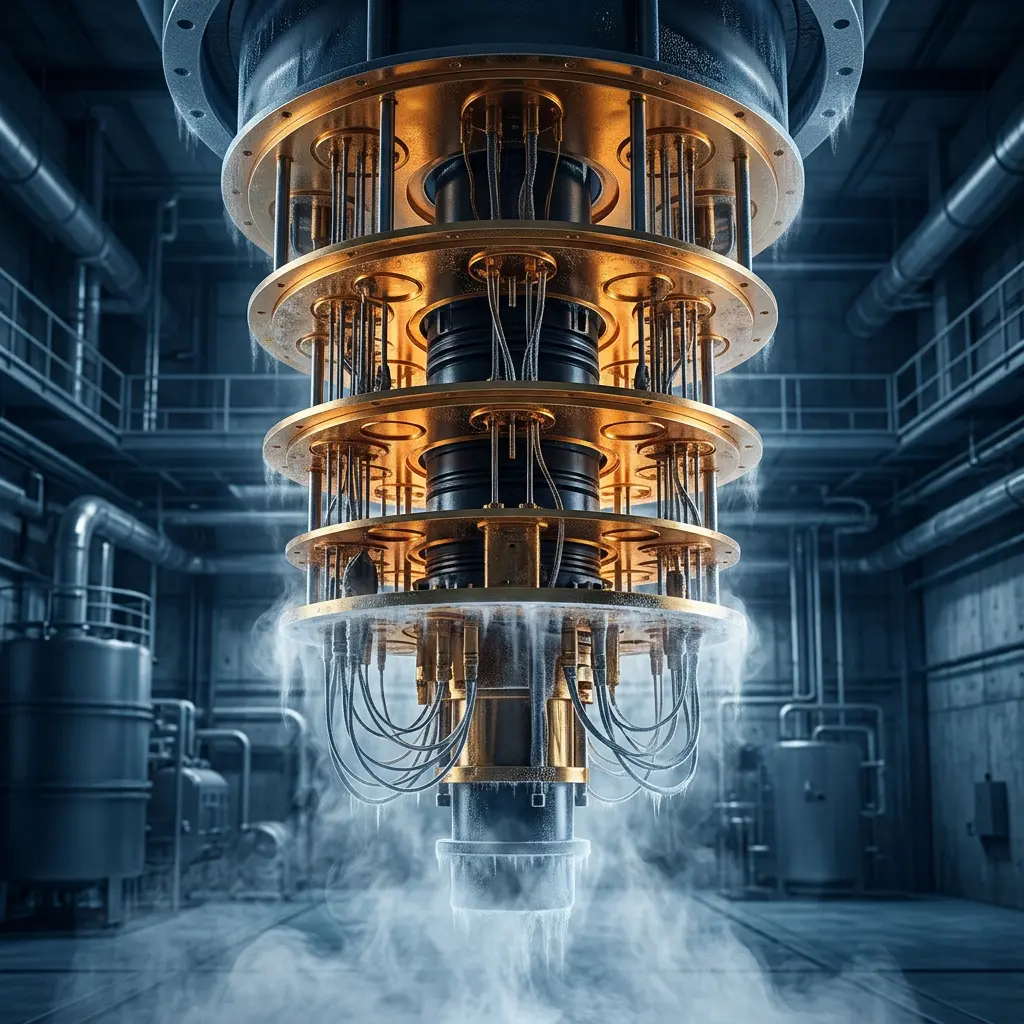
Algorithms for hybrid continuous-variable and discrete-variable quantum processors have lagged behind hardware advancements. Thinh Le, Hansika Weerasena, and Jianqing Liu of North Carolina State University have created a non-Abelian mixer for the Quantum Approximate Optimisation Algorithm, applied to the Max-Cut problem. Simulations consistently demonstrate this new mixer improves both the quality of solutions and the likelihood of finding the best possible solution, when compared to existing methods.
A new computational technique for quantum processors integrating both continuous and discrete quantum bits addresses a current limitation in the field. This innovation centres on a specifically designed ‘mixer’ within the Quantum Approximate Optimisation Algorithm, used to tackle the complex Max-Cut problem, consistently yielding improved solutions in simulations. The development offers a potential route to more efficient quantum optimisation, particularly for emerging hybrid quantum hardware and could benefit areas like communication network optimisation.
At North Carolina State University, Thinh Le and colleagues have devised a new computational approach for quantum processors that combine continuous and discrete quantum bits, tackling a longstanding challenge in the field. This innovation centres on a specifically designed ‘mixer’ within the Quantum Approximate Optimisation Algorithm, a recipe for a quantum computer to attempt to solve complex problems, like optimising delivery routes or financial portfolios. The team’s mixer consistently delivers improved solutions in simulations when compared to existing methods, offering a potential pathway to more efficient quantum optimisation. This ‘non-Abelian mixer’ manipulates the quantum bits during the algorithm, akin to stirring ingredients in a recipe to ensure they combine effectively, and is particularly suited to emerging hybrid quantum hardware.
Non-Abelian mixers enhance optimisation within hybrid quantum algorithms
Across all graph sizes and Fock cutoffs tested, the new non-Abelian mixer consistently improved expected solution quality and the probability of sampling an optimal solution, exceeding the performance of the transverse-field mixer. Achieving consistently better solutions was previously unattainable, as previous hybrid continuous-variable and discrete-variable quantum algorithms lacked comparable optimisation capabilities. This development centres on a hardware-native mixer designed for Quantum Approximate Optimisation Algorithm (QAOA) implementation on hybrid quantum processors, combining the benefits of both continuous and discrete quantum bits. Continuous-variable qubits, often realised using harmonic oscillators, offer advantages in representing certain types of data and performing specific operations, while discrete-variable qubits, such as superconducting transmon qubits, excel in gate fidelity and control. Combining this allows for a more versatile quantum processing approach.
A standard benchmark, simulations on unweighted Erdős-Rényi graphs, revealed improvements across all tested graph sizes and Fock cutoffs, a measure of oscillator excitation levels. The Fock cutoff determines the maximum number of photons, or excitation quanta, used to represent the continuous variable qubits; higher cutoffs generally improve accuracy but also increase computational cost. The mixer consistently yielded a higher approximation ratio, indicating better solutions to the Max-Cut problem, a complex optimisation challenge relevant to network design. The Max-Cut problem involves partitioning the nodes of a graph into two sets such that the number of edges crossing between the sets is maximised, a task with applications in areas like community detection and circuit layout. Building on existing work establishing universal control in hybrid systems, this increased probability of finding the absolute optimal solution currently utilises idealised conditions and does not yet account for the significant noise and decoherence present in real quantum hardware, meaning a substantial gap remains before practical application is achievable. Quantum decoherence, the loss of quantum information due to interaction with the environment, is a major hurdle in building practical quantum computers.
Quantum computers promise to revolutionise optimisation, tackling problems currently intractable for even the most powerful supercomputers. Improving algorithms designed for hybrid quantum processors, systems blending the strengths of continuous and discrete quantum bits, offers a step towards realising that potential. The Quantum Approximate Optimisation Algorithm (QAOA) is a particularly promising candidate for near-term quantum devices, as it is designed to be resilient to some types of noise. However, the performance of QAOA is highly dependent on the choice of mixer, and existing mixers have limitations when applied to hybrid systems. The team acknowledges that their simulations rely on simplified, unweighted graphs, a limitation because real-world networks are far more complex, possessing varying connection strengths and intricate topologies; further research will need to address these complexities. Investigating the performance of the non-Abelian mixer on weighted graphs and graphs with more realistic topologies is crucial for assessing its potential for practical applications.
Real-world optimisation problems rarely involve neat, unweighted connections, so acknowledging the use of simplified network models is important. However, this establishes a vital building block for more sophisticated quantum algorithms designed for these emerging hybrid processors. Demonstrating improved performance, both in finding better solutions and increasing the chance of finding the best solution, on even basic networks validates the core principle of this new approach, unlocking new possibilities for more subtle control over the quantum system. The non-Abelian mixer achieves this control by exploiting the unique properties of both continuous and discrete qubits, allowing for more complex and efficient manipulation of the quantum state.
The development of a non-Abelian mixer represents a major step towards realising the potential of hybrid quantum processors. Researchers moved beyond adapting existing techniques intended for single-type quantum systems by designing a mixer specifically for these hybrid architectures. Simulations consistently demonstrated improved performance compared to the transverse-field mixer, a commonly used alternative, and this hardware-native approach enables more subtle control over the quantum system. The transverse-field mixer applies a uniform magnetic field to all qubits, while the non-Abelian mixer allows for more targeted and precise manipulation of individual qubits or groups of qubits. This increased control is essential for optimising the performance of quantum algorithms on complex problems. Further work will focus on mitigating the effects of noise and decoherence, and on extending the algorithm to more complex and realistic optimisation problems, bringing the promise of hybrid quantum computing closer to fruition.
The significance of this work extends beyond the specific Max-Cut problem. The principles underlying the non-Abelian mixer could be applied to a wide range of other optimisation problems, including those in logistics, finance, and materials science. Moreover, the development of hardware-native mixers is a crucial step towards building practical and scalable hybrid quantum processors, paving the way for a new era of quantum computation. The ability to systematically design and implement quantum algorithms on these platforms is essential for unlocking their full potential and addressing some of the most challenging computational problems facing society.
Researchers developed a new non-Abelian mixer that improves the performance of the Quantum Approximate Optimization Algorithm on hybrid continuous-variable and discrete-variable quantum processors. This advancement matters because it offers more precise control over quantum systems than existing methods like the transverse-field mixer, leading to better solution quality and a higher probability of finding optimal solutions in simulations on Erdős-Rényi graphs. The authors intend to address noise and decoherence and extend the algorithm to more complex optimisation problems. This work represents a step towards building practical hybrid quantum processors capable of tackling challenging computational tasks.
👉 More information
🗞 Non-Abelian Mixer for QAOA on Hybrid Oscillator-Qubit Quantum Processors
🧠 ArXiv: https://arxiv.org/abs/2605.30234


See today’s quantum computing news on Quantum Zeitgeist for the latest breakthroughs in qubits, hardware, algorithms, and industry deals.



