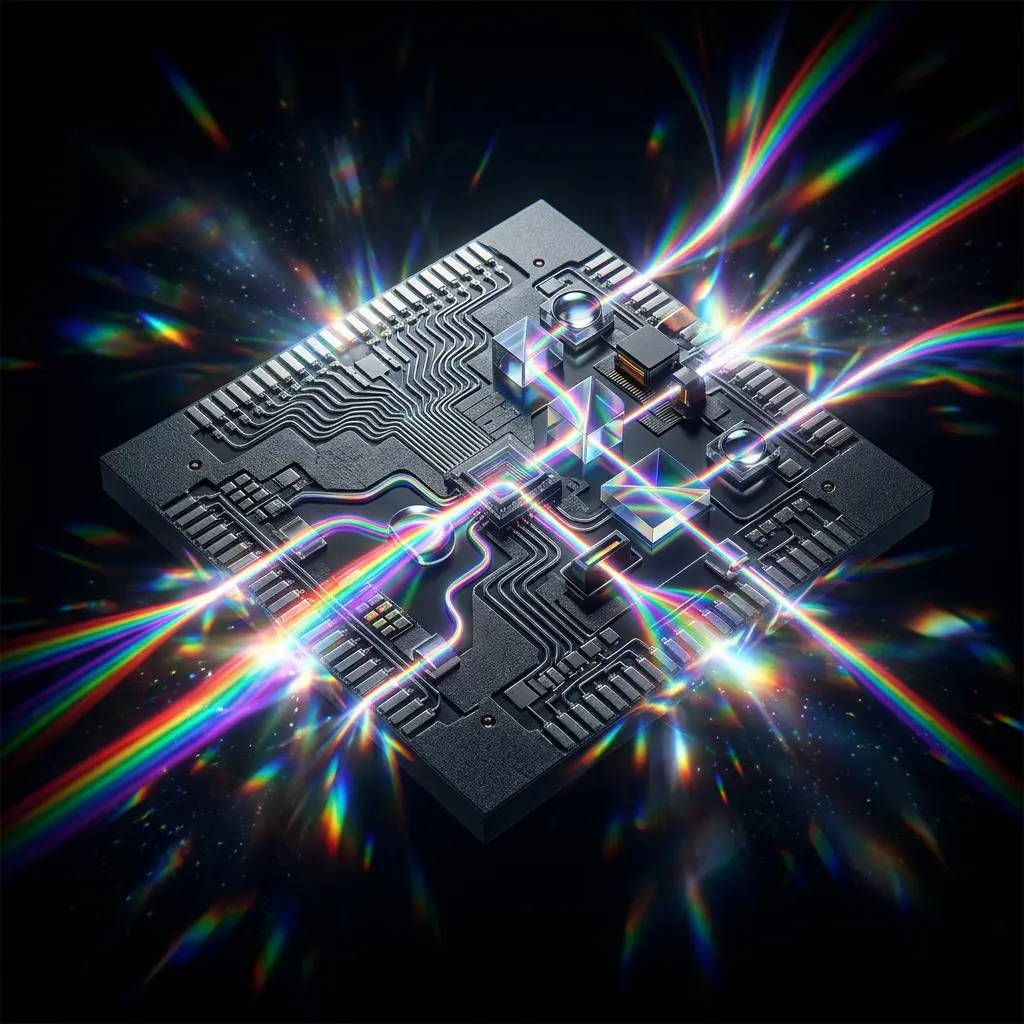
Published in PRX Quantum on June 5th, researchers at National University of Singapore (NUS) have created a quantum random number generator (QRNG) chip that actively tests its own hardware integrity, a first that moves beyond reliance on manufacturer certifications. Every encryption key and secure transaction relies on unpredictable random numbers, yet until now, all random number generators have required users to trust the underlying hardware would remain uncompromised; this is a potentially critical vulnerability as quantum computing advances. The NUS team, led by Associate Professor Charles Lim from the College of Design and Engineering, built a chip that verifies its own measurement hardware in real time, providing security guarantees even against an attacker with quantum computing capabilities. The chip achieved an efficiency of 69.1 percent. The current data rate exceeds 100 gigabits per second, which is significantly higher than trusted-device QRNGs. “The measurement unit in quantum random number generators has traditionally been very difficult to characterise, making its real-world reliability hard to guarantee,” said Associate Professor Lim. “Our solution removes the need to trust that this unit is operating as specified during use.”
MDI Protocol Verifies Quantum Chip Measurement Integrity
This innovation addresses a long-standing vulnerability in all random number generators, both classical and quantum, where the trustworthiness of the measurement hardware was previously assumed, not proven. Unlike prior designs, this QRNG utilizes a measurement-device-independent (MDI) protocol, shifting the burden of trust from the detector itself to the input light signals. The chip prepares known quantum light states and measures them with an on-chip detector, then compares the output against theoretical predictions, essentially performing a self-calibration with each operation. If the detector’s performance deviates from expectations, the system halts, preventing the release of potentially compromised random numbers. Fabricated using a standard eight-inch wafer process, the chip operates at room temperature and achieved a detector efficiency of 69.1 percent, exceeding the protocol’s minimum requirement. The current data rate is 64 bits per second, which is lower than trusted-device QRNGs that exceed 100 gigabits per second, but the team anticipates a five-order-of-magnitude increase to 68 megabits per second with upgraded photodiodes already developed, solidifying its potential for integration into secure systems across diverse fields.
This innovation is particularly crucial as quantum computing capabilities advance, potentially allowing malicious actors to exploit weaknesses in existing systems. A key achievement was maintaining functionality even with a detector efficiency of 69.1 percent. Collaboration with Squareroot8 Technologies, an NUS spin-off specializing in quantum communication, was integral to both the protocol design and subsequent security certification, highlighting a direct pathway from academic research to commercial application.
The measurement unit in quantum random number generators has traditionally been very difficult to characterise, making its real-world reliability hard to guarantee. Our solution removes the need to trust that this unit is operating as specified during use.
Associate Professor Charles Lim
Quantum Randomness Achieves Highest Demonstrated Chip-Level Security
The demand for truly unpredictable numbers is escalating, underpinning everything from secure online transactions to the training of artificial intelligence; however, conventional and even many quantum random number generators (QRNGs) have historically relied on trusting the integrity of their internal hardware. Crucially, this chip achieves the highest demonstrated chip-level security, even when facing a potential quantum-equipped attacker, a threat classical testing cannot address. The on-chip detector achieved a total efficiency of 69.1 percent, above the protocol’s minimum threshold of 67 percent. The experimental rate of 64 bits per second is modest compared to trusted-device QRNGs that can exceed 100 gigabits per second.
This chip paves the way towards integrating practical self-testing quantum random number generators into compact, secure systems.
Assoc Prof Lim




See today’s quantum computing news on Quantum Zeitgeist for the latest breakthroughs in qubits, hardware, algorithms, and industry deals.