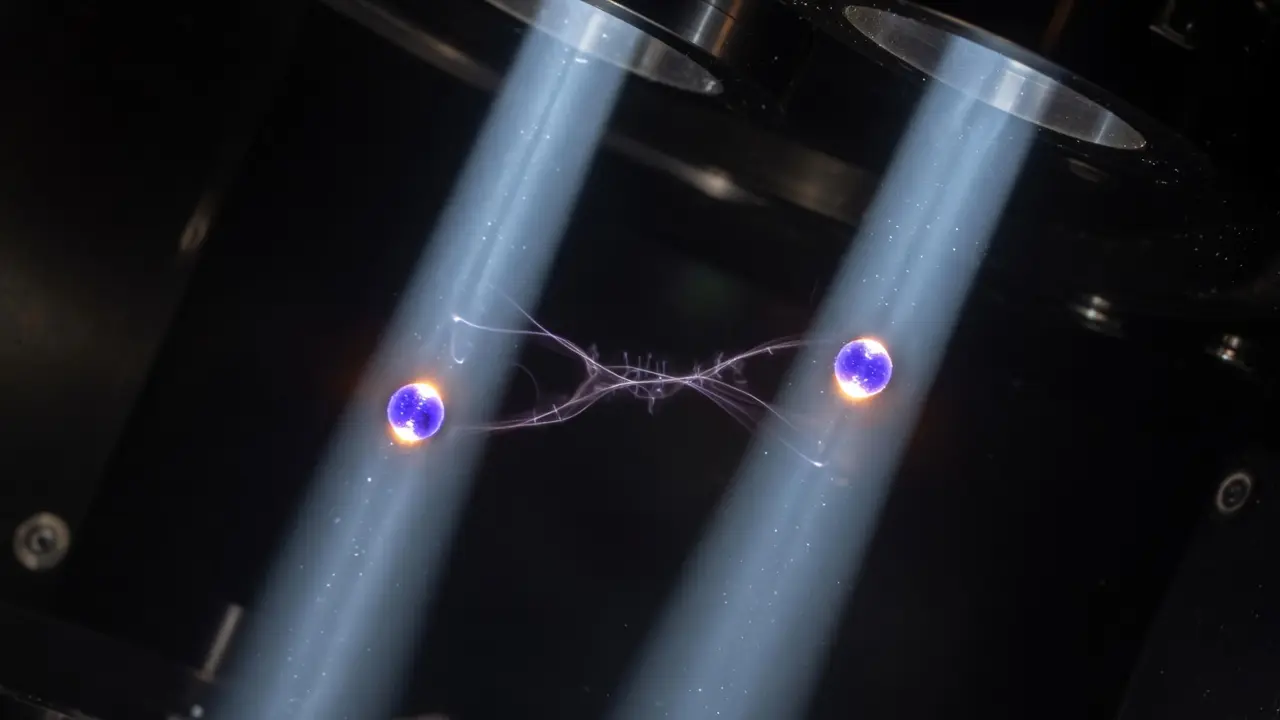
Pedro V. Paraguassú, Luca Abrahão, Daniel Tandeitnik, D. Martínez-Tibaduiza, Antonio Zelaquett Khoury and Thiago Guerreiro of the Pontifical Catholic University of Rio de Janeiro and Universidade Federal Fluminense report a new optical trap architecture capable of force detection with sensitivity in the zepto-Newton regime. The researchers created a rotating saddle-like optical potential by combining Gaussian and Laguerre-Gauss modes with detuned frequencies to levitate a nanoparticle.
This design offers opportunities for quantum experiments by reducing decoherence caused by photon recoil and absorption. The work demonstrates a path toward improved isolation and manipulation of particles for quantum science.
Structured Light Creates Rotating Saddle Optical Trap
A newly designed optical trap uses a rotating, saddle-shaped potential to isolate nanoparticles, enabling force detection at the zepto-Newton scale, a level of precision previously difficult to achieve. This trap, created through the superposition of Gaussian and Laguerre-Gauss modes with differing frequencies, offers a unique method for manipulating particles intended for quantum experiments. The creation of this rotating saddle potential relies on carefully partitioning optical power between the Gaussian and Laguerre modes, denoted as IG and IL, respectively, while maintaining the constraint IG + IL = 1.
By adjusting the relative phase of these components through frequency detunings, the saddle shape can be rotated at speeds reaching the megahertz range, providing dynamic control over the trapped particle. The researchers found that a lower numerical aperture significantly reduces the rate of purity decay.
This reduction in absorbed power, combined with the controlled rotation, allows for the large delocalization of the particle’s center-of-mass motion, expanding the possibilities for exploring quantum phenomena. The trap architecture supports particle recovery protocols, enabling the recapture of particles that may escape the potential, and facilitates the generation of motional entanglement and momentum squeezing, essential tools for advanced quantum experiments.
The ability to achieve force detection with zepto-Newton sensitivity represents an advancement in the field of precision measurement. “Through introducing structure in the optical field, the saddle beam offers a novel and complete toolbox for levitated quantum experiments,” the authors state in their report.
The team’s work builds upon previous explorations of structured light in levitated optomechanics, refining the technique to create a more stable and controllable trapping environment. The electric field configuration used to generate the saddle beam is a variation of a previously introduced saddle trap, but incorporates weight coefficients IL and IG to modify the shape of the potential. This careful calibration of the optical potential, combined with the precise control over rotation, positions the saddle trap as a promising platform for future investigations into the quantum behavior of mesoscopic systems.
Laguerre-Gauss Modes Define Saddle Beam Potential
This technique allows for tunable angular velocities reaching the MHz range, a critical parameter for manipulating levitated nanoparticles and exploring their quantum behavior. By altering the relative phase of these modes, the trap’s rotation can be precisely controlled, influencing the particle’s dynamics within the potential. The saddle trap’s design addresses limitations found in conventional optical traps, specifically concerning photon recoil and thermal emission, which contribute to decoherence.
The paper details how careful calibration of the fractional powers of the Gaussian and Laguerre-Gauss modes can substantially reduce the photon recoil experienced by the trapped particle. This reduction in unwanted momentum transfer is a consequence of the trap’s geometry and the specific modes used to create it.
Beyond minimizing decoherence, the saddle beam architecture facilitates the generation of motional entanglement in the transverse xy plane of the levitated particle. Throughout the study, the researchers prepared nanoparticles in a low-occupation thermal state with = = 0. 8 before transferring them into the saddle optical potential at time t = 0. This initial state preparation ensures a consistent starting point for observing the particle’s subsequent evolution under the influence of the structured light.
The detailed analysis of the Hamiltonian and master equation governing the particle’s motion provides a theoretical framework for understanding and predicting its behavior within the trap. The study’s findings suggest that this saddle trap architecture could become a valuable tool for advancing research in levitated optomechanics and quantum sensing.
Saddle Trap Dynamics and Potential Equation
The validity of quadratic approximations within the saddle trap is maintained when transverse particle displacements remain significantly smaller than the beam waist divided by the square root of one plus two times the square root of the ratio of Laguerre-Gauss to Gaussian mode intensities. This constraint ensures the potential closely resembles a quadratic form, simplifying the dynamics by allowing nonlinear contributions to be disregarded, as detailed in a referenced supplemental analysis.
A thorough characterization of the saddle potential itself is also available in a prior publication, providing a foundation for understanding the trap’s behavior. Analysis reveals a strong dependence of the trap’s confinement properties on the Laguerre-Gauss intensity fraction, IL, as illustrated in supplementary figures. Specifically, a saddle-like potential only emerges when IL exceeds 0. 2; below this threshold, no stable saddle configuration exists.
As IL increases, the critical threshold frequency, Ω0, decreases due to a flattening curvature along the unstable axis, and the overall trap depth diminishes as the origin transitions toward a dark spot. The researchers describe the system’s unconditional evolution using a Lindblad master equation, accounting for both coherent evolution under the trapping potential and momentum diffusion from recoil heating.
Because the potential is quadratic in position coordinates, the resulting dynamics are Gaussian, meaning the state of motion is fully defined by the first moments and covariance matrix of the canonical variables. This state is represented in phase space via the Wigner transform, which evolves according to a Fokker-Planck equation comprising a Liouvillian describing coherent evolution and a recoil superoperator accounting for momentum diffusion.
Operationally, the team implements this by measuring the phase of the scattered field, enabling the description of conditional dynamics through a stochastic master equation for the Wigner function. The ability to achieve this level of control is critical for isolating the nanoparticle and observing its quantum behavior.
Reduced Decoherence for Mesoscopic Quantum Experiments
The ability to maintain a particle’s quantum state for extended periods is key for advanced experimentation, and this saddle trap architecture allows for the potential delocalization of a particle’s center-of-mass motion, a key requirement for certain quantum experiments, by reducing the influence of photon recoil. The design’s effectiveness stems from the specific configuration of light used to levitate the nanoparticle, enabling a level of control previously difficult to achieve.
Beyond simply isolating the particle, the trap’s geometry supports particle recovery protocols, allowing the same nanoparticle to be reused in repeated quantum experiments. This is a critical advantage, as the ability to track and re-interrogate a specific particle avoids the “washing-out” of interference patterns and other quantum phenomena that can occur when using a different particle for each trial.
The work builds on previous advances in levitated optomechanics, but addresses limitations inherent in both Gaussian optical tweezers and Paul traps, offering a novel approach to maintaining quantum coherence. This represents a step forward in the field, as it allows researchers to focus on mitigating environmental factors rather than inherent limitations of the trapping technology. The work demonstrates a pathway toward more complex and robust quantum experiments with mesoscopic particles, potentially revealing new understanding of the boundary between the quantum and classical worlds.
Zepto-Newton Force Detection with Saddle Traps
The resulting trap not only isolates the nanoparticle but also facilitates measurements of extraordinarily weak forces. A key benefit of this saddle trap lies in its ability to substantially suppress decoherence arising from photon recoil and absorption, processes that typically limit the duration and clarity of quantum observations. This suppression is critical, as it allows for extended observation times and enhances the precision of measurements, particularly those involving momentum.
The trap’s design also facilitates momentum squeezing, a phenomenon where the uncertainty in a particle’s momentum is reduced below the standard quantum limit. This squeezed momentum state is a valuable resource for enhancing force sensitivity, as it allows for more precise measurements of even the smallest forces acting on the particle. The researchers write that this approach offers a promising avenue for future research in quantum sensing and fundamental physics.



See today’s quantum computing news on Quantum Zeitgeist for the latest breakthroughs in qubits, hardware, algorithms, and industry deals.