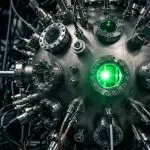
Italy has launched its first neutral-atom quantum computer, named SOL, featuring a 140-qubit quantum processing unit from Pasqal. The system, inaugurated at CINECA in Bologna, is a significant addition to Europe’s growing hybrid high-performance computing and quantum infrastructure, co-funded by the EuroHPC Joint Undertaking and Italy’s Ministry of Research. Engineered for tight integration with the Leonardo supercomputer, ranked 10th on the Top500 list, SOL utilizes the open-source Quantum Resource Management Interface and supports workflows with NVIDIA CUDA-Q and Qiskit. “The inauguration of this quantum computer marks a major milestone for CINECA and ICSC and for Italy’s role in Europe’s advanced computing ecosystem,” said Sara Marzella, Responsible for Quantum Computing at CINECA. This deployment builds on Pasqal’s existing quantum processors in France and Germany, forming a federated network for tackling complex challenges in fields like materials science and machine learning.
Pasqal’s SOL: Italy’s First Neutral-Atom Quantum Computer
Featuring 140 qubits, the newly inaugurated SOL system at CINECA represents a substantial advance in Italy’s quantum computing capabilities, establishing the nation’s first neutral-atom quantum computer. Delivered by Pasqal, the Orion quantum processing unit (QPU) is not operating in isolation; it’s been specifically engineered for close integration with Leonardo, the pre-exascale EuroHPC supercomputer currently ranked 10th globally on the Top500 list. This deliberate coupling signifies a critical advancement in the pursuit of quantum-accelerated high-performance computing, moving beyond isolated quantum experiments toward practical hybrid workflows. At CINECA, Pasqal has implemented its HPC and quantum integration stack, exposing the QPU as a native resource within the existing supercomputing environment. This allows researchers to leverage both quantum and classical resources through standard HPC scheduling and operational mechanisms, streamlining complex calculations.
This commitment to open standards is intended to foster collaboration and accelerate innovation within the broader quantum community. The launch of SOL builds on Pasqal’s expanding European presence, following successful deployments in France and Germany under the EuroHPC Joint Undertaking’s (JU) pilot project, HPCQS. Wasiq Bokhari, CEO of Pasqal, affirmed this progress, stating, “By integrating Pasqal’s neutral-atom technology with the Leonardo supercomputer, we are enabling a new class of hybrid applications that will empower researchers and industry leaders to address some of the most complex scientific and industrial challenges.” He added, “This inauguration is further proof of Pasqal’s ability to execute at scale and deliver quantum systems where they matter most.”
The inauguration of this quantum computer marks a major milestone for CINECA and ICSC and for Italy’s role in Europe’s advanced computing ecosystem.
Sara Marzella, Responsible for Quantum Computing at CINECA

See today’s quantum computing news on Quantum Zeitgeist for the latest breakthroughs in qubits, hardware, algorithms, and industry deals.